Politics & Government
Vineyard 48 Decision 'Epic Fail,' Neighbor States, Urges Definition of 'Tasting', Crackdown on Cigar Sales
The Shipman say they still have grave concerns , over traffic safety near Vineyard 48, and a definition of 'tasting' is critical.


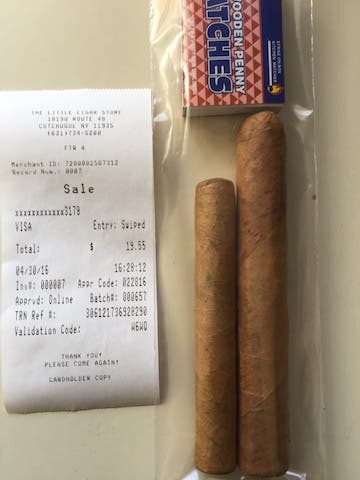

(Caption: Cigars that Beth and Bill Shipman say were recently purchased at Vineyard 48.)
CUTCHOGUE, NY -in light of what they deemed an "epic fail" on the part of the New York State Liquor Authority and its decision regarding Vineyard 48, one Cutchogue couple says they still harbor grave concerns that traffic concerns and the lack of a clear definition on what constitutes a "tasting" could spell future disaster on the North Fork.
Bill and Beth shipman, for years before last July's deadly limo crash on Route 48, said they had been pleading with the town board about traffic concerns, quality of life issues stemming from loud noise, obscenities being shouted over a loudspeaker at the winery, and sex acts in the bushes — all stemming from a raucous crowd at Vineyard 48.
Find out what's happening in North Forkfor free with the latest updates from Patch.
And this week, heartsick over a ruling by the New York State Liquor Authority the they said was a "slap on the wrist" Beth Shipman said without immediate action, the North Fork community could be poised for another out-of-control summer with safety concerns escalating.
Definition of tasting needed, neighbors cry
Find out what's happening in North Forkfor free with the latest updates from Patch.
According to Shipman, had the word "tasting" been defined by law, charges in the litigation surrounding Vineyard 48 would have been upheld, with SLA Chairman Dennis Rosen originally, in fact, sustaining charges that the operation was exceeding the scope of its license and operating as a "night club" with "dance parties" held and advertised.
But, she said, because New York State has no legal definition of "wine tasting," charges involving dance parties, and the fact that they believe the business was acting "as a nightclub" did not stick in the end.
The Shipmans also said they were shocked at the SLA's ruling on a penalty on March 1, which required Vineyard 48 to pay a $10,000 fine and adhere to a 21 day suspension in April.
"Especially given the tremendous amount of testimony and photo/video evidence supporting the fact that they were In fact holding these events," Shipman said. "They even advertised them. So without a law in place, this ruling sends the message that they are free to use their 'tasting license' to do as they please. This coupled with the minimal penalty, screams, 'Do what you like with your tasting license. There are no substantial consequences.'"
Shipman has said that the large "buckets" of alcohol served are much larger than a normal ounce-sized sip of wine offered at a traditional tasting room, and clarity is desperately needed.
"This was a case of first impression as no other winery has had its license revoked. This was a landmark decision regarding the wine industry in New York State, and it was an epic fail. I'm not sure they could have set the bar any lower if they tried. And hey, if they can use this business model of 144 oz. tastings why can't every other vineyard in New York State? What constitutes a wine tasting in our great state? Nothing — draw your own conclusion."
The Shipmans feel an ongoing traffic situation, including off-site parking that creates dangerous traffic conditions, still exist at Vineyard 48. Beth Shipman produced a letter for Patch written two years before last July's deadly limo crash that took the lives of four young women, predicting tragedy.
And the couple said they hope to never see the heartache of that devastating limo crash descend again upon Southold Town.
Supervisor speaks out
On Friday, Southold Town Supervisor Scott Russell spoke to Patch about the penalty imposed on Vineyard 48: "I am sure many people are as disappointed as I am in the nominal fine leveled at the operators of Vineyard 48. We need to be mindful, however, that the town never had the goal of closing the winery down. Our primary goal was to get a business to operate in a legal, responsible manner and be mindful of the community its located in. That fact is, we succeeded. The activities taking place there each weekend are consistent with what the zoning permits. We no longer get complaints of loud music or bad behavior. If, at any time, there is an effort to return to the bad old days, we will take action to stop it."
He added, "Traffic and unsafe conditions created by too many limos, too many buses and too many cars traveling on roads that were never built for them is a townwide problem with many causes."
Concerns still looming
This week, after years of crying out against quality of life concerns posed by Vineyard 48 in Cutchogue, the Shipmans were dismayed to learn that the State Liquor Authority had ruled on the case — and given the winery what the couple believes is a "slap on the wrist."
On March 1, at a full meeting of the New York State Liquor Authority, which is available online for review, a vote was taken to order Vineyard 48 to a 21-day suspension and a $10,000 fine.
But the Shipmans, who have come to many Southold town board meetings to cry out against the influx of cars, drunk patrons in the road, obscene language, sex acts in the bushes, and limousines making dangerous U turns, are devastated by the ruling.
Beth Shipman said her family is heartsick, and she's fearful of what the summer will bring, remembering last July's tragic limo crash that took the lives of four young women.
Those women, along with four friends who were also gravely injured, had just come from Vineyard 48 in the limo they'd hired for a day of fun on the North Fork — a day that ended up an unspeakable tragedy not only for the victims and their families, but for the scores of North Fork first responders and residents who will forever be changed by what they saw that day, Shipman said.
The SLA did not contact the Shipmans about the meeting, and the attorney for Vineyard 48 was not notified to be present when the decision was made regarding the penalty.
The fine and suspension were a result of a Supreme Court, appellate devision decision on January 28, 2016, that said the winery "failed to notify SLA of a change in its operating hours," and "permitted noise, disturbance, misconduct, or disorder on and about its premises, which resulted in the premises becoming a focal point for police attention . . which adversely affected the health, welfare or safety of neighborhood residents."
Vineyard 48 first had its liquor license revoked in 2013, but appealed that decision. Later, a decision was made to grant a temporary restraining order allowed Vineyard 48 to conduct business.
In 2013, according to Southold Town Police Chief Martin Flatley, after the full board hearing of the New York State Liquor Authority on Dec. 17, during which Vineyard 48's liquor license was revoked, "Everybody was aware that they had the ability to appeal this decision. They took the route of going before a New York State Supreme Court justice to receive a temporary restraining order."
The judge, Flatley said, allowed the winery to conduct business including pruning grape vines, bottling wine and engaging in manufacturing activities, and conducting retail sales and wine tastings.
"However, the judge was very specific that they were not to have any parties at this location, with or without music, inside or outside," Flatley said.
The Cutchogue winery was the source of heated contention, with neighbors complaining about noise, parking issues, and "sex acts" in the vines.
After the first ruling, Vineyard 48 lost its liquor license after a decision by Chairman Dennis Rosen; the case then went before Judge Ling Cohan, who ruled on the matter and did not send the case to appellate court. The most recent decision came out of appellate court, but the Shipmans were shocked at the 21-day suspension and $10,000 fine.
Shipman said she and her husband were also upset not to be notified; they expected to be in attendance when the general council brought the matter before SLA Chairman Vincent Bradley.
"As this directly, adversely affects the health, welfare and safety of not only our family but also the surrounding neighbors, town folk and visitors to this establishment and community, many of our neighbors would also have made the trip in. This in itself is very disappointing," she said.
According to Shipman, instead of one $10,000 fine, Vineyard 48 could have been fined $10,000 per charge. And, she said, "Why suspend their license in April? Why not August, or, even better, October, at the height of the industry's season? These are questions I would like answered."
Shipman also noted that the case was not on the SLA's calendar for March 1.
"This community wants and needs resolution," Shipman said. "One of the 'focal points of police attention' is the traffic generated by this business, and the limo and party buses constantly attempting to make U-turns to get in and out of this establishment. County Road 48, is not now, nor has it ever been, able to handle the amount of oversized vehicles maneuvering around, to get in and out of this business."
Of the penalty, she said, "It was a slap on the wrist, of a business that has complete disregard for both its neighbors, community and the laws. It is a slap in every neighbor's face."
And, she said, "Another fatality is inevitable without change."
After the SLA ruling, Southold Town Police Chief Martin Flatley responded, "I have come to realize that the SLA operates a lot differently than other government agencies that we deal with on a regular basis, so I would say that the fine is appropriate for the referrals our department submitted to the SLA. However, the timing of the suspension in April was not much of a punishment, probably some of the slowest period for a winery tasting room."
He added that he appreciates the time and effort attorneys and investigators for the New York State Liquor Authority dedicated on the complaints regarding Vineyard 48. "We continue to work with them on correcting some of the conditions that existed in 2012-2013," Flatley said. "We have noticed the site better managed and the complaints we are receiving regarding Vineyard 48 have been reduced from previous years’ levels."
Cigar shop crackdown?
The Shipmans maintain that a cigar shop is operating on the property, a use not allowed on the parcel. According to town code, wineries can only sell gifts or items related to the sale or creation of wine, Beth Shipman said. She offered a bag containing cigars, and a receipt, to show that they'd been purchased at the winery.
Russell said a cigar shop allegedly operating in Vineyard 48 is a non-permitted use. "Reports that it had been operating have been brought to our attention. If it is, the town will take immediate action and prosecute to the fullest extent of the law," he said.
SLA spokesman Bill Crowley did not immediately return a request for comment.
Vineyard 48 representatives could not immediately be reached for comment.
Others cry out for definition of "tasting"
The Shipmans are not alone in their desire to firm up a legal definition of the word "tasting."
The Long Island Wine Council said recently that they are seeking a dramatic shift in the way East End wines are perceived, with live music and large party groups in limos soon a thing of the past and a focus on a more discerning clientele.
in April, Steve Bate and Ali Tuthill of the Long Island Wine Council came before the Southold Town Board with plans that will forever change the experience for those heading out to the North Fork to savor local wines.
Bate said wineries with live music have not proven profitable for the area; Tuthill agreed that many just spend the day "sipping" on a glass of wine while listening to free entertainment, paying little for a day of free agri-tainment, with few customers availing themselves of the opportunity to learn about the wines and buying bottles to take home.
The goal, she said, is to enhance the educational component of the winery experience, and foster an enriched experience for true wine lovers.
The board agreed the idea was a good one; Councilman Jim Dinizio said that was the goal in the beginning, to offer wine, "cheese and crackers — and maybe a guitar player," not the full-blown revelry that has ensured, with more than 40 tasting rooms on the North Fork currently.
Tuthill said while local wines have continued to garner favorable reviews nationally and on the international canvas, the area's reputation has not followed suit, due in large part to the limo and party bus crowd.
However, Tuthill said, there might be some challenges ahead in relation to "customer expectations"; currently, large groups might demand tasting room staff to pour more than the customary one ounce of wine.
A clear definition of the word "tasting" could mean a level playing field across the board for wineries, the group said.
Down the line, training will ensue to enable pourers to handle that type of client and provide a consistent hospitality experience across the board. Tastings might be priced higher, with incentives offered to clientele who buy cases of wine.
Plans to implement the program include shifting the focus from bottle sales. Currently, Tuthill said, clients who come and buy a bottle are skipping over the educational component and just spending the day drinking, sometimes having "too much" fun.
In addition, reservations may be required for large groups, with a credit card given in advance. Those who cancel might forfeit a deposit. Advance reservations would allow for a more manageable flow of traffic and guests, she said. As it stands, currently, some groups are coming in more than one car and converging upon wineries in groups of 16 to 18, which makes it difficult for staff, she said.
Companies providing transportation will also be vetted, with tour groups given a list of preferred transportation providers to utilize.
A look at children and pets will also be taken, with no children allowed in the tasting room areas and a push to urge at least one parent to drink sensibly or not at all, so that one "responsible adult" is caring for children in the group.
Pets, Tuthill said, have proven problematic, with dog fights reported at wineries.
Another issue, Tuthill said, is groups who bring picnics to wineries. The picnics are not only lavish and sometimes, include beer and hard liquor, but also create an enormous amount of litter. Looking ahead, outside food may be banned, with wineries providing snack boxes or offering a list of local purveyors and eateries for guests to frequent, therefore providing a boon to local businesses.
Russell asked about food trucks; the supervisor said the town needs to ensure they're even allowed in the code. "It's not clear to me that they are," he said.
Tuthill said food trucks on-site, serving the winery's own menu, would be fine. The focus is on shutting down large, refuse-strewn outdoor picnics.
The move, both Bate and Tuthill agreed, will ultimately mean positive changes for wineries, who will be able to see the value of their wines escalate.
But, they added, it will take a unified approach from all wineries in the region for the movement to gain steam.
Both said it will take time to see the shift take place, but the long-term benefits for the region, as wineries that adopt the new approach see increased profitability, could lead to a "groundswell" of change.
Get more local news delivered straight to your inbox. Sign up for free Patch newsletters and alerts.