Politics & Government
Experts Say Improved Tracking of Opiate Painkillers Needed
In response to recent area crimes against pharmacies, some say more needs to be done to increase safety and security.
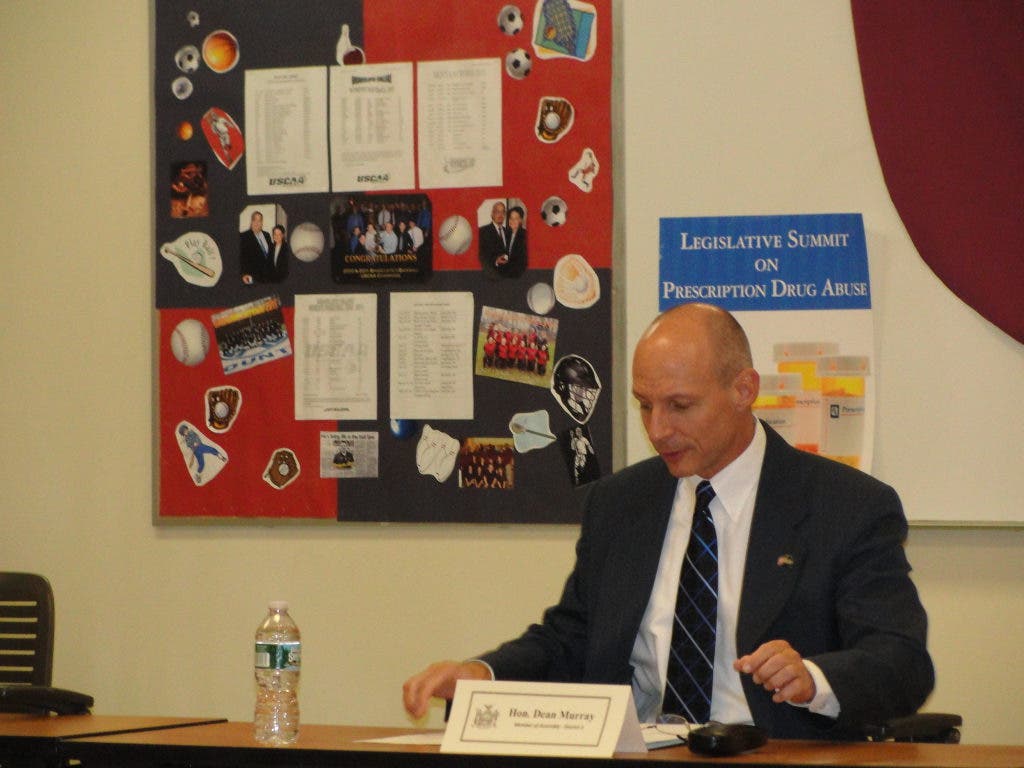


A forum to discuss possible changes to New York State law to help curb prescription drug abuse was held at in Patchogue on Thursday.
The forum was put together by Assemblyman Dean Murray, R-Patchogue, in response to calls by the Long Island Pharmacist Society and other groups who have advocated closer monitoring of the availability of strong opiate painkillers.
These calls have increased following the recent pharmacy shootings and other cases of prescription drugs being stolen from area drug stores.
Find out what's happening in Patchoguefor free with the latest updates from Patch.
"Less than two weeks ago, our community was stricken with a senseless tragedy that was the symptom of an epidemic problem of abuse of prescription drugs, and the crime associated with it," Murray said.
Murray said the objective of the meeting was to bring together a panel of experts to discuss various angles to either change or strengthen current laws regarding prescription drugs.
Find out what's happening in Patchoguefor free with the latest updates from Patch.
The panel included politicians, law enforcement officials, local school officials, members of the pharmaceutical and medical community and drug counselors.
Murray and his fellow Assemblyman Michael Cusick, D-Staten Island, have joined forces to sponsor a bill calling for on-line tracking for pharmacies to cut down on multiple pharmacy shopping.The bill passed in the Assembly but has not yet made it to the floor of the state Senate.
Joanne Hoffman-Beechko R.Ph., president of the Long island Pharmacists Society, explained that there is currently a requirement for pharmacies to send data once a month to the state where it is put on a centralized site available solely to prescribers, and to which pharmacists don't have access.
"The pharmacy community needs to be part of it. All electronic information available to physicians should be available to us," Hoffman-Beechko said.
Dr. Ronald Klein, chief medical officer at , suggested making point of care urine tests mandatory so that doctors can determine what drugs are already in a person's system.
Hoffman-Beechko countered that's going down a slippery slope.
"Pain management cannot be denied," she said while conceding that prescription drug abuse is a widespread concern.
"It's not just this crime ... There isn't a pharmacist we know that hasn't been affected by a robbery of prescription pills," she said.
Dr. Alan Groveman, president of the Suffolk County School Superintendents Association, said that a number of kids report stealing medications from their grandparents.
Murray suggested that educating grandparents with brochures at the pharmacy and doctor's office could be an important step in the right direction.
Some other possible changes Murray mentioned include: Finding a middle ground on the Rockefeller Drug Laws that let dealers, who claim to be addicts, off the hook; co-pay reductions for refills to avoid large stockpiles of medication in homes; and schools being proactive in response to early warning signs, before an addiction escalates.
"I think it's a multi-pronged problem, and it's going to take a multi-pronged approach," Murray said.