The Hendrick Hudson Science Research Symposium will be held on May 21st (Thursday) at 6:30 pm in the High School library.
“I would advise that anyone who has registered for the science research program for the fall come (student and parent),” said Christine Rogers, PhD, Science Research Program Director and Science Teacher at Hendrick Hudson High School. “Students of the science research class will be presenting their research. Participation in the symposium is a requirement for the class and counts for 20% of their final grade. This program is a University at Albany program. Students get up to 12 credits starting in the junior year for their work.”
The class is a mixed group starting at the freshman level all the way up to senior year. The science research program is a 3-4 year program starting at the freshman or sophomore year. Students work on the skills necessary for research during the year, and define a project. Then they find scientist-mentors to develop their research, write a proposal and implement their research. They mostly do the research over two consecutive summers.
Find out what's happening in Peekskill-Cortlandtfor free with the latest updates from Patch.
Then, at the beginning of senior year, student researchers write a scientific paper, which is submitted to competitions. They later go on and compete with poster presentations or PowerPoints (depending on the competition). Hen Hud seniors will be presenting their award-winning presentations:
· Jazz Munitz has developed a nanoparticle which has the ability to kill cancer cells. He is an INTEL STS and Siemens competition semi-finalist; took first place at the Tri-County Science Fair; and second place at the Westchester Science and Engineering Fair (WESEF).
Find out what's happening in Peekskill-Cortlandtfor free with the latest updates from Patch.
· Jordan Hudock worked on a study looking at the effects of meditation and anxiety. She took second place at WESEF.
· One junior, Jane Milcetic, will be at Duke University working with her mentor and will present her research project on the ability of birds to recognize faces by recording it ahead of time.
The other students, who are sophomores and freshmen, may not have yet a mentoring scientist to work with. They will be presenting posters of their research, which mostly will include proposals for research but will not yet have any experimental data. Some of them will be presenting posters they will compete with at the Westlake (in southern Westchester) competition on June 6th.
“This class is a student-centered class,” Dr. Rogers explained. “Everyone is progressing at a different pace since student has a different project with different levels of difficulties. There is a lot of independent study time and one-to-one work with me. They choose their topic of interest and I guide them to define a particular project they want to research.”
There are no tests or quizzes in the class, but projects, writing and reading scientific papers, research and effort receive a grade. The program develops reading and writing skills in the scientific domain (including proper ways to cite papers, ways to avoid plagiarism), research skills (how to use databases and how to find information which is reliable), presentations skills, organization skills, and professional communication skills (email, interviews). All of these are critical for college.
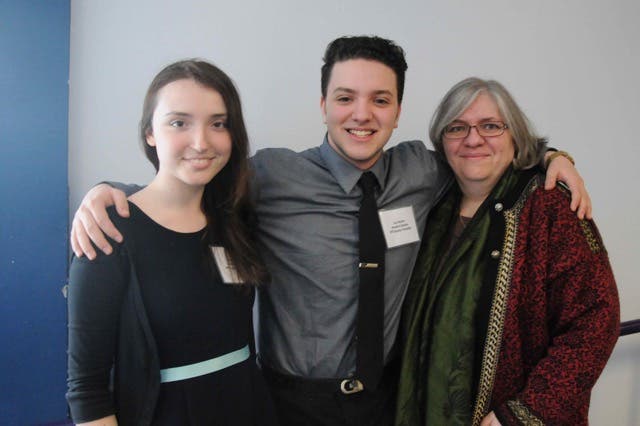
Photo caption: Jordan Hudock, Jazz Munitz, and Dr. Christine Rogers, of Hen Hud H.S.