Neighbor News
America at 250: The Republic That Declared Equality While Protecting Slavery
The Revolution Exposed America's Founding Contradiction. The Constitution Postponed the Reckoning.

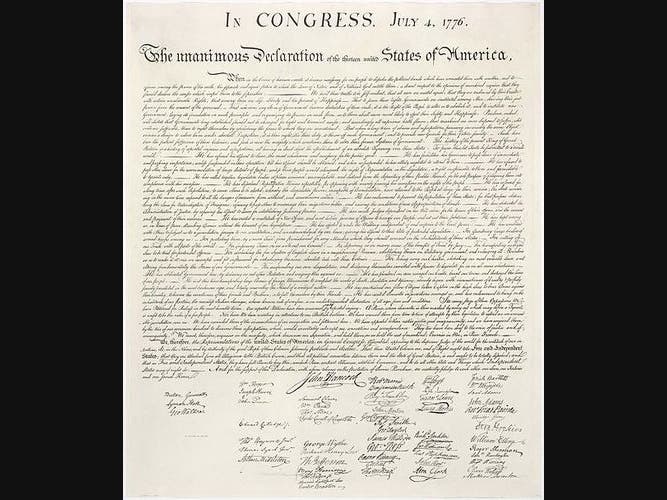
The American Revolution is often remembered as a struggle for liberty. That memory is not wrong, but it is incomplete. In 1776, the same political movement that declared that all men are created equal existed alongside a system in which slavery remained legal throughout the thirteen colonies and was deeply embedded in the economy, politics, and social order of the emerging republic. The founding generation lived with a contradiction that shaped the Revolution, the Constitution, and the future of the United States.
No serious commemoration of America at 250 can avoid that contradiction. The question is not whether the Founding was pure or irredeemably flawed. The harder question is how a republic could articulate universal ideals while protecting a system built on human bondage. That contradiction did not sit outside the Founding. It was built into the republic's operating system.
This is the unavoidable center of gravity of the American Founding. The Revolution did not resolve the contradiction between liberty and slavery. It revealed it, militarized it, and then allowed the Constitution to postpone the reckoning.
Find out what's happening in Pelhamfor free with the latest updates from Patch.
Liberty and Bondage in the Same Political Moment
The Declaration of Independence gave the Revolution its moral language. It asserted natural rights, government by consent, and the right of a people to alter or abolish political systems that denied those rights. Those words became the ideological foundation of the United States, and later generations would use them to challenge exclusions the founding generation refused to resolve.
Slavery, however, was not a marginal issue. It was a central feature of colonial life, especially in the Chesapeake and the Lower South, and it existed in some form across all thirteen colonies. The New York Public Library's guide to the Black experience of the American Revolution notes that thousands of free and enslaved Black people fought on both sides of the war, and that their motivations were more complicated than those of their white counterparts. That fact matters because it changes how we understand the Revolution. Slavery was not a background contradiction to be debated later. It became a military, political, and strategic reality during the war itself. The rhetoric of liberty collided with the practical question of who could claim freedom, who could offer it, and who had the power to deny it.
Find out what's happening in Pelhamfor free with the latest updates from Patch.
The War Forced Choices
The Revolution did not simply expose the contradiction between liberty and slavery. It forced every side to act on that contradiction. The British, the American colonists, the French, and enslaved people themselves all made decisions shaped by the unstable relationship between ideals and interests.
For the British, slavery was a vulnerability in the Patriot cause. For American revolutionaries, slavery was property, labor, wealth, and social order, even as they spoke the language of natural rights. For the French, the American alliance was part of a larger imperial contest, even though France itself remained deeply tied to Atlantic slavery. For enslaved people, the war created danger, uncertainty, and sometimes opportunity.
The Revolution cannot be understood only as a contest between liberty-loving colonists and imperial Britain. It was also a conflict in which enslaved people assessed shifting lines of power and made choices within brutal constraints. Governments and armies treated them as labor, property, military opportunity, and political risk. They were also historical actors, seeking openings in a world that denied them basic rights.
The British Weaponized Freedom
The British did not become abolitionists during the American Revolution. They were an imperial power acting in their own interest. British commanders understood that slavery created a strategic weakness within the rebellion, especially in the South, where Patriot leaders depended heavily on enslaved labor and feared slave uprisings.
Lord Dunmore's Proclamation made that vulnerability explicit. In 1775, Virginia's royal governor declared martial law and offered freedom to enslaved people held by rebel masters if they were able to fight for the British. The Library of Virginia describes the proclamation as freeing enslaved people of rebel masters who could fight with British forces, and the NYPL guide notes that the offer was powerfully persuasive to many enslaved people seeking escape. The offer was limited and strategic. It did not apply to enslaved people held by Loyalists, and it was not a general abolition program. Still, to many enslaved people, the British line represented something the Patriot cause often did not: a possible path away from bondage.
The British later expanded this approach. Sir Henry Clinton's 1779 Philipsburg Proclamation broadened British protection for enslaved people escaping rebel enslavers. At the end of the war, the British evacuation of Black Loyalists demonstrated the scale of the issue. The Book of Negroes documented thousands of Black Loyalists who left with the British rather than being returned to American enslavers. For American slaveholders, the departure of formerly enslaved people represented stolen property. For those who left, it could represent the fulfillment of a wartime promise. The same event could be seen as a loss, a betrayal, or a liberation, depending on where one stood in the system.
The Patriots Fought for Liberty While Protecting Slavery
The Patriot position was more conflicted because the Revolution's public ideals and its social realities pointed in different directions. The language of independence rested on liberty, equality, and resistance to arbitrary power. Yet many Patriot leaders were enslavers, and the revolutionary coalition depended on the participation of states where slavery was central to the economy and political order.
This contradiction shaped military policy. Early in the war, Black enlistment in the Continental Army was restricted, reflecting white fears about arming Black men and destabilizing the racial order. But workforce shortages and the realities of war forced policy to evolve. The Museum of the American Revolution's Patriots of Color Archive includes documents naming Black and Native American soldiers who served in the Continental Army, underscoring that the army that fought for independence was more diverse than popular memory often allows.
The NYPL guide similarly notes that thousands of Black men fought for the Continental Army, voluntarily or under duress, and played an extensive role in the War of Independence. Some served as free men, while others served in circumstances shaped by coercion, substitution, or promises of freedom. Their presence complicates any simple story of the Revolution as either fully inclusive or entirely exclusionary.
Regional differences also mattered. Northern states, where slavery was less central to the economy, moved gradually toward abolition in the revolutionary and post‑revolutionary period. Southern states, where slavery was more deeply embedded, resisted measures that threatened the liquidity of their primary capital asset and undermined the racial hierarchy that structured their political and economic order. In some cases, southern leaders preferred military risk to the prospect of arming enslaved people and weakening the system on which their wealth and authority depended.
This was not simply a failure of individual morality. It was also a system problem. Slavery was wealth, labor, credit, inheritance, political power, and social control. To abolish it would have required not only moral conviction but also a willingness to remake the economic and racial order of large parts of the new nation. Most leaders who understood the contradiction were unwilling or unable to pay that price.
The French Complication
France's role adds another layer to the story. French support was indispensable to American victory, especially in money, arms, troops, diplomacy, and naval power. The American Revolution, for all its national mythology, was not a purely American effort.
But France was also an imperial power that enslaved people. Its Caribbean colonies, especially Saint‑Domingue, were central to the Atlantic economy and depended on enslaved labor. The French alliance helped secure American liberty while remaining tied to systems of bondage elsewhere in the Atlantic world. This point should not distract from the main American contradiction, but it does widen the lens. The Revolution was part of a global imperial conflict involving Britain, France, Spain, the Netherlands, the Caribbean, and the Atlantic world. Liberty moved through that world unevenly, carried by armies, navies, pamphlets, commerce, and enslaved people who heard promises of freedom and measured them against their own circumstances.
The later Haitian Revolution would reveal the explosive force of these contradictions in the French Atlantic world. It demonstrated that the ideas the French subsidized in America could not be contained by imperial borders. The same revolutionary language that helped secure American independence circulated through the Caribbean, where it collided with a plantation system even more dependent on enslaved labor. The result was a political and social upheaval that reshaped the Atlantic world and exposed the limits of imperial control over the ideals it helped spread.
The Constitution Managed What the Revolution Did Not Resolve
The Revolution forced choices, but it did not produce a national solution. When the Constitution was written in 1787, the framers faced a practical and moral crisis. A stronger union was needed because the Articles of Confederation had proved too weak to manage taxation, commerce, defense, and national authority. But that stronger union could not be built without the participation of slaveholding states.
The result was a Constitution that avoided the word slavery while protecting the institution in practice. The Three Fifths Clause increased the political power of slaveholding states by counting enslaved people for representation while denying them rights. The fugitive slave provision protected the ability of enslavers to reclaim people who escaped across state lines. The slave trade clause prevented Congress from banning the importation of enslaved people before 1808, giving the institution another generation of constitutional protection. The National Constitution Center notes that the slave trade clause barred the federal government from limiting the importation of enslaved persons for roughly twenty years after the Constitution took effect.
These provisions did not create slavery. Slavery already existed. But they gave it constitutional shelter. They helped bind the new union together while preserving a contradiction that would become more dangerous over time.
This is the central institutional point. The Constitution solved some problems and postponed others. It created a more durable national government, replaced the failures of the Articles, and gave the republic a workable governing structure. But on slavery, it managed conflict rather than resolving it. It converted a moral crisis into a constitutional compromise.
That compromise made union possible in the short term. It also helped make future crises unavoidable. The unresolved tension between liberty and slavery did not disappear after ratification. It moved into Congress, the courts, territorial expansion, party politics, abolitionist organizing, slaveholder resistance, and eventually the Civil War.
The Founding Was Visionary, Compromised, and Unfinished
At America's 250th anniversary, there will be a temptation to simplify the Founding. One version will present the Revolution as an almost sacred national origin story, centered on liberty, courage, and constitutional genius. Another version will treat the Founding's ideals as permanently compromised by the exclusions and injustices that accompanied them.
Neither version is sufficient. The Founding produced ideals powerful enough to challenge slavery, monarchy, aristocracy, and inherited authority. It also produced institutions that protected slavery and denied millions of people the rights those ideals seemed to promise. The importance of the Founding lies in that tension.
To say this is not to reject the Founding. It is to understand it. A republic can be visionary and compromised at the same time. A political system can expand liberty while protecting injustice. A Constitution can solve one crisis while postponing another. The American story is not coherent unless we can hold those truths together.
Slavery cannot be treated as a side issue in any serious commemoration of America at 250. It was central to the economy, the war, the Constitution, and the republic's future. It shaped who could claim liberty, who could deny it, and how long the nation could avoid the consequences of that denial.
The American Revolution declared a universal principle. The Constitution built a functioning republic. Between the principle and the system stood the unresolved reality of slavery. That contradiction became the nation's most dangerous inheritance.
At 250, the task is not to commemorate the Founding as myth or condemn it as failure. The task is to understand how a republic built on liberty could also protect bondage, and how that unresolved contradiction shaped the next two and a half centuries of American life.