Neighbor News
Banned Books Week returns October 4–10, 2026
"Let Books Be. Protect the Freedom to Read."

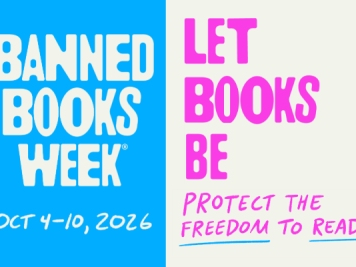
Let Books Be…may be the simplest argument ever made for the freedom to read.
A book does not demand that we agree with it. It doesn't require us to admire its characters (well, maybe its cover!), accept its argument, or share its author's view of the world. It asks only to be opened. What happens after that belongs to the reader.
Banned Books Week returns October 4–10, 2026
Find out what's happening in Pelhamfor free with the latest updates from Patch.
Today, those three words carry 150 years of history. In 1876, the American Library Association (ALA) was founded. In 1982, amid a sudden surge in challenges to books in libraries, schools, and bookstores, ALA launched Banned Books Week. Now, as ALA marks its 150th anniversary, Banned Books Week returns October 4–10, 2026, with a theme that brings the conversation back to first principles:
"Let Books Be. Protect the Freedom to Read."
Find out what's happening in Pelhamfor free with the latest updates from Patch.
For generations, libraries have given readers places to encounter information, stories, and perspectives that challenge, confirm, or complicate their understanding of the world. That reading culture is now on display in an entirely different setting. Across the pond (Atlantic Ocean), judges are debating which of six very different novels should win the 2026 Booker Prize. The shortlist moves from dystopian fiction and contemporary realism to campus satire and historical fiction, exploring family, identity, shame, love, loneliness and survival. The Booker Foundation describes the books as funny, violent, intriguing, horrifying and hopeful. The Booker Prizes
Mary Beard, who chairs this year's judging panel, said the books made them "think, argue and sometimes disagree." She praised their ability to surprise readers and challenge their certainties. That is not a failure of reading. It is part of its purpose.
No one expects every reader to love every title on the Booker shortlist, just as no library shelf can promise that every book will appeal to every person who passes by. Some books become old friends, as To Kill a Mockingbird has for generations of readers. Others introduce us to new neighbors, from Elwood Curtis in Colson Whitehead's The Nickel Boys to the many unforgettable characters who populate his vision of American life. Some reassure us with wisdom, humor, and the gentle company of characters like Precious Ramotswe in Alexander McCall Smith's beloved No. 1 Ladies' Detective Agency series. Others unsettle us through the dark pleasures of suspense, horror, and the unknown, whether through the haunted halls of the Overlook Hotel or the terrifying presence of Pennywise in Stephen King's fiction. A healthy literary culture makes room for every one of those experiences.
The principle matters because access to books is not theoretical. The American Library Association's Office for Intellectual Freedom tracked 4,235 unique titles challenged in 2025, the second-highest number it has documented. ALA reports that nearly 92 percent of those challenges were initiated by pressure groups, government officials, and decision-makers. The organization cautions that its figures represent only a snapshot because many challenges are never reported.
Perhaps, then, during Banned Books Week we should stop speaking over the books for a moment. If we let the shelf speak for itself, it might say something quite simple:
"For generations, hands have reached toward me. Some found answers. Others found questions they had never thought to ask. Some discovered themselves; others discovered someone entirely unlike themselves. You need not approve of everything I hold. You need not finish every book you open. I ask only that the choice remain yours."
One hundred fifty years of library history is worth celebrating. But an anniversary is also an invitation to look forward. What will sit on the shelf 150 years from now? We cannot know the titles. We cannot know the authors. We cannot predict what ideas will challenge, delight, disturb, comfort, or inspire readers in 2176.
But we can help preserve something about that future now: the possibility that another reader will reach toward a shelf and make a choice. As Banned Books Week concludes with Let Freedom Read Day on Saturday, October 10, 2026, the principle remains remarkably simple:
Let books be. Let readers choose. Let the next generation reach for the shelf (-: