Neighbor News
The Buses May be Gone, but the Ghost of 1974 is Still Very Much in the Room
"Today, education is perhaps the most important function of state and local governments." Brown v. Board of Education of Topeka

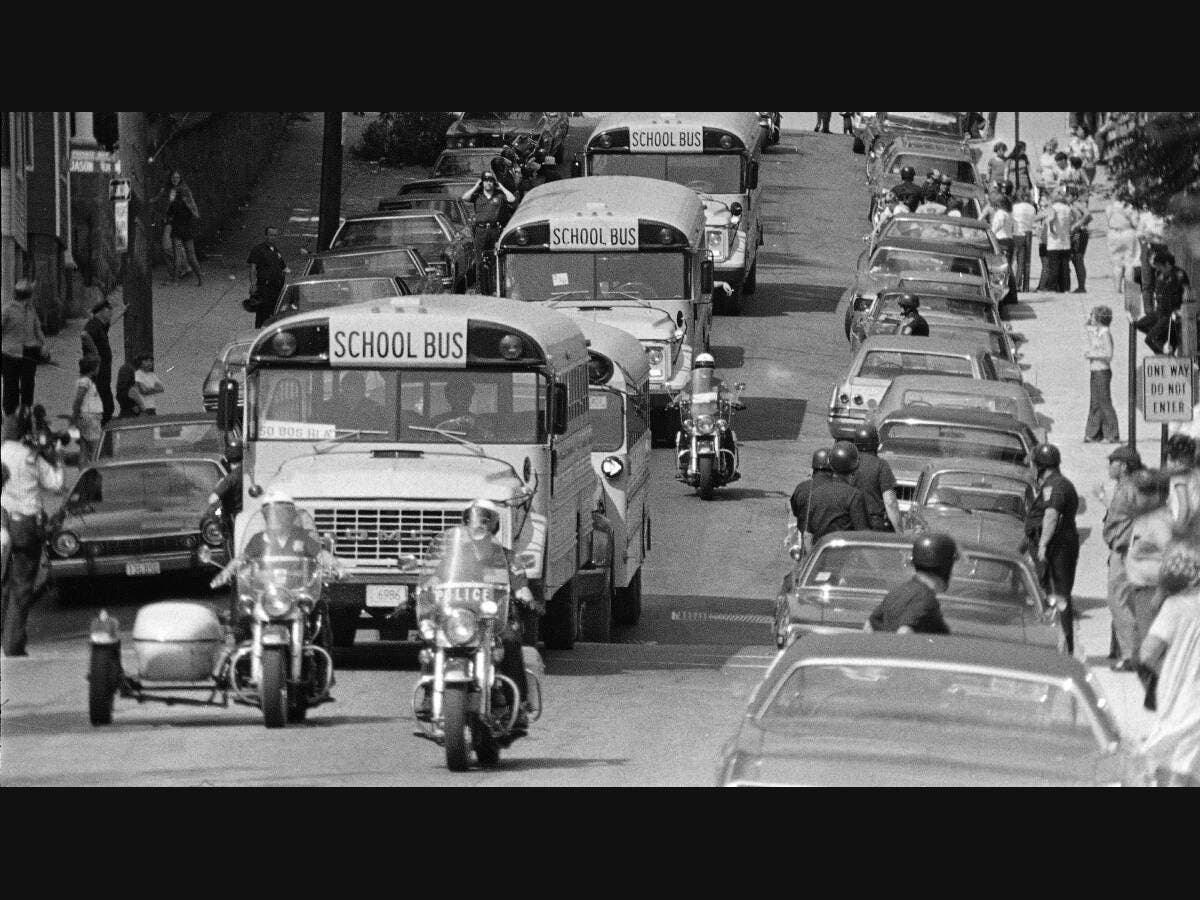


This week we celebrated Bring Your Child to Work Day, and the office was full of kids and young adults of every age: toddlers, grade-schoolers, teenagers, and college students. It was a cheerful disruption to the usual workday, the kind of occasion that makes an office feel less like a collection of departments and more like a small civic cross-section. In the elevator, I found myself next to a mother and her high school senior daughter, and I asked what she would be doing if she were not at work with her mom. She said she would probably be working on her AP U.S. History paper on 1970s busing.
It was a great answer. It was also a revealing one. A topic many Americans treat as settled history remains close enough to the present to show up in a teenager's coursework and current enough to matter in 2026. The reason is straightforward: the underlying policy problem never truly disappeared. The buses faded from view. The governance challenge did not.
Seventy-two years after Brown v. Board of Education and fifty-two years after Boston's busing crisis, the United States is still struggling with the same basic question: whether equal access to integrated, well-resourced public schools is a living obligation or a historical accomplishment we prefer to commemorate from a distance. That question now carries renewed urgency. In early 2026, federal judges ended decades-old desegregation cases in Louisiana districts, including Plaquemines Parish and DeSoto Parish, while the Department of Justice has been reviewing many of the remaining school desegregation orders, most of them concentrated in the South. The legal architecture built in response to the segregation battles of the mid-20th century is not simply aging out. It is being actively wound down.
Find out what's happening in Pelhamfor free with the latest updates from Patch.
Supporters of this shift argue that many of these mandates have outlived their purpose. They describe them as outdated, administratively burdensome, and inconsistent with local control. At one level, that argument has intuitive appeal. Decades of court supervision seem like a sign that the law has lingered beyond the crisis that gave rise to it. But the relevant question is not whether an order is old. It is whether the inequality it was meant to address has actually been resolved.
On that measure, the evidence is harder to dismiss. Across the country, segregation by race and class remains deeply embedded in the structure of public education. The visible mechanisms differ from those that defined the busing era, but the underlying pattern is familiar. School quality still tracks geography. Access to advanced coursework, experienced teachers, extracurriculars, and stable infrastructure still varies sharply across districts and within them. Recent school-finance research estimates a national gap of roughly $104 billion between what districts currently spend and what would be needed to meet basic adequacy targets. Black and Hispanic students remain far more likely than white students to attend chronically underfunded districts. In other words, the country is debating whether to close the legal chapter on desegregation while leaving many of the disparities that made desegregation law necessary intact.
Find out what's happening in Pelhamfor free with the latest updates from Patch.
That is why it is a mistake to think of 1970s busing as a transportation story. It was never mainly about transportation. It was about access. Buses became the most visible instrument because courts needed a way to break through entrenched patterns of residential segregation and school assignment. Once those orders receded, the country did not solve the problem beneath them. It largely returned to managing access through quieter, more administrative tools: district boundaries, attendance zones, selective admissions, and open-enrollment rules. The language changed. The bureaucracy changed. The politics became less dramatic on television. But the question remained the same: who gets access to well-resourced public schools, and on what terms?
Boston made that conflict impossible to ignore in the 1970s. It forced a Northern city to confront the fact that segregation was not just a Southern inheritance. It could be maintained through neighborhood lines and resource allocation as readily as through explicit law. That was one of the most important lessons of the crisis. Another was that resistance to integration did not always present itself as opposition to equality. It often presented itself as a defense of neighborhood schools, local authority, or community cohesion. Those arguments have not disappeared. They have simply migrated into a newer vocabulary.
Today, many debates over school assignment are framed in terms of parental choice or local governance. Some of those concerns are legitimate; families do care about proximity and safety. But administrative neutrality is not the same thing as equity. A boundary line can be drawn neutrally and still reproduce inequality. An open-enrollment plan can be described as empowering while still intensifying racial and economic sorting. A district can be released from federal oversight and still remain structured around unequal access to opportunity.
That is what stayed with me from the elevator exchange. The student was writing about a period many adults assume is over. In one sense, of course, it is over. The iconic images of buses, protests, and police lines belong to another era. But in the more important sense, it is not over at all. The country may be moving past the most visible legal forms of desegregation. Still, it has not moved past the conditions that made those forms necessary. It has instead become more comfortable managing unequal outcomes through systems that appear less dramatic and therefore less urgent. Once a public problem becomes an administrative issue, it becomes easier to ignore. It seems less like a crisis and more like a background structure. If the country is going to unwind long-standing desegregation orders, it should do so on the basis of demonstrated equality, not legal fatigue.
We are ending desegregation orders faster than we are ending segregated outcomes. The high school senior in the elevator is studying a history that isn't yet history. The buses may be gone, but the ghost of 1974 is still very much in the room.