Neighbor News
I Misheard NPR. What I Found Was More Interesting.
A misunderstood statistic sent me looking at where electoral competition has gone in American politics.



I was driving the other morning, listening to NPR, when I (mis)heard a statistic that grabbed my attention: ninety percent of elections for the U.S. House of Representatives were uncontested. Ninety percent? That couldn't possibly be right.
This may be why I am better off taking Metro-North, reading The New York Times, and leaving the driving to someone else. By the time I had a chance to check, I discovered the obvious: I had misheard the report. Ninety percent of House elections are not uncontested. Not even close. But fact-checking what I thought I heard led me down another path and toward two words that sound similar but describe very different conditions in American elections: uncontested and uncompetitive.
An uncontested election is easy enough to understand. A candidate runs unopposed, and the ballot itself tells you something is missing. An uncompetitive election is different. There can be multiple candidates, campaign signs, television ads, fundraising appeals, debates, and volunteers outside the polling place. Millions of votes can be cast. It looks like a multi-candidate election because it is one. But everyone, except the underdog candidate, may have a pretty good idea who is going to win before anyone walks into the voting booth.
Find out what's happening in Pelhamfor free with the latest updates from Patch.
Part of what interested me was the language itself. Every November, I watch Steve Kornacki work the Big Board, so I'm familiar with the election lingo. We hear about safe seats, solid districts, battlegrounds, races that lean toward one party, and, of course, the all-important Toss Ups. I don't remember hearing nearly as much about uncompetitive elections.
That phrase seems more at home in the language of K Street, political scientists, policy researchers, and organizations studying the health of our electoral system. They may describe an election as uncompetitive, while an election analyst looking at the same district may call it safe. They are looking at the same political landscape from different directions. One is asking how competitive the election is. The other is trying to tell us where the campaign is actually competitive.
Find out what's happening in Pelhamfor free with the latest updates from Patch.
That could be part of what sent me down this rabbit hole. I had started with a word I thought I heard on NPR, uncontested, and discovered another word, uncompetitive, that I wasn't accustomed to hearing on election night. Yet every time Steve Kornacki points to a safe district on that enormous map, he's showing us something about electoral competition, even if that isn't the word flashing across the screen.
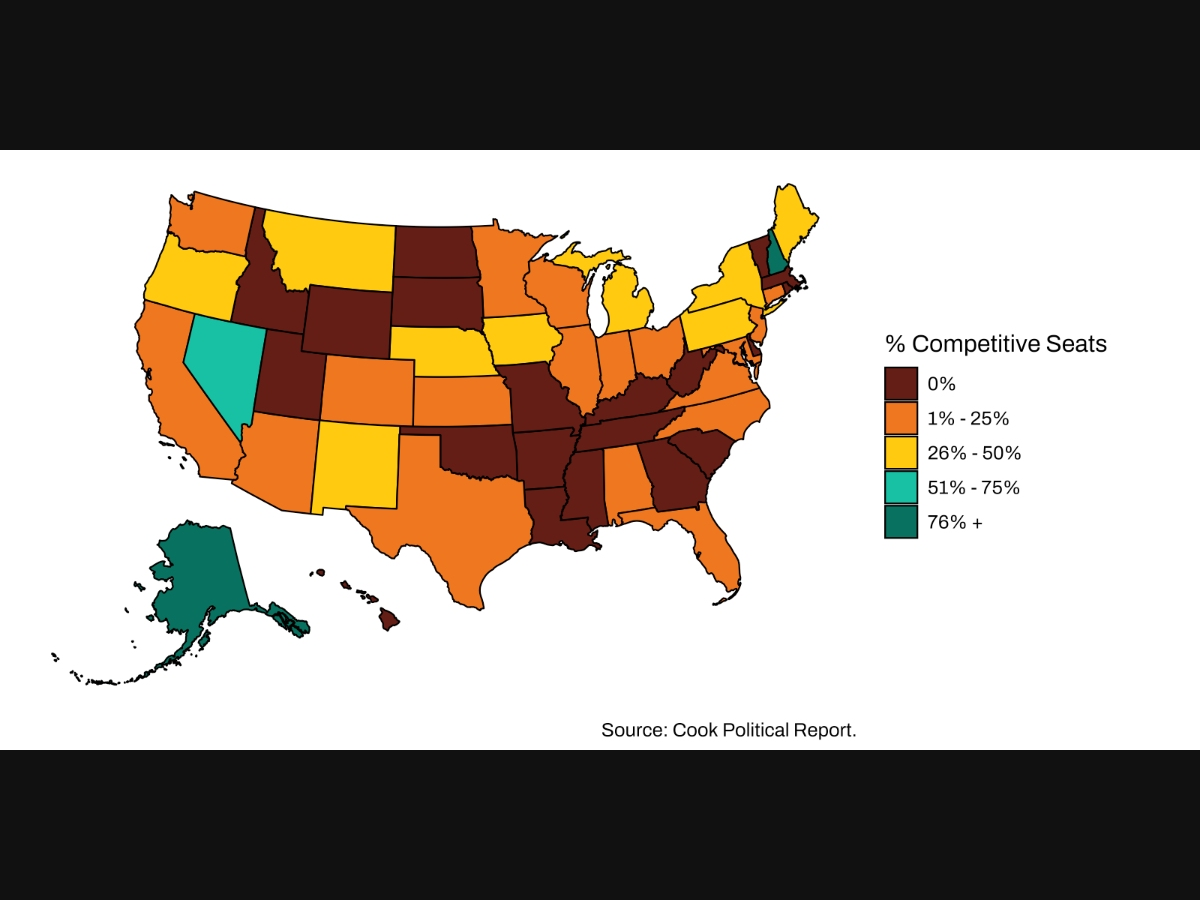
And that brought me surprisingly close to the number I mistakenly thought I had heard. There are 435 seats in the House of Representatives. As of mid-July, the Cook Political Report rated 184 of them Solid Democratic and 185 Solid Republican, for a total of 369 seats, nearly 85 percent of the chamber. Add the districts Cook rates as Likely or Lean toward one party, and 417 of the 435 House districts begin with some partisan advantage. Only 18 are Toss Ups.
My misheard ninety percent was still wrong, but it had nudged me toward a new question: What does it mean to have competitive elections when most congressional districts aren't particularly competitive?
Enter: The Election Rating Scale: Election forecasters generally place races along a spectrum of competitiveness:
1. Solid/Safe Democratic or Republican: The favored party has an overwhelming advantage, and the race is not currently considered competitive.
2. Likely Democratic or Republican: The favored party has a substantial advantage, although an upset remains possible.
3. Lean Democratic or Republican: A competitive race in which one party has an identifiable advantage.
4 . Toss Up: Neither party has a clear advantage, and both have plausible paths to victory.
An election rating is not carved in stone. Candidates matter. Campaigns matter. Political environments change. Scandals happen. Voters change their minds. Districts once considered safe can become competitive. And not all of this is about gerrymandering. Partisan mapmaking plays a role, but Americans have also sorted themselves geographically over time, with Democrats concentrated in many cities and metropolitan areas and Republicans dominant in many rural and exurban communities. (Exurban may be my new word of the day.) Even neutrally drawn maps can produce districts that strongly favor one party.
However we got here, the result presents a paradox: the battle for control of the House can be extraordinarily competitive even when most individual House elections are not. Both parties begin with large collections of seats where they are heavily favored. Control of Congress can therefore come down to a relatively small number of districts where neither party has a decisive advantage. The national election may be a nail-biter; your local election may not be.
And that raised yet another question I hadn't considered when I started trying to figure out what I had misheard on the radio: If November isn't really deciding who represents many congressional districts, when is that decision made? The answer, most likely, is months earlier during the primary season.
In a district overwhelmingly inclined toward one party, that party's primary can become the more consequential contest. Win the Democratic nomination in a heavily Democratic district, or the Republican nomination in a heavily Republican one, and the general election may present a much easier hurdle.
In some places, the most meaningful competition occurs not between Democrats and Republicans but within the parties themselves. Progressives, democratic socialists, and more traditional Democrats can compete for the nomination in one district, while conservatives, populists, and more traditional Republicans battle over another. The competition hasn't necessarily disappeared. It may have moved.
New York City offered a vivid example earlier this summer. Mayor Zohran Mamdani backed three candidates in the June Democratic congressional primaries, and all three won, with two of them defeating sitting members of Congress. Whatever one thinks of those candidates or their politics, the races showed something important about safe districts: a primary can still feature a vigorous ideological contest even when the general election is expected to favor one party strongly.
And as I write this, we are not talking about an abstract point on an election calendar. We are now swimming through primary season; Michigan, Kansas, and Missouri held congressional primaries earlier in August. Minnesota, Wisconsin, and Connecticut followed this week, with Florida and Wyoming voting on August 18 and Massachusetts on September 1. In districts that strongly favor one party, some of these summer contests may prove more consequential than the general elections that follow in November.
That shifts attention to elections in which far fewer Americans typically participate, which is a pet peeve of mine. Primaries were designed to give voters a voice in choosing party nominees. In a safe district, they can do considerably more than that. They can effectively determine who is likely to hold public office. And the voters making that choice may be only a fraction of those who will show up in November.
This is where the difference between uncontested and uncompetitive becomes more than semantics. An uncontested election announces its lack of competition. An uncompetitive election is subtler. There may still be a Democrat and a Republican. Both may campaign seriously. Both deserve to have their votes counted, and voters can still produce an upset. But the district's underlying partisan composition can make one outcome substantially more likely than the other.
That may be why my NPR mistake stuck with me. I initially imagined a democracy in which voters walked into polling places and found only one candidate on the ballot. That would be an obvious problem. What I found instead was more complicated. America still holds 435 separate elections for the House every two years. Candidates campaign. Voters choose. Ballots are counted. Yet the genuinely competitive battlefield for control of the House can encompass only a small fraction of those districts.
That doesn't mean the other votes are meaningless. A representative serves everyone in a district. Electoral margins can change. Parties can gain or lose support. Today's safe seat can become tomorrow's battleground. And, as those New York City primaries reminded me, a district that is uncompetitive between the parties can still contain a very real contest within one of them.
But it does mean that political competition is distributed in a remarkably uneven way. Some Americans live in districts where November offers a genuine contest between two candidates with plausible paths to victory. Others live in districts where the more consequential choice occurred during the primary. Still others may encounter little meaningful competition at either stage.
Yikes! So as the voting needle moves every two years across our country, how many of those 435 members of the House are really elected on Primary Day, and how many on Election Day? Regardless of the math in your district, both days deserve your ballot. (-:
Next time, I'll take Metro-North. But I'm glad I was driving that morning.