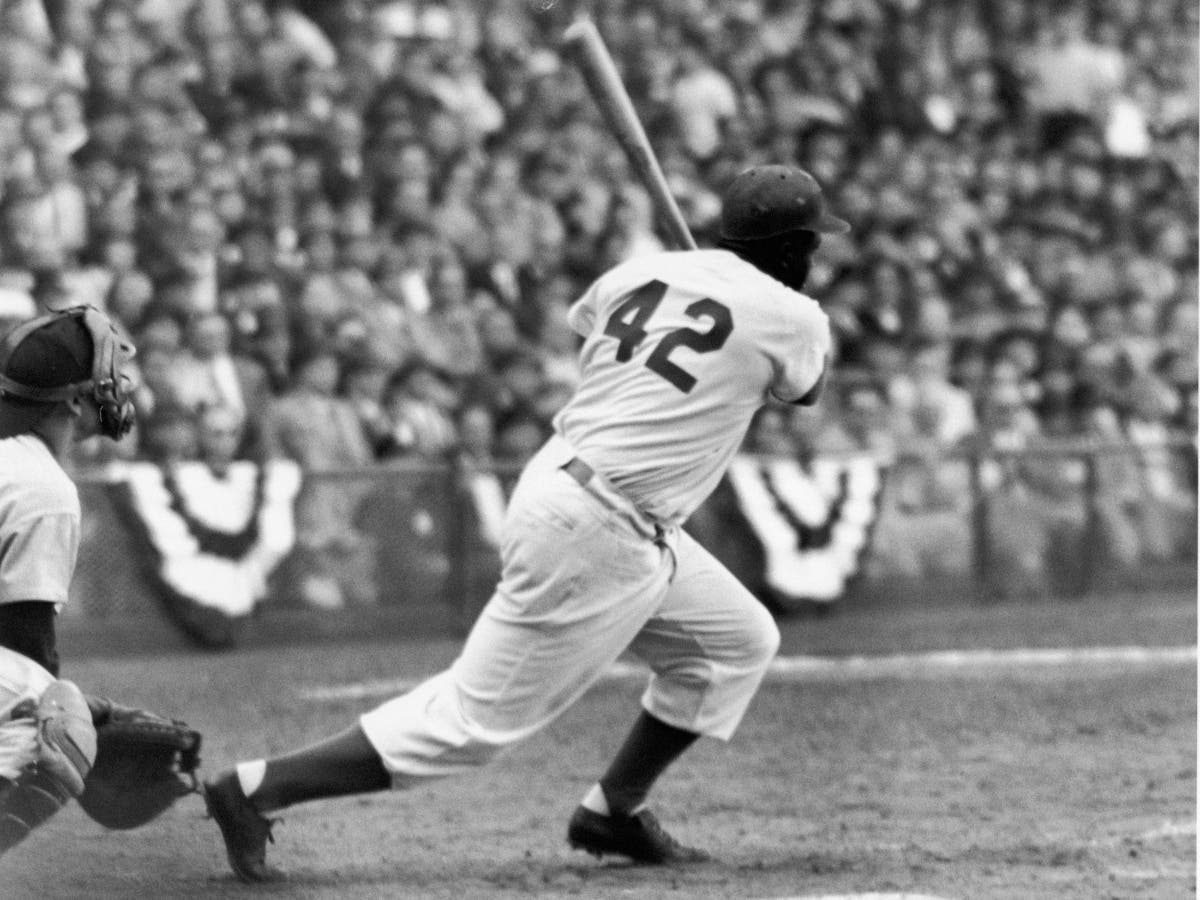

Every year, Major League Baseball marks April 15 with a simple ritual. Every player wears 42. The story is retold. The moment is honored. It remains one of the most effective commemorations in American sports and invites a closer look at what made that moment endure.
The familiar account centers on Jackie Robinson as the singular figure who integrated baseball in 1947. That account is accurate, but it captures only the breakthrough. It does not fully reflect the system of stability that allowed that breakthrough to endure. Integration is often remembered as an event. In practice, it is a sustained condition under pressure. It requires more than entry. It requires support, structure, and continuity. Much of that continuity came from Rachel Robinson.
Long before she became a public figure, Rachel Robinson had been preparing for the work history rarely recorded. Born in 1922 in Los Angeles, she grew up in a community that valued discipline and civic responsibility. By the time she met Jackie Robinson at UCLA in 1940, she was already on a path defined by rigor. She graduated in 1945 with a degree in nursing, specializing in psychiatric care, a training that would become central to sustaining a household under extraordinary pressure.
Find out what's happening in Pelhamfor free with the latest updates from Patch.
When Jackie Robinson entered the major leagues, he was not simply joining a team. He was entering a national experiment under hostile conditions. The pressure was relentless, the scrutiny constant, and the emotional cost profound. Rachel Robinson carried much of the burden of making that experiment survivable. She managed the volatility around him, maintained stability for their growing family, with children born in 1946, 1950, and 1952, and absorbed the private consequences of a very public breakthrough. Travel, threats, and public exposure did not exist separately from family life; they were part of it. What appeared as composure on the field depended on stability off it, and that stability required discipline, emotional regulation, and sustained effort. It required someone to absorb the pressures that the system itself had not yet learned how to carry. In that sense, integration was not a solo act. It was a shared system.
The way we tell the story often favors visibility over function. It elevates the moment of entry and compresses everything that follows into the background, even though the period after a barrier is broken is where most reforms fail. That is when systems are tested and when early gains can collapse without reinforcement. Rachel Robinson's professional trajectory during these years reinforces the point. In 1961, while raising three children and supporting a public figure, she earned a master's degree in psychiatric nursing from NYU. She became a clinical nurse in the Bronx, later head of psychiatric nursing at the Albert Einstein College of Medicine, and by 1965, director of nursing at the Connecticut Mental Health Center and an assistant professor at Yale. These were not symbolic roles. They were positions of institutional leadership built on expertise and the ability to manage complexity.
Find out what's happening in Pelhamfor free with the latest updates from Patch.
Her work after Jackie Robinson's death in 1972 makes the institutional argument even clearer. Within months, she became president of the Jackie Robinson Development Corporation, building more than 1,600 units of low‑ to moderate‑income housing. The following year, she founded the Jackie Robinson Foundation, creating a structured pipeline that combined scholarships, mentorship, and career development for students from underserved communities. Its graduation rate approaches perfection. Through these efforts, she shifted the work from legacy to infrastructure. Legacy preserves memory. Infrastructure produces results.
This distinction points to a broader institutional pattern. Organizations are generally effective at recognizing firsts, but they are less consistent at building the systems that sustain them over time. Recognition is visible and immediate. Maintenance is ongoing and often invisible. Rachel Robinson's life sits squarely in that second category. It is the kind of work that determines whether a breakthrough becomes durable or fades into symbolism.
This pattern extends beyond baseball. Institutions across sectors announce change, celebrate milestones, and then underinvest in the support structures required to make those changes hold. The result is a cycle in which progress is achieved, strained, and sometimes reversed — not because the initial step was insufficient, but because the follow‑through was.
Jackie Robinson Day succeeds because it keeps a pivotal moment in view. But to understand how that moment translated into lasting change, the frame has to widen. Wearing 42 honors a barrier that was broken. Understanding Rachel Robinson explains how it endured. History remembers the figure who enters, but systems depend on the people who make it possible for that entry to last.