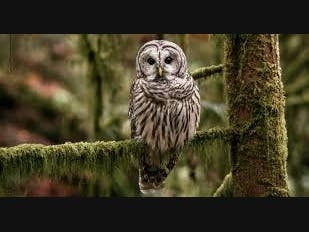

In the sometimes not-so-quiet of the Pacific Northwest's old-growth forests, a Barred Owl's call —"Who cooks for you? Who cooks for you?"— echoes through the trees. But today, public policy intends to silence that call in a controversial effort to save our old friend, the Northern Spotted Owl, a species teetering on the brink of extinction. A recent New York Times article notes that this isn't a plot from a dystopian novel—it's the reality of the U.S. Fish and Wildlife Service's public policy conservation efforts in the 21st century, a reality echoed in conservation debates worldwide.
The U.S. Fish and Wildlife Service's decision to cull nearly half a million barred owls to protect the northern spotted owl raises ethical and ecological questions. While the intention is to save an endangered species, this strategy might be both ethically troubling and ecologically short-sighted, underscoring the need for a more holistic approach to conservation—one that acknowledges the complex interplay of species within ecosystems, as highlighted in conservation efforts around the globe, from New Zealand to Scotland.
Ethical Dilemmas in Conservation: Choosing one species over another brings to light significant ethical concerns. The idea that humans can decide which species "deserves" to survive is deeply problematic. Conservation should not be about picking winners and losers but finding ways to coexist and protect biodiversity in our rapidly changing climate crisis. This dilemma is not unique to the Pacific Northwest. Consider the lessons from the film The Biggest Little Farm, where Molly and John Chester transformed barren land into a thriving ecosystem by working with, rather than against, nature's inherent systems. Their journey underscores the potential of holistic approaches that enhance biodiversity rather than diminishing it. Similarly, as Elizabeth Kolbert discusses in The New Yorker, ethical quandaries arise in other parts of the world, such as Scotland, where hedgehogs were culled to protect bird populations.
Find out what's happening in Pelhamfor free with the latest updates from Patch.
The Barred Owl Management Strategy, initiated as part of the 2011 Northern Spotted Owl Recovery Plan, reflects the complexity of these ethical issues. It specifically targets the barred owl, identifying it as one of the two primary threats to the northern spotted owl, the other being habitat loss (Smokey Wire). This raises the question: is it ethically justifiable to cull one species to save another, or does this approach oversimplify the intricate relationships within ecosystems?
Ecological Ineffectiveness: The barred owl cull may not achieve its intended purpose. Studies have shown that even with the removal of barred owls, the northern spotted owl population continues to decline due to habitat loss and other environmental pressures. The 2011 Recovery Plan emphasizes the need to reduce the negative impacts of barred owls to stabilize spotted owl populations. Still, the plan acknowledges that these efforts are part of a broader strategy addressing habitat protection. Without addressing the root causes of habitat loss and degradation, species-specific interventions like the barred owl management strategy may offer only temporary relief, failing to provide a sustainable solution.
Find out what's happening in Pelhamfor free with the latest updates from Patch.
Limitations of the Endangered Species Act: While the Endangered Species Act (ESA) has been instrumental in saving many species, it is not without its limitations. The ESA's focus on individual species rather than entire ecosystems often leads to interventions like the barred owl cull. The Barred Owl Management Strategy, while comprehensive in its approach to reducing barred owl impacts, does not address broader habitat conservation issues that are also critical to the survival of spotted owls. As Kolbert points out, this approach is part of a more significant trend in conservation where the focus on specific species often neglects the broader ecological context. As climate change accelerates and ecosystems continue to shift, it becomes increasingly clear that conservation policy must evolve. We need laws that protect whole ecosystems, ensuring that all species, not just a select few, can thrive in their natural habitats.
Addressing Counterarguments: Critics might argue that the northern spotted owl could face extinction without immediate action and that the cull is a necessary evil. While it's true that the situation is dire, we must question whether such a drastic measure will have lasting success. Conservation is more than just saving one species; it's about maintaining the balance and integrity of entire ecosystems. Kolbert's article reveals that even the most well-intentioned culling campaigns, such as those in New Zealand, have faced significant challenges and unintended consequences. The Barred Owl Management Strategy proposes rapidly implementing culling efforts to meet recovery goals. Still, even the strategy notes that barred owl removal should be complemented by broader conservation efforts to ensure the long-term survival of the northern spotted owl.
Circling Back: In our mind's eye, as we walk through the ancient forests of the Pacific Northwest, we find ourselves questioning why our focus isn't more on protecting the ecosystems that sustain life in all its forms. Global conservation efforts remind us that the ethical and ecological challenges of "owl vs. owl" are not unique but highlight the urgent need for a more holistic, ecosystem-based approach. Supporting broader conservation efforts—such as habitat restoration and climate action—can lead to more sustainable outcomes for both the northern spotted owl and the barred owl and the biodiversity that enriches our planet.
The complexities of conservation compel us to think beyond simple solutions, urging us to adopt strategies that respect and protect the full spectrum of life within our shared ecosystems.