Neighbor News
When Federalism Leaves No Exit
At America's border choke points, tightly stacked jurisdictions can turn minor mistakes into sovereign encounters.

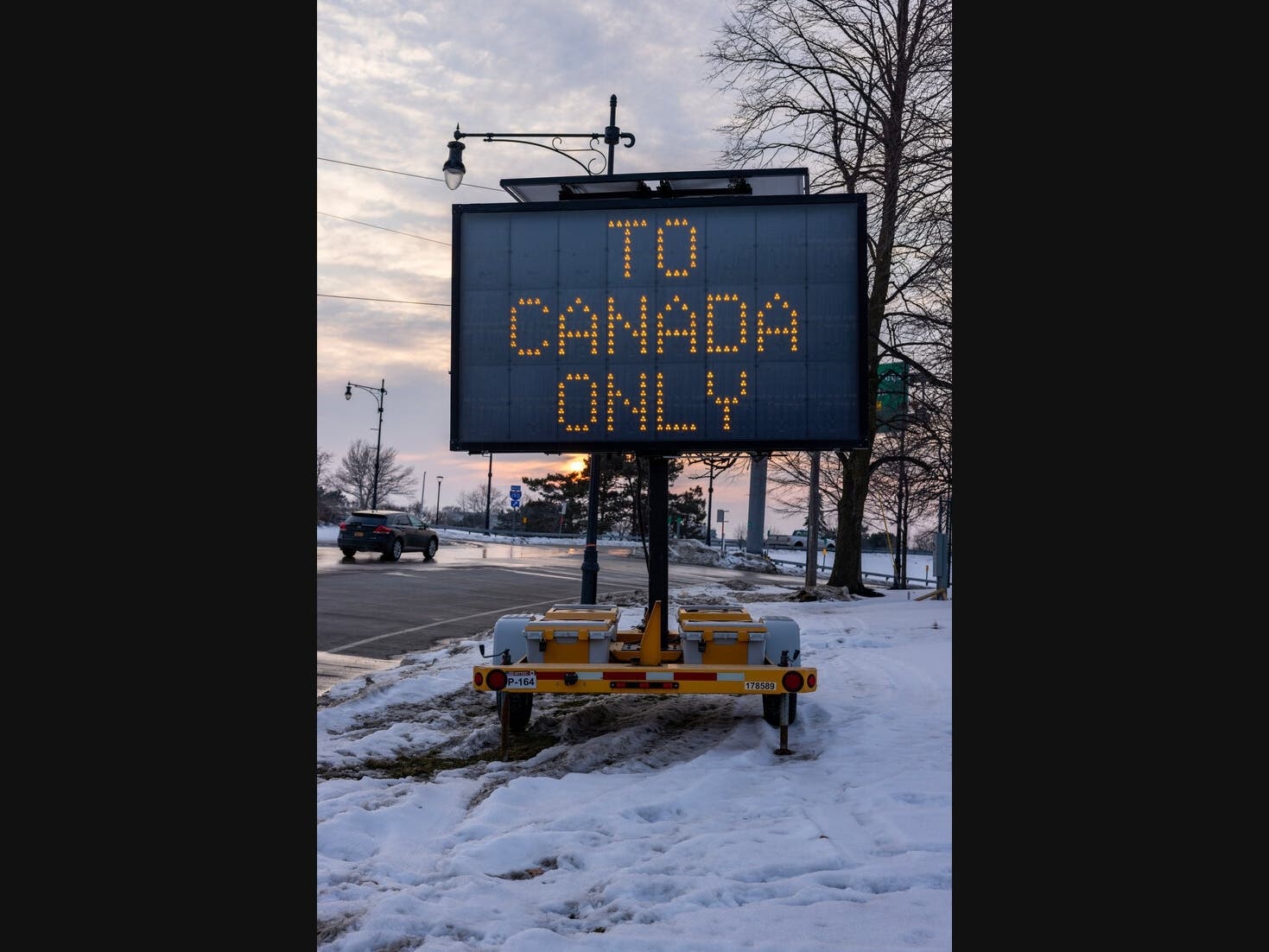
Miss the final exit on the approach to the Peace Bridge in Buffalo, and there is no shoulder to pull onto, no median to cross, no local detour. The roadway narrows. Concrete barriers rise. The lanes funnel toward the international span. At that point, the only way to correct the mistake is to leave the United States.
Last year, a University at Buffalo researcher did just that. A split‑second lane choice sent him past the previous opportunity to remain on U.S. soil and directly into Canada’s primary inspection lanes. Because the U.S. immigration checkpoint is located on the return side of the bridge, he could not simply turn around. He had to enter Canada, submit to Canadian authority, and then re‑enter the United States under full federal inspection. That routine turnaround ended with him in federal detention despite holding a valid visa.
The details of his case are specific. The underlying design is not. A trivial driving error activated a stack of jurisdictions that typically operate separately. This is not a story about signage. It is a story about governance architecture — about what happens when multiple layers of authority sit so tightly on top of one another that ordinary human movement is reclassified as a sovereign event.
On the approach to the Peace Bridge, a municipal roadway becomes a state‑engineered traffic pattern, which becomes the domain of a bi‑national bridge authority, which becomes a Canadian inspection point, which becomes a U.S. federal inspection zone — and can become a federal detention event. Once the final exit is missed, the sequence is mandatory: Canada first, then U.S. re‑entry. A wrong turn is not reversible. It becomes jurisdictional.
Find out what's happening in Pelhamfor free with the latest updates from Patch.
The system is brittle, not because any single agency is misbehaving. It is brittle because no single actor owns the composite outcome.
- The state controls the roundabout.
- The bi‑national bridge authority controls the span.
- The Canada Border Services Agency controls the turnaround.
- U.S. Customs and Border Protection controls re‑entry.
- Immigration and Customs Enforcement controls detention.
- Immigration judges control bond.
Each institution is rational within its domain. No single institution is responsible for the chain reaction.
Find out what's happening in Pelhamfor free with the latest updates from Patch.
And the Peace Bridge is not unique. Airports, seaports, land crossings, and other regulatory choke points exhibit the same jurisdictional density. These are places where municipal infrastructure, state authority, federal regulation, and international sovereignty converge within a few hundred feet. When enforcement intensifies, these nodes become stress points. Minor errors propagate quickly because the system is tightly coupled. In calmer policy environments, these sites function as intended. A wrong turn is an inconvenience. A missing document is a delay. But under heightened enforcement, the same infrastructure produces different outcomes. The design has not changed; the stakes have.
This is the quiet lesson of the Peace Bridge: modern federal systems contain hidden escalation points — places where ordinary behavior crosses an invisible membrane and becomes legally consequential. These membranes are not marked on maps. They are embedded in the architecture of governance.
The solution is not to redesign every roundabout or rewrite every statute. It is to recognize that systems with high jurisdictional density require buffers — mechanisms that prevent trivial human error from activating maximal state authority. In a country built on layered federalism, that is not a luxury. It is a design requirement.
A wrong turn should cost time, not liberty. When it costs liberty, the failure is architectural.