Neighbor News
When a Shoe Company Becomes a Financial Vehicle
What the Allbirds pivot reveals about markets that reassign value when production economics collapse

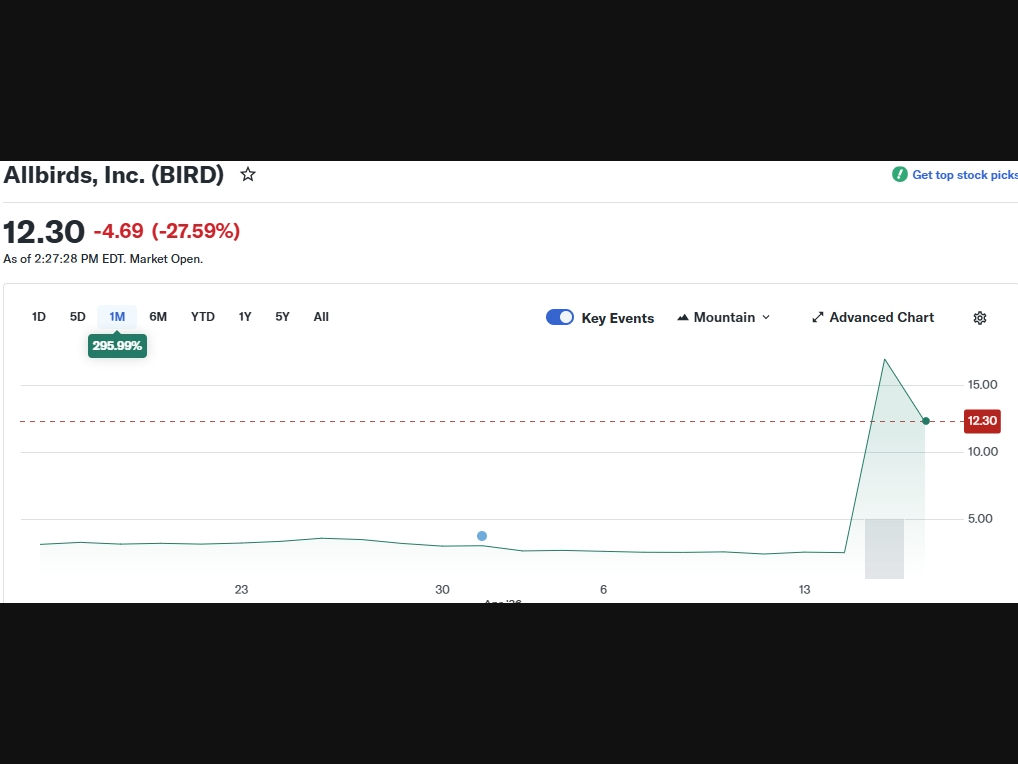

A company that could not sell enough shoes to survive became a tradable vehicle with exposure to AI upside. That is not a contradiction. It is a market outcome.
Allbirds agreed to sell its assets for $39 million after being valued at $4 billion. Within days, its stock rose by more than 500% after announcing a pivot into AI infrastructure. The sequence looks unusual only if the story is framed as one about footwear or artificial intelligence. It becomes clearer when framed as a story about microeconomics.
The Allbirds pivot is not about AI. It is about what happens when the economics of production fail, and the economics of capital take over. The distinction matters because it separates what the firm can produce from how the market values it.
The retail failure followed a familiar pattern. A New York Times report describes a company that never escaped its niche. The wool runner found early traction among a narrow set of consumers, but demand did not extend beyond that group. Attempts to expand into apparel and new silhouettes did not succeed. Sales fell, and losses widened, and the business never turned a profit as a public company.
Find out what's happening in Pelhamfor free with the latest updates from Patch.
The underlying constraint was demand. Allbirds could not find enough customers willing to pay enough to cover the cost of reaching them. That gap between willingness to pay and acquisition cost defined the model's limits.
The product also had the characteristics of an experience good. Consumers only know if they like a shoe after trying it, which requires sustained marketing and repeated exposure. That cost rose over time as customer acquisition became more competitive. Physical retail added fixed costs that required scale to justify, including rent, staffing, and inventory. That scale never arrived. Instead of lowering the average cost, growth exposed the model's weakness and made it more visible.
Find out what's happening in Pelhamfor free with the latest updates from Patch.
Once marginal cost exceeds marginal revenue, expansion destroys value. At that point, the firm is no longer solving a strategy problem. It is operating under a structural constraint. The shutdown condition is reached in the product market, and the original production logic no longer holds.
In the product market, that should have been the end of the story. What followed came from a different mechanism.
The capital market wrote a different ending. According to The Wall Street Journal, Allbirds announced a pivot into AI compute infrastructure and secured fifty million dollars in financing. Investors responded by buying the stock aggressively, and the price moved accordingly. The immediate explanation is mechanical, since buy orders exceeded sell orders. The more important explanation is that the announcement changed the company's expected return profile.
Before the pivot, Allbirds was priced as a failing retailer with limited growth prospects and little expectation of profitability. After the pivot, it was priced as an option on AI. It was not a proven operator and not a credible competitor to firms investing billions in computing. It was an option in a sector with high expected returns and strong capital demand. In that context, optionality carries value even without demonstrated production capacity.
Investors were not buying a turnaround in the shoe business. They were buying exposure to a different sector and a different return profile. The company did not become an AI firm. It became a different kind of asset whose value is tied to expectations rather than output.
This is where classical microeconomics still provides a clear explanation. Comparative advantage describes what firms should produce when they remain viable producers. A firm should specialize in the activity where it has the lowest opportunity cost relative to alternatives. That framework assumes that production itself is sustainable.
Once the underlying business cannot operate profitably, the firm is no longer choosing between productive activities. It is choosing between liquidation and redeployment. The relevant mechanism shifts from operational efficiency to financial viability, and the firm becomes a vehicle for capital rather than a producer of goods.
In the product market, demand for Allbirds shoes was too narrow to sustain its cost structure. In the capital market, demand for AI exposure was strong enough to support a new valuation. The company did not acquire a comparative advantage in artificial intelligence. Investors simply began valuing the corporate shell differently from the business it once contained.
The broader lesson extends beyond one company. When consumer demand ceases to support a firm, investor demand can still sustain the corporate structure that remains. Public companies do not always disappear when their business models fail. In some cases, they are repurposed, and their value reflects access to capital rather than the output they produce. This dynamic raises questions about how capital is allocated across sectors and how markets price firms whose underlying economics have already broken down, especially in periods of rapid technological change.
The Allbirds pivot is not a story about AI innovation. It is a reminder that markets will often find a use for a company long after consumers stop using its product.