Sports
Pleasantville Historian Talks Baseball Hall of Fame Inductions in Chappaqua
Dennis Corcoran describes tidbits from his new book, the culmination of six years of research.


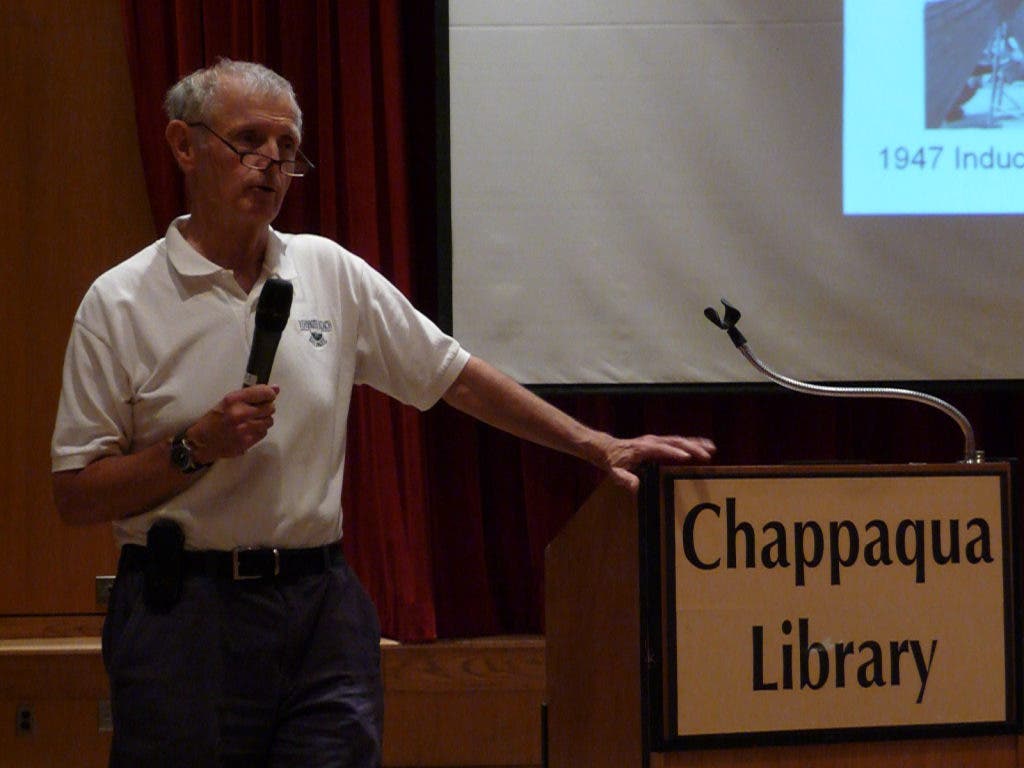


Did you know it took Joe DiMaggio three ballots to get into the Baseball Hall of Fame in 1955? Or that he only found about that he was picked after hearing about it from another driver while in traffic?
These facts, ones that diehard baseball fans can chew on, were discussed in detail by Pleasantville historian Dennis Corcoran at a Thursday night Chappaqua Library appearance.
There, he shared some details from his new book, Induction Day at Cooperstown, which details the history of the selection process and the players behind the scenes for it. It is the culmination of six years of research and writing for Corcoran, a local resident and former teacher. He has attended all but one induction year since 2004.
Find out what's happening in Pleasantville-Briarcliff Manorfor free with the latest updates from Patch.
During the talk, Corcoran described the array of groups and forces that he propelled people into the Hall of Fame, located at Cooperstown, NY. Two groups, according to Corcoran, have authority to approve inductees, a veterans committee and the Baseball Writers Association of America.
The first induction in 1939 included “immortals” such as Babe Ruth, Honus Wagner, Ty Cobb and Cy Young. With a hiatus–World War II played a role–the next induction was in 1947. What was particularly notable about that year, according to Corcoran, was four inductees did not attend. While the media did not cover the induction to the same degree as today, Corcoran gave folks in the audience an idea of the significance if it happened today.
Find out what's happening in Pleasantville-Briarcliff Manorfor free with the latest updates from Patch.
“I think you’d have people working for the Hall of Fame jumping off the top of the museum roof because they’d be so upset,” he said.
As noted with DiMaggio taking multiple tries, his ordeal was hardly uncommon during the post-war years, as many Hall of Famers were unable to get in right away, Corcoran explained, and the trend only changed later on.
Candidates, who get up to 15 tries, often get inducted due to large grass roots support. One example of this is Phil Rizzuto, who benefited from an initative backed by The Daily News, in which he received more than 100,000 write ins.
Rizzuto’s 1994 speech provided comedic odder for Corcoran, who described how he jokingly told people to leave. Two took him up on his offer, one of whom was Yogi Berra, then came back. Another notable speech was Bill Mazeroski’s in 2001, in which “he said, ‘I can’t read this crap,” abruptly stopping what was intended to be a longer speech, only to receive applause from Hall of Famers.
During the induction ceremonies, there have been years in which tens of thousands have flocked to Cooperstown. The most notable recent year was 2007, with more than 70,000 people, Corcoran explained, when Cal Ripken, Jr. was inducted. The event also attracts some unusual fans, including Oakland A’s diehard Stacy Samuels, who was pictured in a slideshow with a banjo and green helicopter hat, as well as Babe Ruth doppelganger Willis Gardner. The later fan had several anecdotes associated with Ruth, including his granddaughter having described him as a grandfather she never knew, and a woman visiting the real Babe Ruth’s grave in southern Westchester, awkwardly encountering him at the gravesite.
Corcoran also delved into moral and ethical issues. He praised a 1966 induction speech given by Ted Williams, in which he called for Negro League greats Leroy “Satchel” Page and Josh Gibson to be inducted; Jackie Robinson was inducted in 1962, but players who made a career under segregated baseball weren’t let in yet. Williams’ speech, said Corcoran, was “the most important, most significant speech,” and its objective was accomplished just five years later.
Going into the area of controversial players, such as Pete Rose–he was tarnished by a gambling scandal–and the alleged steroid uses by Roger Clemens and Barry Bonds–he noted that people who deny something for a long time and then tell the truth later have a commonality that hurt former President Richard Nixon during the Watergate cover up, in that their actions hurt them the most.
With the end of his talk, Corcoran noted that he was heading up to Cooperstown on Friday to get prepared for this year’s induction, which is July 24 at 1:30 p.m., according to the Hall of Fame’s website.
Get more local news delivered straight to your inbox. Sign up for free Patch newsletters and alerts.