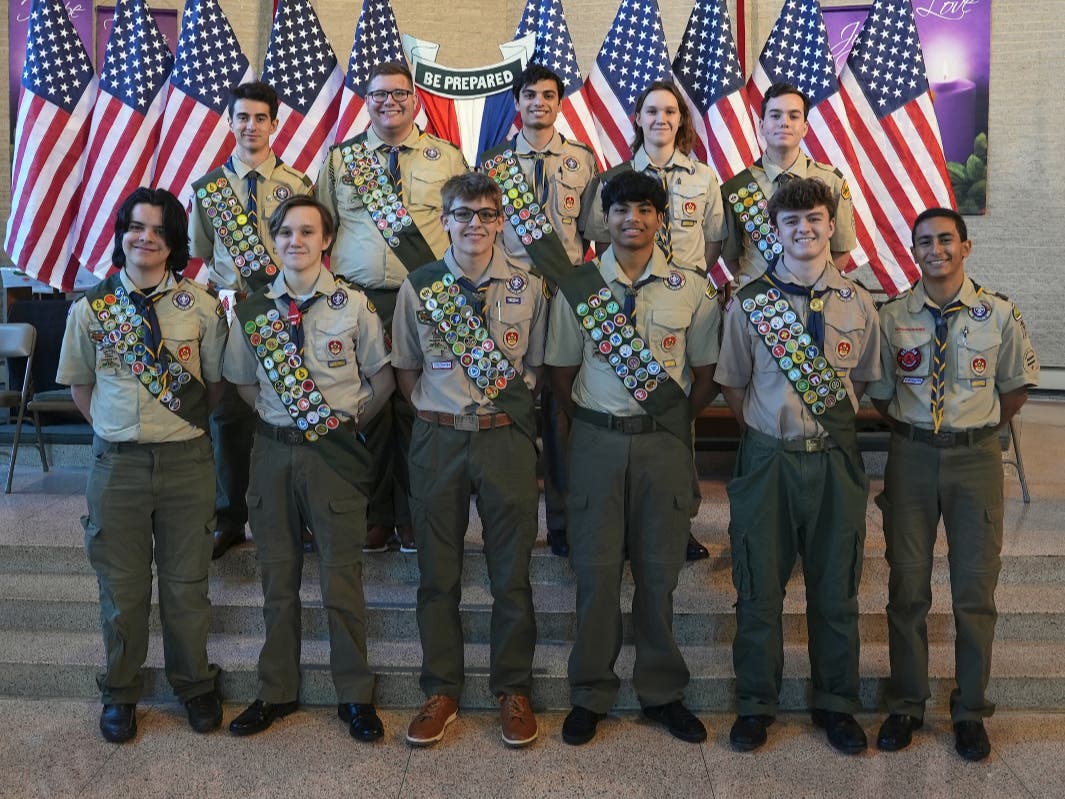


The trail forward often starts with a 6-year-old carving their first Pinewood Derby car and racing it against other cars in their "Pack". Or it could start with a friend asking them to come to a "Troop" meeting to play some games and learn a few outdoor skills. For only 4% of those that have weaved in and out of Cub Scouts and Boy Scouts (BSA), soon to be "Scouting America" in 2025, the trail peaks with the attainment of Eagle Scout. On Saturday, November 30, 2024, eleven young men of Port Washington's Troop 7 who followed that trail to its pinnacle received their Eagle Scout rank at the United Methodist Church. They were awarded a title that will follow them if they hold true to an oath which shaped the character of generations before them – duty to others, duty to self, duty to country, duty to their faith.
The roots of Scouting date back to the early 1900's, as a way to prepare boys for the British military after lessons learned during the Boer Wars. The idea of teaching character development with wilderness skills was derived to increase preparedness. The youth-driven program developed into what we know today. Hence the Scout motto “Be Prepared.”
Each of the Eagle Scouts was once a new Scout, gaining confidence in their Scouting skills as they advanced through each rank. Though they all advanced by meeting a rank’s common requirements, each was individually responsible for his accomplishments. Attaining the first six ranks through the Scouting journey, each Scout met with the adult leaders to ensure they had completed what is required in their Scout Handbook. Once approved, the next step was to sit before a group of three to five parents who constitute a "Board of Review" for 20 minutes. Much like a job interview, not to check their Scout skills but rather to help them develop and practice "social interaction” with adults whom are not their parents. The reward for each advancement success was recognition in front of their peers, validation through applause and cheers, pats on the back and fist bumps. A new rank brings new requirements. Each rank required them to study merit badges to gain knowledge from others, and share it with their fellow scouts. Each rank taught them to apply the Scout Oath and Law to their daily life in steps.
Find out what's happening in Port Washingtonfor free with the latest updates from Patch.
Scout Law? These 12 virtues that the program seeks to instill is really what we as adults try so hard to teach our children. Some say it is outdated, but is it really? Trustworthy, Loyal, Helpful, Friendly, Courteous, Kind, Obedient, Cheerful, Thrifty, Brave, Clean and Reverent. These ideals compete with teenage angst and growing up in the present day: school work, competitive sports, family life, social groups, part time jobs, and social media. So, attaining the rank of Eagle Scout is taking the time to focus on something that does not give them immediate gratification, but will give back in the amount that is paid forward in effort and determination.
These eleven Scouts all performed some of the differing duties needed to support the Troop as older Scouts: quartermaster (maintain equipment), scribe (secretary), troop guide (trainer), chaplain’s aide (faith), den chief (ambassador to cub scouts), patrol leader (lead a small group), and a few will become senior patrol leader (lead the entire troop). Troop 7 consists of more than 60 youth aged 11 to 17, so the variation in age has all the “challenges” that a family of multi-aged children faces daily, only at a much larger scale. Looking at these many senior staff positions (there are many more, too) it resembles a small business or government. Additional leadership roles also took place on high adventure teams, at the county level, and at summer camp.
Find out what's happening in Port Washingtonfor free with the latest updates from Patch.
The largest step for each of these Eagle Scouts was their respective Service Project, benefiting the community or a non-profit organization. A service project teaches each Scout, working individually, to devise a proposal, outline a detailed plan, raise funds, execute the plan, review their successes and set-backs, and prepare a report for the Scoutmaster and the local Council as part of their Eagle application. An Eagle Scout service project can take over 200 “person-hours” to complete (taking up to a full year from start to finish), and as part of this, Eagle candidates must demonstrate their leadership by, among other things, recruiting volunteer youth and adults to help them execute the project. They lead not by participating but by delegating, by supervising, by adapting. Do adults help? Of course, through proof-reading, constructive critique, insightful advice, and contributing skills while working within the Scout's team on “project day.” After their final scoutmaster's conference, like so much in life today, the deadline to reach this point of completion: their 18th birthday.
After the BSA's national office verifies all requirements are completed, the final Eagle Board of Review is scheduled. Two Scouting volunteers from Theodore Roosevelt Council of Nassau County, the Troop Scoutmaster and three other community leaders (who could be a member of the police or fire department, the Chamber of Commerce, a religious leader, a local elected official, a teacher, a member of the VFW or a local business owner) make up this final Board of Review. All will ask these teenagers about their ambitions; how they have helped their community, how they have applied the Scout Law to their lives and plan to continue to apply it. The candidates will spend an hour advocating their accomplishments and their future.
Once these boys achieve the rank of Eagle Scout and “graduate” from Scouting, they are ready to move on to the next stage of their life – be it college, full time employment, military service – and there will be the realization that the path to Eagle was a rehearsal for adulthood. Some will visit the Troop after aging out, and smile at the energy that buzzes the hall that they used to inhabit with their fellow Scouts.
The fact that they have achieved this means they showed commitment and rose to a challenge. As with so much in history we can look back and say “it’s easier now,” however it’s really not. With so many competing programs, the constantly updated requirements are harder and require more thought and more planning. What really needs acknowledgment is that we are raising young people to rise to the challenges, that they are more capable than we were at their age. Isn’t that the goal?
Although the Scouting program has evolved in its inclusiveness to reflect the changing demographics of the new generations of youth, the Scout Oath and Scout Law remain the same because the moral needs of humanity remain the same.
Port Washington Troop 7 Eagle Scout Award Recipients:
Jeremy Fahmy; University of Maryland
Austin Hyde; University of Chicago
Owen Iwanciw; Paul D. Schreiber High School
Nathan Jackman; Paul D. Schreiber High School
Gavin Kinney; Paul D. Schreiber High School
Rigel Kinney; Paul D. Schreiber High School
Shawn Klein; Rensselaer Polytechnical Institute
James Kott; Paul D. Schreiber High School
Joseph Maguire; Adelphi University
Dillon Persaud; Paul D. Schreiber High School
Steven Theodoropoulos; Sacred Heart University
Interested? Troop 7, the oldest continuously active Scout Troop in Nassau County, meets Wednesday evenings at 7:30pm at the United Methodist Church, 35 Middle Neck Road, Port Washington and is open to all boys aged 11 to 17 years. The Troop 7G girls’ troop meets on Friday evenings, and Cub Scout Pack 77 (serving all kids aged 5 to 11) meets on Tuesday evenings. The Community Chest proudly supports Scouting. Visit www.troop7bsa.com for more information.