Arts & Entertainment
Independent Art Show To Premier In Crown Heights Apartment
Elizabeth Vogt and Susan Skakel will hold their art show, Infinity in a Tiny Room, within the confines of Vogt's Crown Heights' apartment.


CROWN HEIGHTS, NY — Who needs an art gallery when you've got a perfectly good apartment in Crown Heights?
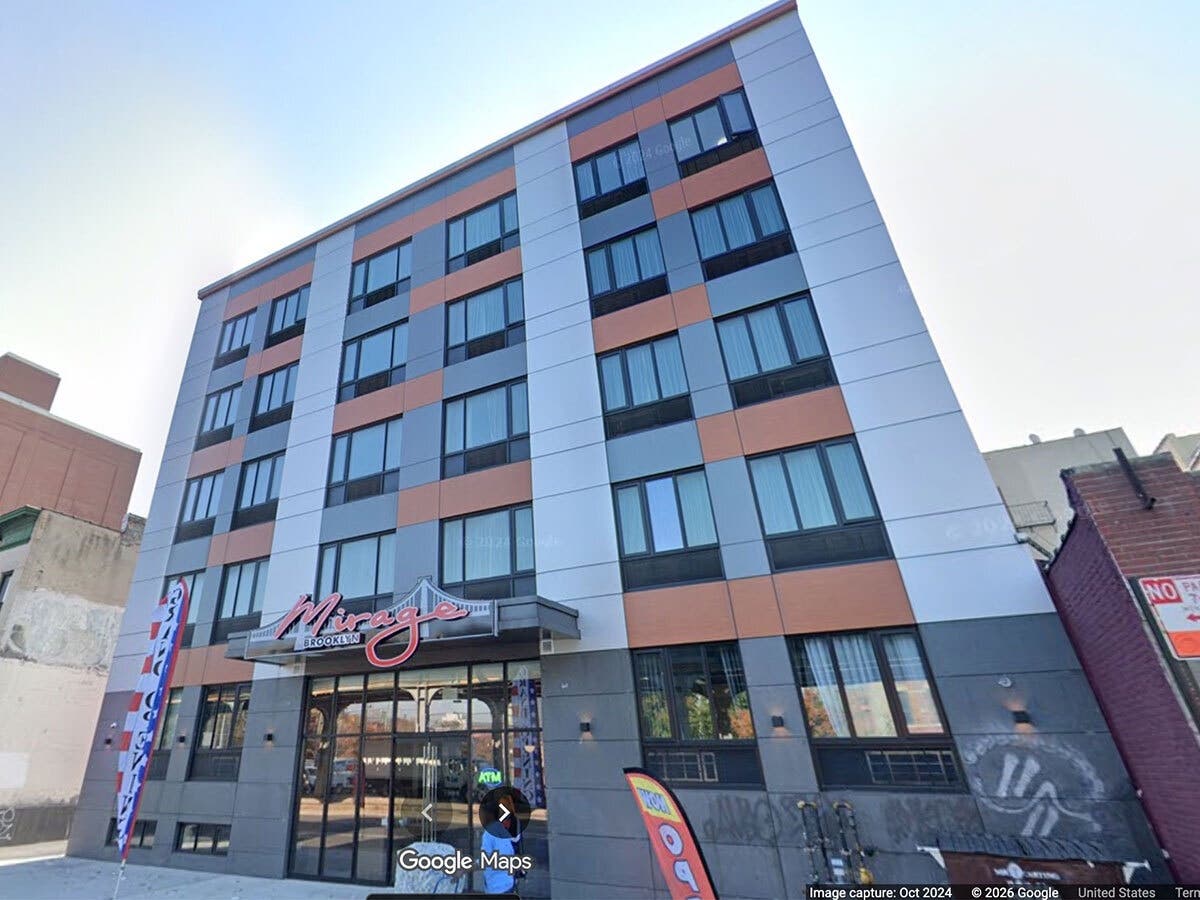
Artists Lizzie Vogt and Susan Skakel are using Vogt's home at 775 Lincoln Place to host their first independent art show, Infinity in a Tiny Room, on May 30 from 6 to 10 p.m.
Vogt, who has been involved in the art world on a more corporate level for many years, decided alongside Skakel that they wanted to create a show centered around emerging artists and more affordable art.
Find out what's happening in Prospect Heights-Crown Heightsfor free with the latest updates from Patch.
"We're excited to present a group of artists whose work tells the story of places they've been," said Vogt. "They are works that incorporate the particulars of a lived experience and paint a dreamscape around them, reminding us of the distances within localities, the infinitude of possibilities within any given set of circumstances."
After many studio visits and long hours of research, the two curators settled on a diverse list of five artists, a collection of talent which hails from France to the Philippines and across the United States.
Find out what's happening in Prospect Heights-Crown Heightsfor free with the latest updates from Patch.
Vogt described the process as one of the most enjoyable of her career. "I noticed doing this how nice it was to be working in a capacity sort of where everyone is on the same page. You're not trying to convince anyone of anything. The artist's want to share their work. You want to show their work."
While the concept of the home, migration and doing what you can with what you have is at the center of Infinity in a Tiny Room, there were plenty of challenges in presenting an art show in an apartment that Vogt more often rents out to Airbnb guests.
"That has honestly been the most challenging part. Especially, since we planned this right at the tail end of some pretty serious house renovations," said Vogt. On top of having people into your own home, you feel all the added pressures of making things perfect beyond that."
The sense of community within Crown Heights is also an important aspect in the show for Vogt.
"Most people who live on my block have lived here for generations. They'll tell you when the tree in front of your house was planted, and how to best take care of it. Which I think is important to us, that it's not just a place to see art, but a place to come together and build a community."
Artists:
Jean-François Le Minh
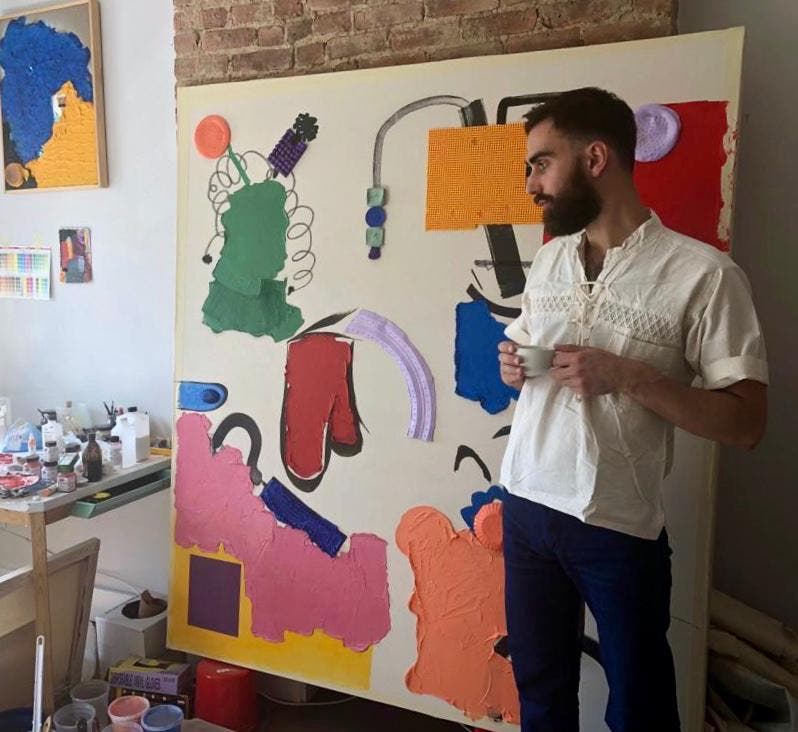
Born in Paris and raised by his grandparents on the west coast of France, Jean-François Le Minh was independent by the age of 17, making his way to England to study at Central Saint Martins, University of the Arts in London, and then to New York. A sense of place features in his work in unexpected ways. His pigments are self-mixed from materials encountered in his travels - cochineal from Mexico for the scarlets and lapis lazuli from Afghanistan for the blues- resulting in colors that feel like languid summer days. Just below that feeling, however, is the power of tightly-coiled springs. As Le Minh sees it, “the forms and constellations generate energy...each shape possesses its own verb.” That energy is sustained in part from the tension between the luxuriousness of his canvases and his incorporation of found items, studio debris or remnants from a construction site. Explicitly site-specific, in Le Minh’s deft hands the items feel so far removed from that functional use economy as to render the reference meaningless. In this language, which performs the potential of reordering and transformation, they are signifiers of kinetic energy. His work speaks to that independence, those travels, the possibility of crafting new language from old words - not so much where have you been, but where are you going?
Marcus Leslie
Marcus Leslie Singleton created this mixed media series during a protracted recovery from an Achilles heel injury. Reminding us of a bed-bound Frida, Singleton’s series cuts through the solitude of that experience: stripped-down compositions depict vividly-colored memories as well as the hazy, monochromatic moments between sleep and wake. “I paint to ask questions,” Singleton explains. And these questions feel near at hand; immediacy born from flattened perspective and minimal brush strokes. Stephanie Baptist of Medium Tings writes that Singleton “gives gravity to the transitory occasions in life.” Some of the paintings reference childhood spent in the Pacific Northwest, but the series feels like New York, familiar and fleeting as trees through your apartment window while you lie in bed or faces you’re sure you have encountered before, moments that speak to the collective consciousness of city living.
Vernon O’Meally
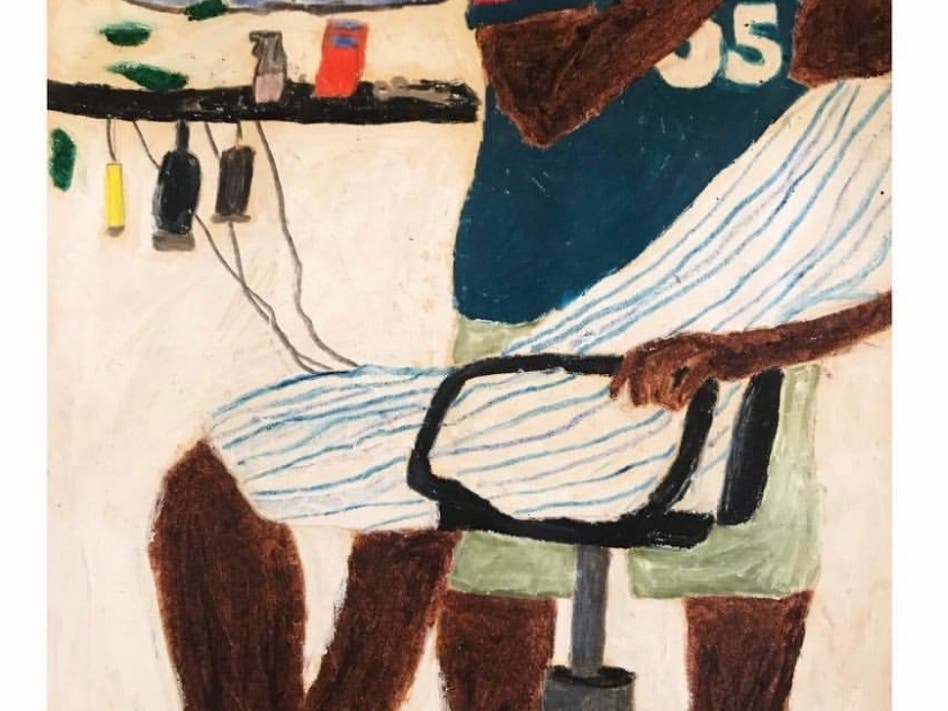
Vernon O’Meally works out of a studio in Bushwick, directly across the street from a Owen Dippie street art mural of Basquiat. “He has Mona Lisa eyes,” O’Meally’s studio mate and Atlanta childhood best friend, fellow artist Malik Roberts tells me. He’s not wrong, and working under that watchful gaze gives the studio a hint of the hyperreality that seeps from O’Meally’s acrylic and oil interior room series. The grittiness of a wayward juul or a wayward drug remnant is tempered by a Matisse-like handling of wallpaper and fabric. Delicate rendering of flowers balance rhythmic intensity. The juxtaposition of the profane and memento mori reference the futility symbolized in 17th century vanitas paintings, but his work feels more like celebration than lament - neon dreamscapes that evoke sound, to which O’Meally offers the explanation: “When a particular riff plays over and over again in my head, art is the way I get it out.” Familiar scenes rendered in technicolor feel like being given access to someone else’s (better) experience of the same party you had mistaken for boring.
Manny Padernos
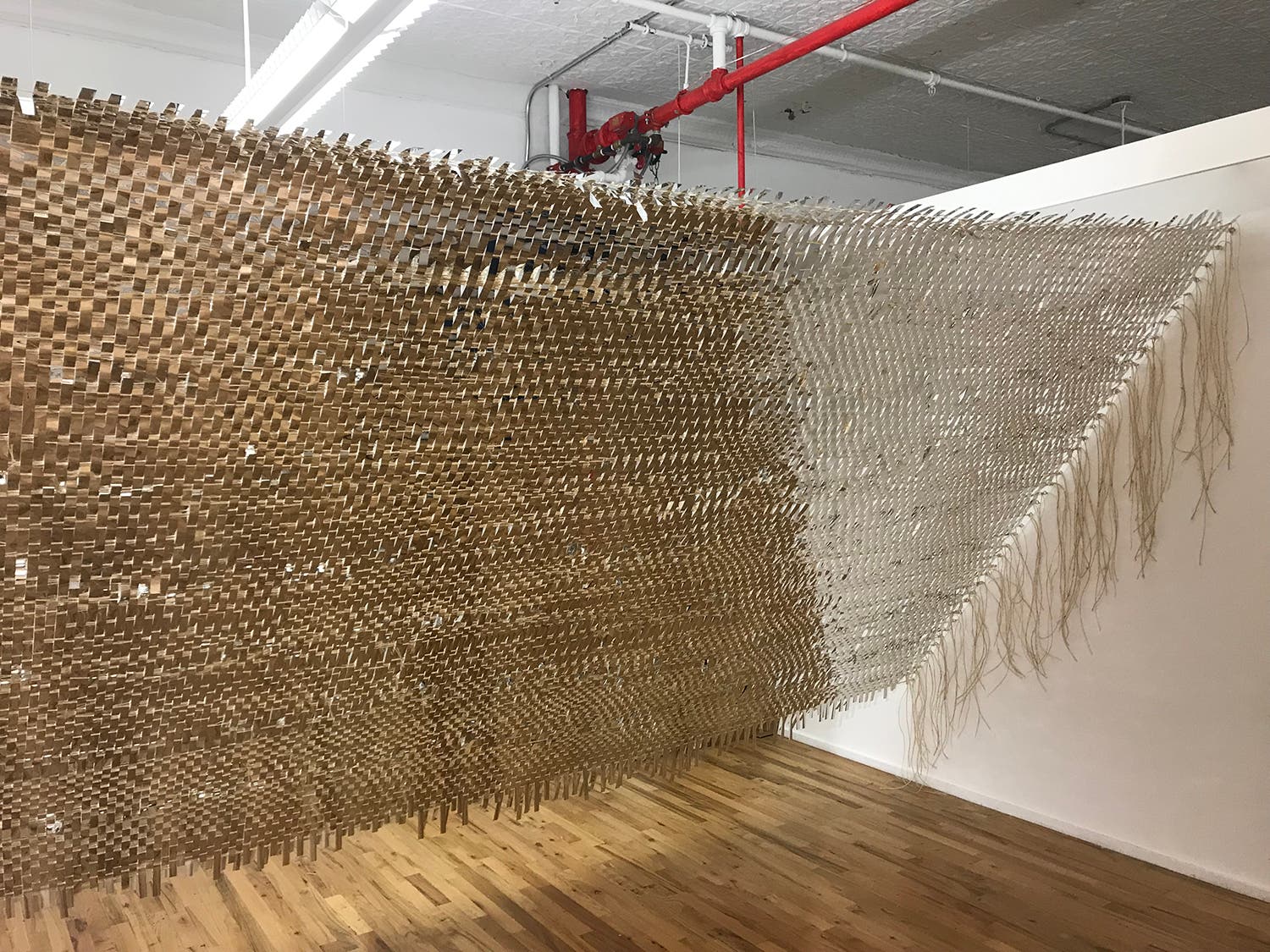
Arriving in America, by way of Singapore, Manny Padernos’ installations draw from a childhood spent in the Philippines, where you’ll find a banig - a leaf-woven sleeping mat- in most households, stuck in a corner and ready to be rolled out for guests needing a place to stay.
It’s a cultural norm that speaks to the kind of hospitality that insists on every person’s right to belong. Large-scale and physical, the installations are built to fit the space where they will live, however long they will last. Padernos likens the process to factory work done as a kid. The weavings are at once arresting and inaccessible. “Part of the experience is being on the outside, to know what it is to feel you are somewhere you don’t belong,” Padernos explains. It feels like bearing witness to someone’s reckoning with loss, a visual roadmap of the work done to rebuild a semblance of home. Still, there is something intensely peaceful in their presence. “Art is labor,” is Padernos’ answer to that, “and part of that labor is taking something painful and working until you find some peace in it.”
Kate Skakel
An artist and a fabricator, Kate Skakel’s series of paper cut-outs is an exploration of work done started while she lived in New Orleans. Living in an environment where femininity and feminism are culturally different from her native Connecticut, Skakel gravitated mostly toward materials solid and impermeable, finding expression in woodworking and fine furniture design. Her migration to New York took place as she was developing her practice of paper as a sculptural form. “I can’t help thinking about paper’s life cycle,” she explains. “It’s beaten to a pulp, and remade in service of something else.” This body of work is an exploration of that duality- fragility as a form and the strength inherent in mutability. The result is both sparse and intricate, mirroring the contradictions of the medium. Precise folds and stark cuts come together improbably to create an overall sense of movement and fluidity.
Get more local news delivered straight to your inbox. Sign up for free Patch newsletters and alerts.