Business & Tech
Yoga Studio Goes Beyond Poses — and Wallets
The founders of donation-based Dharma Yoga put their money where their philosophy is.
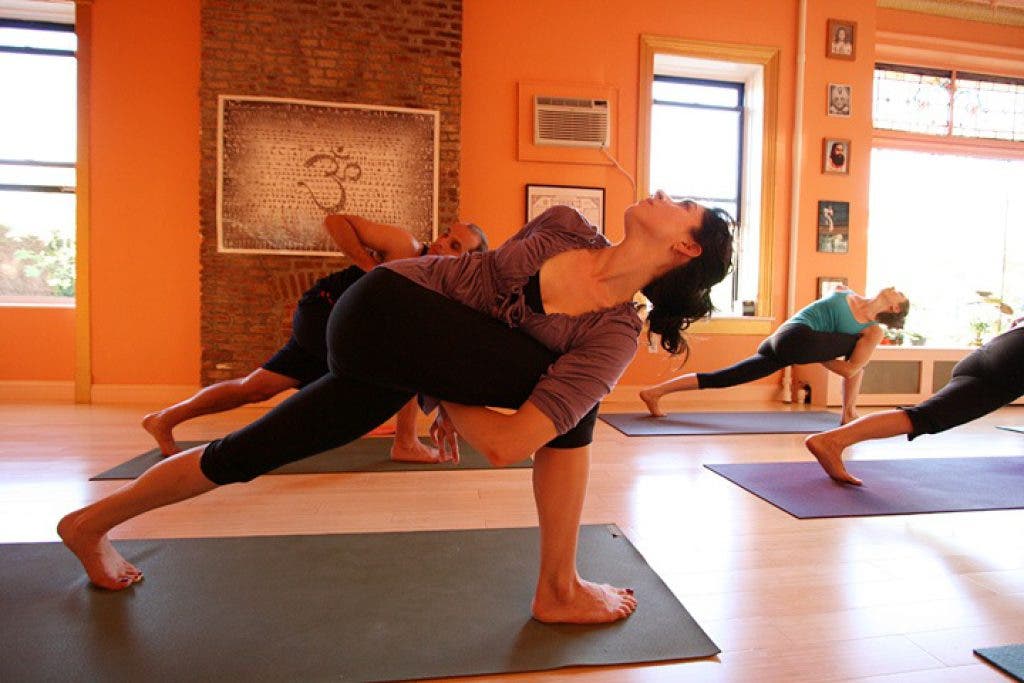


Entering the light-filled, serene space at , there is no reception desk at which to pay your entry fee.
At Dharma Yoga, there is no entry fee. But the classical yoga classes aren't free exactly — rather, they are donation-based.
A discreet box nailed to the wall invites donations from yoga practitioners, who typically elect to pay between $5 and $20, said Lily Cushman, one of the studio’s co-founders. After Cushman and her partner, Jeremy Frindel, opened Dharma Yoga last March, at first they put a bucket in the corner of the room into which people could drop money.
“We didn’t mention it in class," Cushman said. “We just wondered how people would respond. It was kind of an experiment. A lot of people thought donation meant free.”
Frindel acknowledges that accepting donations makes for less financial predictability than setting prices. Income “definitely fluctuates,” he said. Part of what enables the pair to maintain the business model is the low overheads of the small “jewel-box” space. The other part stems from regular attendees who can be relied upon to donate.
Classes tend to be full these days, to the point where people are sometimes turned away. One class was full 15 minutes before the start time last Sunday. Disappointed yogis lingered on the stone steps, rolled mats tucked under arms, and then reluctantly dispersed. Cushman gestured through the floor-to-ceiling windows for them to return for the next class at two.
“Jesus. That’s incredible,” said Kate Friedman, who recently moved to Park Slope and had been to Dharma once before. “I thought I was getting here early.” The class she had attended previously was “really good,” she said.
For that class, Friedman gave $5. “It’s what they suggest,” she said.
The idea of accepting donations rather than requesting payment fits into the classical yoga philosophy that Dharma espouses, Cushman said.
“The idea is really foreign in our culture,” she said, contrasting Americans' pricetag expectations with monks in the East who live solely off a community’s generosity. If people embrace yogic ideas beyond the poses, she said, they often find a new way of living and behaving.
“Yoga is not for everyone,” Cushman said. “But when people connect to it and do the work, it starts to open some doors. They feel happier, and they find another way — even in our culture.”
Consequently, one way or another, Cushman and Frindel find that they are able to make ends meet. Dharma is not just their business, but their way of life.
Increasingly, it is a way of life — or at least, a practice — adopted by others in Park Slope and elsewhere, too.
“There is a huge normalization of yoga that’s happened,” Cushman said. “You can go to Target and get yoga mats. That’s amazing.”
Although they would love to be able to offer yoga to more people in a larger space, Dharma’s founders know that the modest size of the place enables them to sustain donation-based classes. They opened the place to begin with thanks to private donations.
They are, however, expanding their offerings, with new classes, workshops and a monthly practicum exploring the eight “limbs” of yogic philosophy, in addition to the regular schedule.
“Classical yoga goes beyond the poses,” Cushman said. “It is a much bigger philosophy. It’s how you live your life.”
“It’s definitely a new world for some people,” she said.


