Community Corner
East End Osprey Population Up 50 Percent, Report Indicates
Riverhead has the fewest osprey nests, with only 19 reported — see why here.


EAST END, NY — For many on the East End, the return of the osprey to their nests every season is a time-honored harbinger of spring and the blue summer skies ahead.
And now, good news for osprey: A monitoring program organized by Group for the East End indicates a 50 percent increase in the local species.
Since 2014, Group for the East End staff and volunteers have worked in partnership with local organizations, including The Nature Conservancy, Eastern Long Island Audubon, North Fork Audubon, and various staff from town agencies, to gather osprey breeding data on eastern Long Island, a release said.
Find out what's happening in Riverheadfor free with the latest updates from Patch.
Most recently, from July 1 through early August, the Group studied the five East End towns of East Hampton, Riverhead, Shelter Island, Southampton and Southold, visiting and revisiting known sites while searching for new ones.
Of the 519 known sites in the Group’s database, 420 were active or of in potential use in 2018, data indicated.
Find out what's happening in Riverheadfor free with the latest updates from Patch.
“When I began at the Group in 2010, a reporter called to inquire about the status and size of Long Island’s osprey population, specifically on the East End. Unsure of the approximate size I checked with the New York State Department of Environmental Conservation’s Division of Wildlife to see if they had an answer. I was told flyover censuses had stopped in the mid-90s after it was clear the population had stabilized,” Group for the East End Vice President Aaron Virgin said.
Building on the Group for the South Fork’s earlier success of building, placing, maintaining, and monitoring osprey platforms, spearheaded by Steve Biasetti, Mike Bottini, Kevin McDonald, and Bob DeLuca, Virgin set out to determine how extensive the population was on the East End and to answer the question of whether or not it was, in fact, stabilized.
According to Virgin, data was collected every summer from 2014 through 2018. Five-year averages for the total number of nesting sites include 28 in East Hampton, 12 in Riverhead, 64 on Shelter Island, 106 in Southampton, and 196 in Southold.
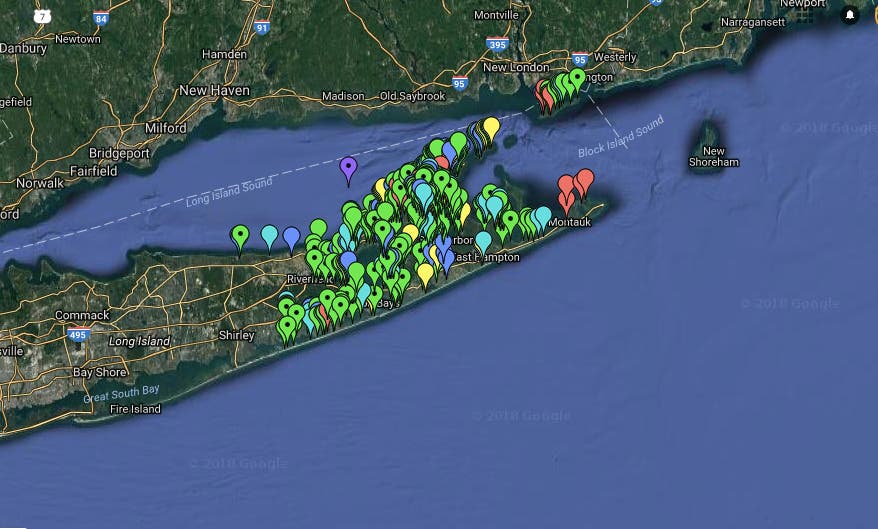
The densest population of breeding osprey exists on the North Fork, specifically in Southold Town, which includes Fishers Island, Plum Island and Robins Island, the study indicated.
Approximately 60 known nest sites are located among the three islands. Southold hosts nearly 50 percent of all osprey activity on the East End, resulting in the birthplace of roughly 48 percent of all young. This is due to the myriad of creeks, coves and small bays adjacent to Peconic Bay and Gardiners Bay.
Shelter Island boasts the highest occupancy rate across the East End, with 80 percent — the five-year East End average is 69 percent, the study said. Nearly every site had a pair of birds and the ones unoccupied were likely put in place within the past two years.
Riverhead had the fewest nests, with 19 noted in 2018 and slightly more than half occupied, the research showed. That, the Group for the East End said, was due to the town’s large shoreline frontage on the Long Island Sound, where there are only roughly one dozen osprey sites due to strong winds and surf during storm events, and minimal habitat along the Peconic Bay.
Southampton has had a very steady population during the past 20 years, a testament to the Group’s earlier days in osprey conservation, the study said. Perennial areas along Dune Road, Shinnecock Bay, Mecox Bay, along with newer sites on Scallop Pond, Long Beach and North Haven have kept the osprey population not only stable but "modestly increasing," particularly in the backcountry areas of Water Mill and Bridgehampton, the release said.
In terms of overall productivity, East Hampton has taken the lead with a five-year average of 1.58. As a rule, a stable population is given as 1, which means one offspring to replace the pair in a given breeding season, the Group said. Anything more than one results in an increasing population. In 2017, East Hampton spiked with 2.04 — the highest across the five-year study, research said.
“Without question East Hampton appears to be showing the fastest growth, particularly in the Accabonac Harbor area where more than a dozen nests could be observed from a single spot this past summer,” Virgin said.
In general, primarily in Southold, there has been an uptick in birds nesting in trees and on utility poles over the past five years, Virgin added.
“Nesting in trees we want, which is what some osprey once did, but nesting along electrical lines not so much,” Virgin said.
Nesting osprey are not the cleanest birds and repeat visits to the nests with wet fish can lead to electrical shortages, sparking fires and resulting in death of young unable to fly, he said.
“I learn about a few instances each year, but PSEG has become a good partner by working with the local community to safely remove a nest and replace with a nesting platform disc,” Virgin said.
This year, a pair of osprey whose nest was removed on Route 24 in Flanders captured hearts and sparked public outcry in April but PSEG erected a new pole, and by late July, a lone chick was ready to fledge, he said.
Why the population increase?
Virgin explained the primary reason for the robust increase is due to changes in fishing regulations over the past decade, specifically regarding the limit on the amount of “bunker” or menhaden, a smaller fish that larger fish, such as bluefish and striped bass, feed upon.
The regulations were put in place to help increase the local fishing economy — industrial and recreational; the indirect result is an increase in the osprey population, which maintains a diet of roughly 99 percent fish, he said.
And, he added, the continued placement of new manmade platforms is also increasing the population, including utility poles, such as PSEG nesting discs.
“On average I receive an inquiry a week seeking information about how to place an osprey pole on private property or to see if someone has the right habitat. The Group is very particular on where to place a new pole, as our goal over the past five-year study has been to see if pairs will return to nesting in trees, old boat docks, and on other natural areas or places in disrepair," Virgil said. "At some point it would be nice if osprey could make it on their own — and with the current robust population we may be near that time."
Another reason for the osprey’s population uptick, he said is the lack of significant competition with other top predators. For example, he said great horned owls sometimes move into a nest, resulting in the osprey pair looking for a new home for that year.
However, this does not occur regularly enough to impact the population, he said.
Bald eagles also winging their way home
In other news, bald eagles are returning to Long Island to nest. Currently, eagles nest on Shelter Island and further west in Shirley at two locations, Virgil said.
“This was the first monitoring season where we encountered adult bald eagles at multiple sites, including Scallop Pond in Noyac, Hubbard Creek in Flanders, and Kellis Pond in Bridgehampton," he said, adding that he's heard of additional adult bald eagle sightings on the North Fork, Plum Island and at points further west.
Bald eagles not only compete with osprey for food, "are well-known thieves that attack other birds shortly after catching fish and carrying it back to their nest," Virgin said. "Eagles have been well-documented attacking and killing young osprey in their nest, both out of dominance and for food."
A final threat is the breeding timing, as eagles begin nesting before osprey return from their southern winter homes in mid-to-late March, he said.
“It’s going to get very interesting very quickly once a critical mass of bald eagles are breeding on the East End. It may not happen next year or within the next five years, but it’s coming,” Virgin said.
A history of osprey on the East End
The decline of the osprey in the 1950s through 1970s was caused by DDT-induced eggshell thinning, greatly reducing the reproductive efforts of osprey and sending the iconic “fish hawk” on a path to local extinction, Virgin said.
In 1976, the species was listed as endangered in New York State. After the ban of DDT in 1972, the population slowly began to rebound in the early 1980s, and in 1983, the osprey was downgraded to “threatened.”
By 1995, there were 230 breeding pairs on Long Island and four years later osprey was downgraded again to a "species of special concern,” its current status, he said.
Patch photo by George McLanahan.
East End osprey map by Group for the East End and Google maps.
Get more local news delivered straight to your inbox. Sign up for free Patch newsletters and alerts.