Business & Tech
This Week: Clocks
The Avid Antiquer gives a history of the clock and tells you how to collect antique ones on the cheap.


We all tell time with a clock. Whether it is from the time clock we punch for work, or the wall clock we stare at in school or the cell phone clock we check to see if we are on time for an event, we use a clock of some sort throughout the day. As this is the weekend we "fall back" and return to Eastern Savings Time, it is the perfect time to take a closer look at clocks.
You do not have to like antiques to collect clocks. If you do like old ones, you can take your pick of them at Bayport stores like Country Junque, GoodWillies Thrift Shop, the and the Salvation Army. You can pick up a new alarm clock or clock radio at CVS, also in Bayport. If you are a fan of another time telling device, the sundial, try Brinkmann True Value Hardware in Blue Point during the summer. They make great additions to gardens.
There are many different types of clocks, so their appeal is just as diverse. Whether your preference is grandfather clocks, mantel clocks, wall clocks, alarm clocks or cuckoo clocks there is a design to fit your decorating style. The prices for some clocks range from inexpensive to hundreds of thousands of dollars. Each clock has a history all its own.
Find out what's happening in Sayville-Bayportfor free with the latest updates from Patch.
Originally the sun was the only way people measured time. That led to the invention of the sundial, followed by the hourglass, the water clock and the astronomical clock. The latter two clocks measured time by celestial movements, according to clockshistory.com. The first clock to use springs dates back to 1511 in Germany.
Clocktypes.com states that keeping time with the use of a pendulum was credited to Galileo Galilei in 1582. By 1656, someone took that knowledge and built the first grandfather clock, which hung on a wall as opposed to in a case.
Find out what's happening in Sayville-Bayportfor free with the latest updates from Patch.
Unfortunately, it did not keep time well until the pendulum was extended in 1670, which required the clock to be kept in a long case to accommodate the extended pendulum. That led to the original name of the clock, a case clock, which was later renamed the grandfather clock.
In 1721, another improvement was made to compensate for the temperature changes in the pendulum, which made the clock accurate to within one second.
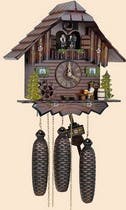
Cuckoo clocks date back to the 17th century Germany. Many people who collect them do so because they consider them works of art more than just clocks. That is exactly why I started my alarm clock collection. None of the clocks I own work because I collect them as art, not for function. I love the look of old ones, especially the ones that have a nice patina or an elegant set of hands. I prefer the silver tone ones to the brass or gold tone ones, but any of those finishes age well if that is something you look for also. I group them all together so in addition to the different makes, models and sizes, the fact that they all show a different time also makes for an interesting display.
My alarm clock collection was affordable mainly because they do not work but also because alarm clocks are quickly becoming obsolete. When they first came out, their main purpose was to wake you up and its secondary function was to show the time. Today many people use other things to wake them up, from a cell phone alarm to an IPOD station to another family member.
If you do own an expensive or delicate antique clock, do not risk breaking it by turning it back this weekend. Instead, turn it ahead 11 hours to prevent causing it any harm. And enjoy the extra hour of sleep!