Crime & Safety
Bellone: 'Significant Progress' In Suffolk Since Superstorm Sandy
The county restored almost 400 acres between Shirley, Timber Point, West Sayville, and Bay Shore since the storm 10 years ago.


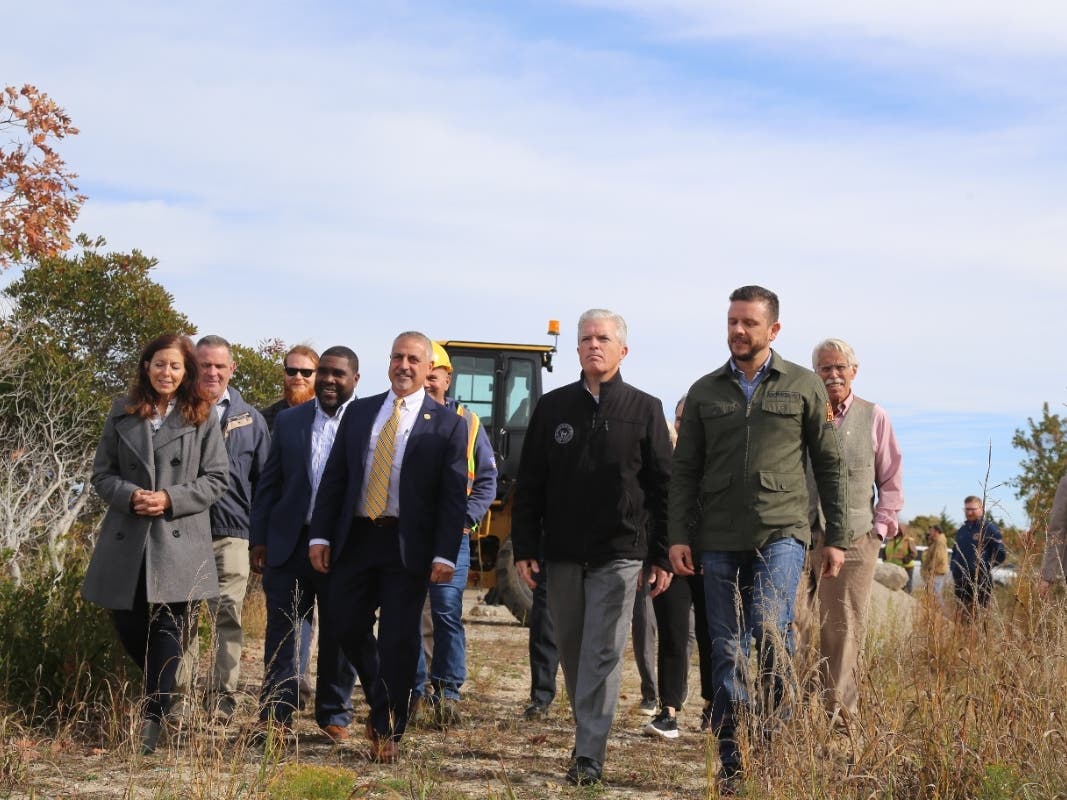
SHIRLEY, NY — When Suffolk County Executive Steve Bellone visited Smith Point County Park in Shirley the day before Superstorm Sandy walloped the South Shore of Long Island in 2012, he saw the waves of the Atlantic Ocean rushing up to the railing.
"You couldn't see the beach anymore," he said Friday at a news conference before the 10th anniversary of the storm on Oct. 29. "The storm was not scheduled to be here until much later that afternoon."
It was only the morning, said Bellone, adding, "So I was stunned by how much impact was already taking place."
Find out what's happening in Shirley-Masticfor free with the latest updates from Patch.
It was at that moment that he received an update from the National Weather Service telling him that the storm would be much worse than predicted.
"And then words that I'll never forget '... that anyone remaining on Fire Island is now in mortal danger,'" he said. "I had been involved in storm management for years, but I had never heard anything like that."
Find out what's happening in Shirley-Masticfor free with the latest updates from Patch.
In preparation for Sandy, officials declared a state of emergency, and the day of the powerful storm, which was intensified by the full moon at high tide, a nine-foot surge of water was forced into the mainland across from the barrier island. In some areas, like Babylon, there were 96-mile-per-hour gusts of wind that wreaked havoc in residential neighborhoods, downing trees.
When it was over, there was significant flooding along the South Shore leaving many waterfront homes underwater and residents displaced.
By the time the night rolled around, all state roadways and major thoroughfares had been closed, and much of the island was dark from the loss of power.
"We've seen a significant amount of progress since then," Bellone said.
In the time since then, officials have been tackling the issue of coastal erosion worsened by global warming, and they have introduced resiliency projects, restoring marshland in hard-hit areas to help keep the pace with sea-level rise.
Studies have shown healthy marshland vegetation significantly reduces the energy and height of storm waves, as well as bolsters the land against flooding.
Altogether, about 340 acres have been restored, Bellone announced at the hard-hit Smith Point Marina.
A project to restore about 80 acres of marshland has recently been finished along Smith Point, Bellone said, adding, that it was funded by a $564,000 coastal resiliency grant for $564,000.
Work began in 2019 at four marshes within the South Shore Estuary Reserve Watershed, including Suffolk County Gardiner Park East and West in Bay Shore, Timber Point Marsh in Great River, and West Sayville Marsh.
About 260 acres of marshes have been restored through the project.
The project was funded by a $1.3 million grant under the Hurricane Sandy Coastal Resiliency Competitive Grant Program from the National Fish and Wildlife Foundation, as part of the Department of Interior's Hurricane Sandy disaster relief appropriation.
Suffolk has also submitted a grant application for $4.5 million to restore about 390 acres of marshland in areas like Scully Marsh in Islip, Cupsogue Beach Marsh, and the southern portion of Smith Point.
Bellone also touted the county's Septic Improvement Program, noting the Babylon Sewage Treatment Plant and the Forge River Watershed Project are making progress.
Suffolk Legis. Jim Mazzarella, whose district includes Shirley, thanked Bellone for not letting Smith Point and the surrounding area be "forgotten."
He noted that Smith Point Park is the busiest park in Suffolk, but for a reason.
"It's one of the most beautiful beaches in the area," he said.
Executive Director of Citizens Campaign for the Environment Adrienne Esposito said that while Long Islanders love living by the water, "there is a growing risk that gets more ominous each year."
"Climate change is real, and we must learn from Superstorm Sandy so we can be ready for the next storm event," she said, adding that the Mastic-Shirley Peninsula is "one of the lowest-lying, vulnerable communities on our island."
She went on to note that the area is "plagued with flooding caused by sea-level rise and storm events."
"Protecting wetlands and investing in coastal resiliency measures provides meaningful and substantive protection to the mainland," she added.
Bellone said that in the aftermath of Sandy, county officials realized that the rebuilding and securing did not only concern infrastructure, but restoring natural boundaries.
"This is very important in preparing us for what is ahead as an island, what is crucial to our way of life," he said.
Get more local news delivered straight to your inbox. Sign up for free Patch newsletters and alerts.