Community Corner
After Charlottesville, Holocaust Memories Haunt: 'This Is How It Started'
"Free speech – if it's for negativity and destruction — has no place in America," Holocaust survivor Marion Blumenthal Lazan says.


After violence in Charlottesville sent shockwaves through the nation, those who survived the Holocaust or whose lives were shaped by loss after unspeakable Nazi atrocities have a clear and urgent message: It cannot happen again.
And yet — as white supremacists carried burning torches through Charlottesville, chanting "Jews will not replace us," an urgency is shared among survivors who vow such evil must be thwarted.
Speaking with Patch recently, a KKK leader who marched at Charlottesville echoed a growing tide of hatred reflected at the rally, where one woman was killed: "I do think Jews want to replace us. Like Christ, I believe Jews are the devil."
Find out what's happening in Southamptonfor free with the latest updates from Patch.
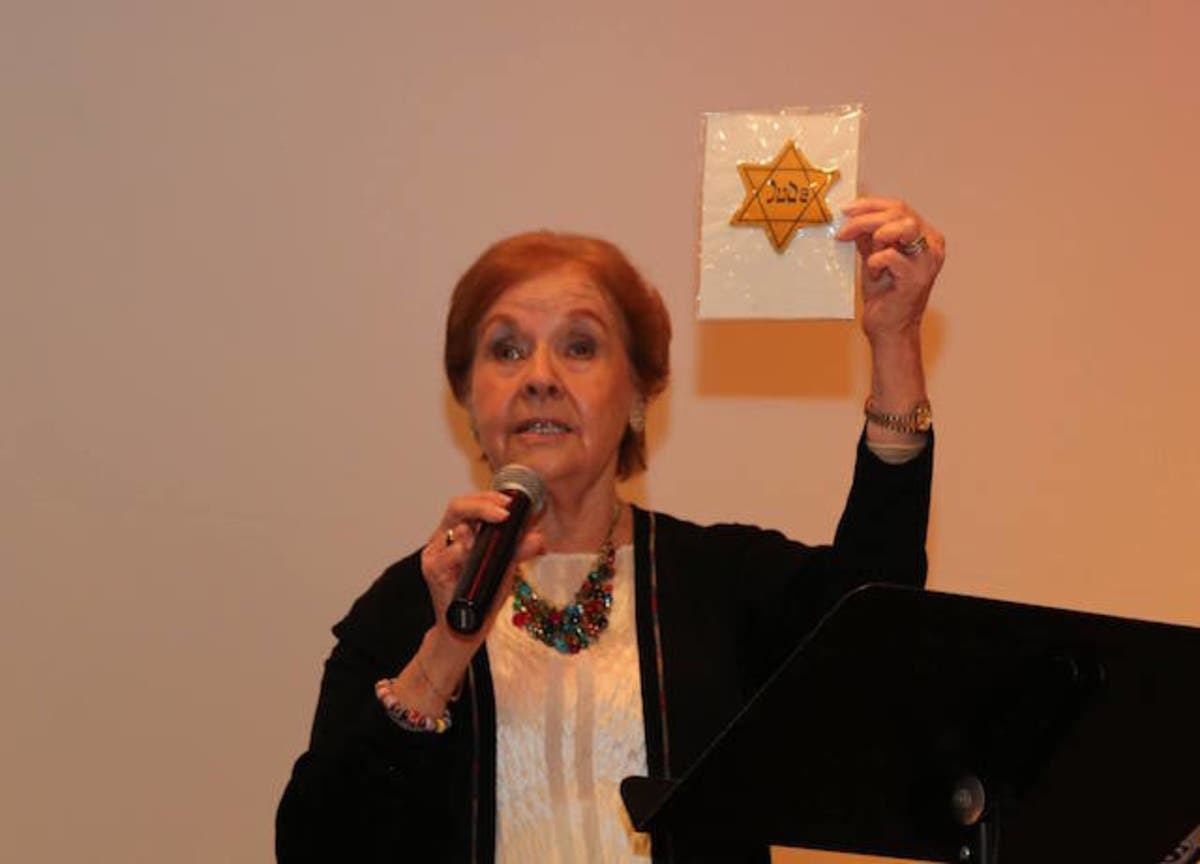
Holocaust survivor Marion Blumenthal Lazan, 82, author of the book "Four Perfect Pebbles" travels the country and the world, telling the story of her harrowing childhood spent in a Nazi concentration camp.
Blumenthal Lazan's young life changed irrevocably when the Nazis came into power in Germany. She and her parents, Ruth and Walter, and her brother, Albert, were ultimately incarcerated from the time she was 4 years old until she was 10.
Find out what's happening in Southamptonfor free with the latest updates from Patch.
Speaking to Patch this week, she addressed those who defend the alt white movement by claiming the right to free speech. "These skinheads, these Nazi sympathizers, all the negative groups have to express their feelings. Yes, there is free speech here, if it's for good —but if it's for negativity and for destruction, there's no place in America, no place in this world, for this, period."
Speaking of Nazi sympathizers, she said: "Don't they have families? Don't they want their families to live in peace?"
Grave danger, Blumenthal Lazan said, lies in those who get caught up in the mob mentality, those who will "just follow anyone's lead. That's what happened during the Holocaust, they said, 'We were just following orders.' That was their excuse. "
Traveling to schools around the country, Blumenthal Lazan tells students to take heed. "Think before you follow anyone's lead. It's not cool to follow, without realizing their true intentions. There are so many lessons learned from that dark period in our history."
What's happening in the United States is appalling to Blumenthal Kazan, who says even in Germany — where she will soon travel to speak to young schoolchildren — her book is taught in elementary schools, so that the horrors of the Holocaust are not forgotten.
In Germany, she said, "They're trying so hard to continually make their people understand what happened — and to never forget, so we never repeat it. Yet here, in this wonderful, beautiful, magnificent country, there are those that want to do this. What are we going to do?"
Despite the fact that many have blamed President Donald Trump for the sudden tide of hate, Blumenthal Lazan said: "These Nazi sympathizers have been here along. They should have been wiped out. We should put them in jail and throw away the key."
Dark history
When the political tides began to turn dark in December of 1934, Blumenthal Lazan said her family had begun to make preparations to leave Germany, but ultimately couldn't part with elderly grandparents. Her family stayed until 1938, and when both grandparents died, they once again made plans to emigrate to the United States.
"We were caught up in red tape," she said. "Everything was ready. We had our tickets, our visas."
Trying to escape the escalating tensions, the family moved to Holland, where they were living when the Germans invaded. "We were trapped," Blumenthal Lazan said.
First, her family was sent to the Westerbork detention and transit camp; they were not separated until Blumenthal Lazan and her mother were torn from her father and brother at the Bergen-Belsen concentration camp, where Anne Frank died only days before liberation.
Blumenthal Lazan said although she never knew Anne Frank, "My story picks up where hers left off."
Anne Frank's diary ends abruptly when she and her family are discovered in hiding; Blumenthal Lazan's story sheds painful light on life in a concentration camp through the eyes of a child.
Blumenthal Lazan, who travels across the world to share her story and raise awareness of what horrors hate and intolerance can wreak, said she and her husband, Nathaniel have been blessed with a beautiful family. Her own mother, she said, died just short of her 105th birthday.
"She was an amazing woman," Blumenthal Lazan said. "She is why I survived."
But, while Blumenthal Lazan could easily relax and spend time with her family, she finds hope and redemption in sharing her story -- and works tirelessly to keep the messages learned in the Holocaust alive.
Her brother, however, "still suffers greatly." With no children by choice, he has difficulty finding a voice to discuss the atrocities he witnessed at the men's camp, she said.
"We lost 1.5 million Jewish little ones — babies and children," she said. "Six million of our people were murdered. The population of Suffolk and Nassau Counties is three million. Can you imagine losing twice the entire population of Long Island?"
Describing her life as a child at Bergen-Belsen, Blumenthal Lazan said: "It was such a horror, the filthiest of all the camps. We had nothing to clean anything. Toilets were benches with holes. We had no toilet paper, no water to wash. In a year and a half, we were not once able to brush our teeth. We had nothing."
Living in squalor, she said, "We were covered with lice. Squashing them became my primary pastime. There are no words, no pictures, that can describe those horrors."
As unspeakable as it was for a child, Blumenthal Lazan said, "Can you imagine what it does to a mother, to see her children in a state like that?"
Still, she said, her mother remained strong, a constant presence as they huddled in their cot. "Somehow she had faith, inner strength to know that things could get better."
A little girl trapped, Blumenthal Lazan said she began to rely on games she created with a vivid imagination. "There was one based on superstition," she said. "I decided if I were able to find four perfect pebbles, it would mean all four members of my family would survive. I made it my business to always find those pebbles."
The games, she said, were a physical manifestation of her inner survival skills. "We all have survival techniques within us," Blumenthal Lazan said. "The key is to find them and be sure we put them to work. No one is spared adversity. No one is spared hardship. We all have to overcome obstacles and with determination, faith, and hope, you can overcome just about anything — and everything."
"I tripped over the dead"
As a small child, Blumenthal Lazan was not aware at first what atrocities were occurring at the camp. "It was not until later that I realized people were being killed," she said. "When I was nine, people were dying around me all the time. I tripped over the dead."
Of living in barracks crammed with 600 women and children — facilities only built to house 100 —Blumenthal-Lazan said, "It was a horror."
Many, she added, did not survive because they succumbed to disease, such as typhus, which killed her own father days after liberation and Anne Frank just days before.
Others, including her mother, had a fierce inner drive to survive. "Some people have inner strength and others do not. She did — and she gave it to me."
Still, Blumenthal Lazan said, she is a woman without a childhood. "There really was none," she said. "When I was 13 we came to the United States and my brother gave me nylons. I was so upset. I didn't want to grow up. I wasn't ready to grow up."
As an adult, Blumenthal Lazan has made it her mission to share her story, so that others may learn. "We're running as fast as we can, for as long as we're able, to reach as many audiences as we can. We're running out of time. This is the last generation that will be able to answer the questons."
While it wasn't her idea to write a children's book, after hearing Blumenthal Lazan speak to students, her co-author Lila Perl urged her to write "Four Perfect Pebbles," for a young audience. The book is widely produced in many languages.
"I'm so happy to have it in book form so the story can be passed on," she said.
Today, Blumenthal Lazan remains friends with many of those she met in the camps as a child. The survivors, she said, meet and talk about the pain of their shared past. "It's very healing," she said.
Despite the horror she endured, Blumenthal Lazan said she has messages for inmates and students — for the world — that she learned from one of the darkest periods in human history.
"Be kind, good, respectful and tolerant. That is the basis for peace," she said. "Do not follow a leader blindly without checking your hearts and minds as to what the consequences might be. A guy with a mustache wouldn't have succeeded without the followers."
She added, "We must never make generalizations about a whole group." Many non-Jews, she said, risked everything to hide Jewish families during the Nazi invasion — and ultimately lost their lives.
"There is very little that we can do against the negativity in our world but reach out and touch one another," she said.
Despite the current nationwide climate, Blumenthal-Lazan said she chooses to focus on positivity. "I'm not in despair. Negativity is not in my vocabulary. There is so much good out there that has to be publicized, and all too often, the media doesn't focus on that."
The most critical lessons to be learned from the dark Holocaust years, she said, are those involving character. "We all need to be kind, good and respectful to one another. That is the basis of peace. Had there been that response to one another then, the Holocaust would not have happened. There's very little we can do against the negativity in our world but how we try to behave and reach out to one another — that is entirely up to us."
Most of all, Blumenthal Lazan reminded, "Don't ever give up hope."
"All that was left was a baby jacket"
Mattituck's Margo Lowry tells the story of her parents and a life torn apart by Hitler's regime.
In the United States Holocaust Memorial Museum, her family's collection exists — "an infant's sweater, documents, and photographs relating to the family of Zofia Rozenberg before and after the war in Lodz, Poland, and a memoir by Anatol Rabinowicz Radzinowicz."
The collection was donated to the United States Holocaust Memorial Museum in 2014 by Joanna Nowinski and Malgorzata Lowry, according to the Museum.
Her parents, Lowry said, spent the war years living in Bialystok until the German army invaded and they were put in the ghetto.
When, in August, 1943, her father learned that the ghetto was going to be liquidated he asked a colleague in the architectural firm where he worked if he and his wife could hide in his home.
"After the liquidation of the Ghetto, they hid in the factory building on the edge of the ghetto . . .they lived in hiding for three or four months, until my mother realized she was pregnant," she said. Her parents escaped by scaling the fence, Lowry said, running to the home of her father's colleagues from the architectural firm.
"The woman opened the door and said, 'Stop crying, this is the way God wanted it. You will be safe now,'" Lowry said.
Once the baby was born, her parents realized they could not safely keep him, and made the heartbreaking decision to ask a Polish family to hide him for the duration of the war, Lowry said.
"He didn't survive," she said.
In the meantime, her father was caught by the Gestapo, "interrogated and tortured," Lowry said. "My father did not break down. He almost died, but he was young and strong and he recovered. He was taken into a prison commando unit that was tasked with digging the graves of Jews who were murdered during the German occupation," she said.
Knowing that the war was coming to an end, the Germans furiously tried to burn the bodies and "obliterate all signs of their atrocities," Lowry said.
Although an execution was planned for those prisoners doing the work and digging the graves, her father escaped, Lowry said, hiding in the forest until the Soviet army liberated Bialystok.
He ultimately reunited with her mother. They survived the war. The couple had two daughters, and never spoke of the Holocaust or her baby brother.
"After they died I found their memoirs and their diaries," she said, adding that learning the truth was both devastating and shocking.
And she found proof of her parents' greatest loss and heartbreak: The death of their baby son. "I also found a little sweater. That was the hardest part," she said.
Speaking of Charlottesville, Lowry said, "We have to keep telling the Holocaust story over and over again, because white supremacists were marching in Charlottesville with torches, saying 'Jews will not replace us' and planning to burn a synagogue. I talk about the story of my parents' survival so that people know what really happened in the Holocaust, so the deniers will stop denying that it happened."
The second generation, she and others whose families perished under Nazi rule are speaking out to fight back against hatred, Lowry said.
"Unfortunately, white supremacists have found their voice. They've found a way to express themselves and that appeals to a lot of people. It's not just against the Jews. It's against all 'other' people. This is how it started then. It's heartbreaking — and frightening."
Courtesy photo of Marion Blumenthal Lazan.
Video courtesy of YouTube.
Get more local news delivered straight to your inbox. Sign up for free Patch newsletters and alerts.