Community Corner
Beloved Hamptons Director Paralyzed After Surgery Needs Help
"I couldn't walk, talk, focus, read, sit," East End director Michael Disher said. "I could barely swallow. Personally, I had lost hope."


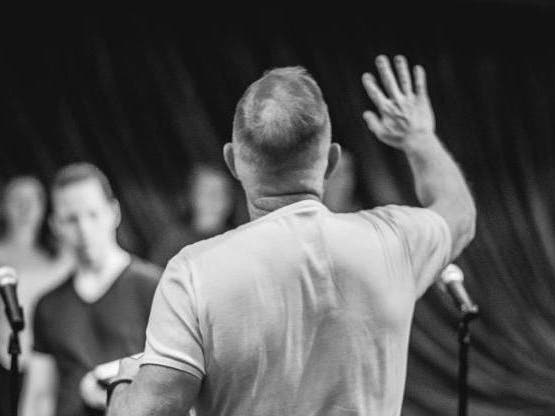
SOUTHAMPTON, NY —Beloved East End director and choreographer Michael Benton Disher, who has shaped the artistic vision of scores of young performers at the Southampton Cultural Center, is facing his greatest challenge. Paralyzed after cancer and brain surgery, he is now working to walk again — but is faced with obstacles in the form of mounting medical bills.
To that end, friend Robert Stafford has created a Facebook fundraiser for Disher, "Michael Benton Medical," to help defray his mentor's medical expenses.
Disher addressed his recent struggles in a letter to friends.
Find out what's happening in Southamptonfor free with the latest updates from Patch.
"Some of you are old acquaintances, new friends, dedicated actors and reasons a teacher wants to teach," Disher said. "All totaled, you are my history."
While there have been "bits and pieces" of his journey on Facebook, Disher said, "Many of the gory details were left out. My second brain surgery was supposed to be simple, an easy convalescence and 9 to 10 days in rehab. I awoke from the surgery without the use of my left arm and leg. Paralyzed. I had little hope."
Find out what's happening in Southamptonfor free with the latest updates from Patch.
After about two weeks of no food, no water, tube feeding and deterioration, Disher said he was moved to Grimes Rehab.
"I had no skills," Disher said. "I couldn’t walk, talk, focus, read, sit and barely swallow. Personally, I had lost hope. My life was a hospital bed, bedpans, wonderful nurses aides and a PT/OT team, one hour a day. Like Shakespeare’s seventh stage of man, I was at the seventh stage: second childishness and mere oblivion. Luckily, my brain and memory were still sharp."
Disher said he memorized the names of every nurse, aide, custodian and therapist.
"Each became my teacher, providing a puzzle piece of my recovery," he said.
Cards, notes, emails and visits, fed Disher's determination to regain life as he knew it. Each card and note was hung on the wall, a living testament to the community of friends and colleagues he has amassed over a lifetime of dedication to his craft.
But the struggle is far from over, and the financial strain is constant.
"Four months later, I can barely walk, can stand tall, can speak clearly and my left arm is still unresponsive," Disher said. "Yes, I’m typing this with one hand. Thank you all for your care and concern. Your notes got me past a very rough patch. Though, at home, I am still in therapy and struggling. But the obstacles are less daunting with my amazing support team — you. I love you all."
Stafford shared Disher's impact on his own life in a moving Facebook post.
"A friend from Center Stage recently asked me what had led me to join a theater group so late in life," Stafford wrote. "When my wife died 12 years ago my life ended and time stood still."
For something to do, Stafford joined the acting class at the Southampton Cultural Center given by Disher.
"He became aware of my situation and suggested that I take on the challenge of being 'someone else.' Nothing is an accident with Michael."
Disher assigned Stafford a scene to play with a woman who was a counselor at the Ross School, and the pair rehearsed, coming back to class each week for Disher's critique, Stafford said. One Saturday afternoon Stafford went out to Ross School so that they could rehearse together in an empty auditorium. When her husband came to pick her up they even invited him to their nearby home for a potluck dinner. A few weeks later, the course concluded and the pair's finale was presented in the basement rehearsal room at SCC to applause, Stafford said.
"Michael Disher has been a guide and mentor to so many of us," Stafford wrote. "We hold him in high esteem. Perhaps the one good thing that has come from this crisis is that it has given us the opportunity to express our appreciation. We are looking forward to having him back soon."
Stafford added, "Theater people are not known to be rich. I've always found it hard to ask for money, or even to accept it. But this is about family. In order to be creative one needs to be vulnerable. Perhaps the best thing to come out of this crisis is the thoughts and feelings that have been expressed that might not have otherwise been spoken. I've met people in this group who have made me a better person, for whatever that's worth. Yes, Michael is grateful for the money, because that will help cover his bills for a while and, most importantly, buy time. But I know Michael pretty well and I can tell you truly, truly that with Michael it's really not about the money. It's about you. On his behalf I say 'thank you.'"
Perhaps nothing expressed Disher's feelings about the lives he's touched more beautifully than a post he wrote before he stepped back from SCC recently to focus on his health.
"Since 1983, I have always had a show in production, a class to teach or a theatrical avenue to present some well-written words and/or music, presented with the hope of bettering a couple of our hours with that greatest of gifts — communication," Disher wrote. "How fortunate I was to know this opportunity for 37 continuous and consecutive years of my life. How fortunate I was to know my purpose throughout this lifetime and how fortunate I was to have known, worked with, taught and learned from so many organizations, artists, actors and wise wordsmiths. Sadly, this will not be the case this year. Choices have been carefully and crucially evaluated, calculated and heartbreakingly made."
He added, "Calendar and cancer now demand my complete and undivided attention. My focus must be one of aggressively tackling every available avenue of self-preservation and re-creation, if you will. The insurmountable pressure of producing a single show, much less a full season, is impossible. This is the hardest choice I have ever made and one that will, no doubt, take time and struggle to grasp and accept. . . Within my four decades of theatrical certainty and direction, I can no longer produce and present theater for Southampton. This pains me most, for it was my reason and in many ways my life."
However, he said life has taught him "cautiously, to never say 'never again.' Should my health improve — and it will — and opportunity present itself, I will certainly be calling upon your support, attendance and participation. Dialogue can continue. And should. Throughout this difficult period of adjustment, know that I thank you all for every moment we have shared in classrooms, theaters and upon stages where art and ideas pierced the darkness and perhaps the soul, dented the walls of ignorance and the unknown and allowed us to listen to what can be and remains possible. I wouldn’t have traded a moment of this life, this gift, for the world."
To donate and help with Disher's medical costs, click here.
Get more local news delivered straight to your inbox. Sign up for free Patch newsletters and alerts.