Health & Fitness
Why and How the H.M.S. Bounty Sank During Hurricane Sandy
The water in the engine room was over 6 feet deep.

It was the stuff that made boys dream and fantasize of days of old when such ships were the tickets for adventure on the high seas.
Anyone who visited and went board the H.M.S. Bounty on its last visit to Greenport last Spring, most likely had such a moment when they climbed aboard the historic replica.
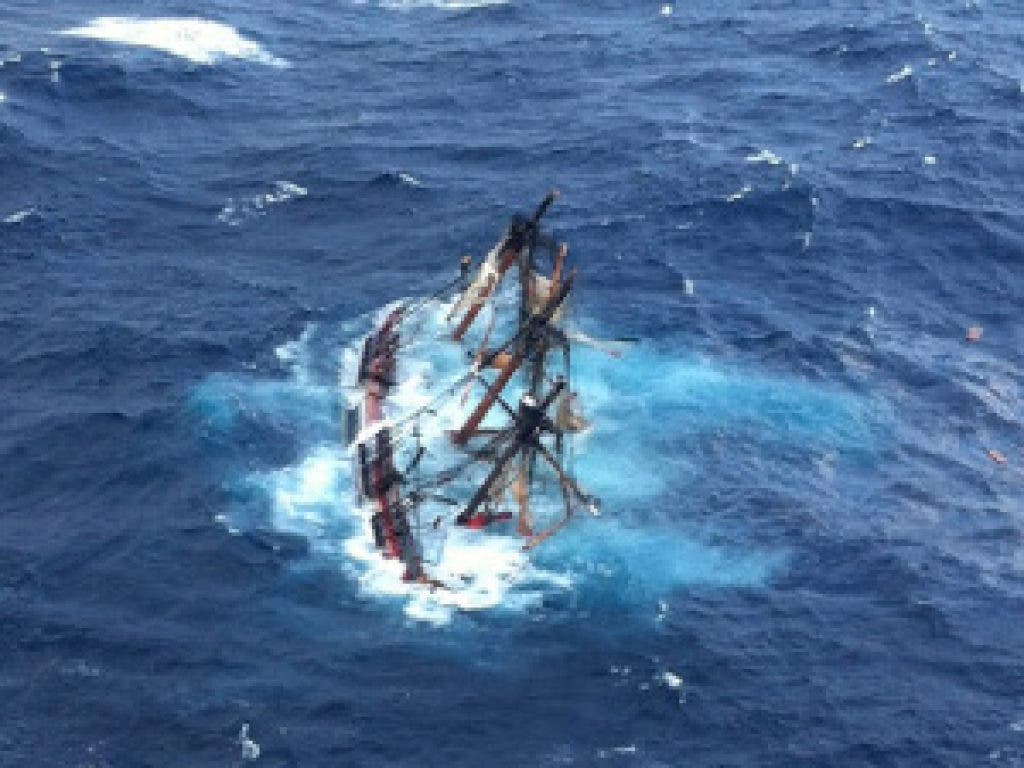
Of course, now the H.M.S. Bounty lies permanently at the bottom of the Atlantic, a victim to Hurricane Sandy.
Find out what's happening in Southamptonfor free with the latest updates from Patch.
The National Transportation Hearing Board and the U.S. Coast Guard have now had their hearings on the incident and although the official result will not be released until well after the summer, the facts of what made the ship sink are now obvious due to the testimony. The facts tell a story of a 50-year-old movie prop ship that, due to a lack of high-level expensive maintenance, eventually leaked more than most wooden tall ships, which led to its demise.
When it became exposed to 70-MPH-plus winds and 30-foot seas, the old boards that made up the ship, with some perhaps rotted or at least in need of replacement, augmented a flooding in the engine room. On the fateful day the crew frantically fought the rising flooded water with two generators powering the bilge pumps in a losing battle due to clogging caused by sawdust, woodchips, and other small items that eventually made the pumps so inefficient that the water coming in surpassed the water coming out. The details of how the water level went from 2 feet, to 4 feet, and finally to 6 feet, in the engine room (the ship had two diesel engines) and over, gives one the feeling of growing doom the crew felt as the they were 90 miles off the coast of Cape Hatteras listing in the high seas at the will of the full force of the hurricane.
Find out what's happening in Southamptonfor free with the latest updates from Patch.
The description of what happened when the rising water level caused electrical shortages and mini explosions along with complete bilge pump and generator shut down thus ending electrical capacity within the vessel. The sad story of an emergency gas generator that did not function also adds to a tragic story. In fact, believe it or not, the distress message to the Coast Guard was not sent by radio but by email after all attempts to contact anyone via the various radios failed. The crew "emailed" the H.M.S. Bounty office, which then notified the Coast Guard.
A few facts: The H.M.S. Bounty was not licensed by the Coast Guard to take passengers out to sea, but just for tours. In the last 10 years, two attempts were made to repair rotted boards, but both while expensive were not extensive enough to do the complete job. There were no deep pockets to pay for such repair. The New York-based HMS Bounty Organization did what they could. Before the Bounty left there was some repair work and concern about the hull. The H.M.S. Bounty sank off the coast of North Carolina during Hurricane Sandy. The 180-foot, three-mast ship — which was built for the 1962 Marlon Brando movie, "Mutiny on the Bounty" — was a replica built based on a British transport vessel. It had appeared in a few other motion pictures, most recent being the 2006 Johnny Depp movie "Pirates of the Caribbean: Dead Man's Chest."
The tall ship had sailed out of Connecticut for St. Petersburg, Fla., its home port, and where tickets for tours in the next week had already been sold. Bounty Capt. Robin Walbridge’s decision to sail off Cape Hatteras, N.C., during a hurricane has been questioned by almost everyone who owns or owned a boat, yet Captain Walbridge was known to claim that a ship is safer at sea than in port during a storm. He intended to skirt around the hurricane. But late Sunday of the storm, when the ship apparently lost power and began taking on water as it tried to make its way around Cape Hatteras, it was doomed. Captain Walbridge was born in Vermont, but he grew up in Florida. His family reportedly said Walbridge developed a love of sailing in his early teens. Research says young Walbridge began his nautical career as a houseboat mechanic on the Suwanee River. Next he rose to captain the Governor Stone, Vision Quest, and Bill of Rights achieving his 50-, 100- and 500-ton captain’s licenses.
Finally, he received a commission on the tall ship HMS Rose, from there fate took his expertise and services to the Bounty in 1995. He also served as guest captain on the USS Constitution when it made its inaugural sail in 1997, after the ship had sat dockside for 116 years. In the end, 14 survived, Captain Walbridge and another crew member did not. The captain of another historic tall ship, the Pride of Baltimore II,(Also at Greenport last Spring) Jan Miles summed up Walbridge's actions concerning taking the H.M.S. Bounty out into the hurricane during the hearings in four words: "reckless in the extreme."