Community Corner
Tears, Painful Truths, Hope At Task Force's 2nd Opioid Forum
A former Long Island town councilman was one of many who shared his story of opioid addiction at emotional opioid forum Wednesday.


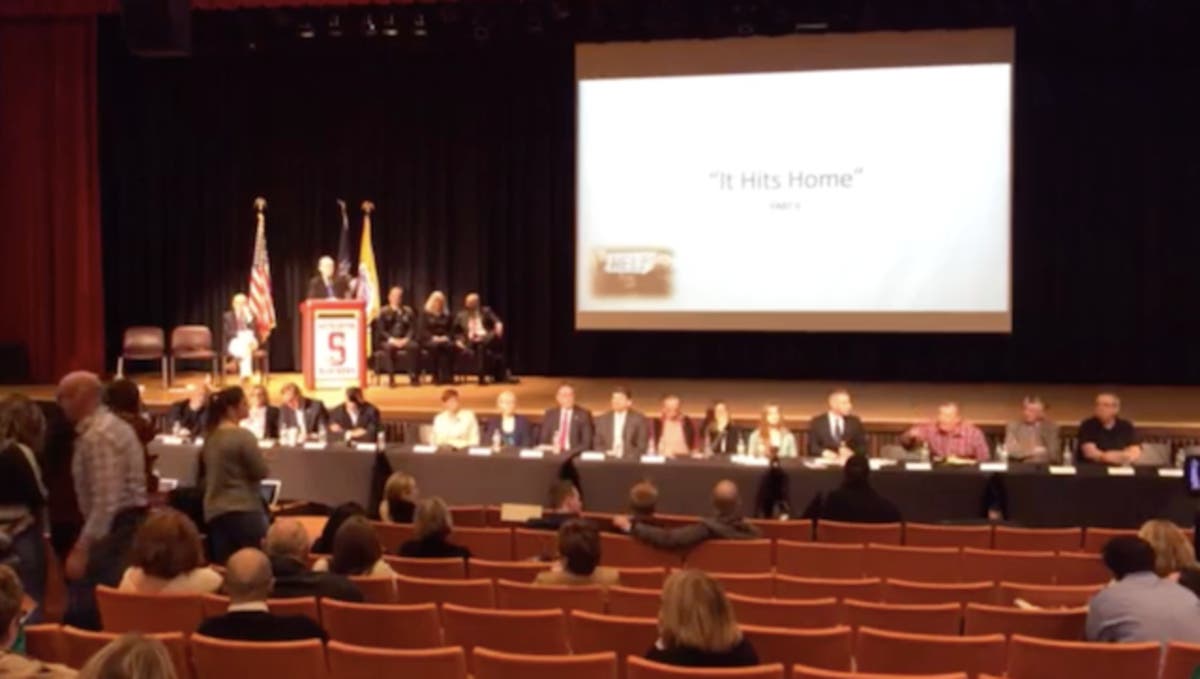
SOUTHAMPTON, NY — Stories of heartbreak and hope intermingled Wednesday night as the human faces of the opioid crisis, raging from young to old and from all walks of life — including former Southampton Town Councilman Brad Bender — stepped forward to share their painfully honest truths in the hopes of creating change.
The Southampton Opioid Addiction Task Force hosted its second public forum, "It Hits Home, Part II" at Southampton High School.
"No drugs, no gangs"
Find out what's happening in Southamptonfor free with the latest updates from Patch.
Southampton Town Police Chief Explorers, a group of young people enrolled in the program to learn about law enforcement, began the evening with a message, holding letters that read, "No drugs, no gangs."
Southampton Police Chief Steven Skrynecki spoke, presenting statistics "that appear to show the number of opioid deaths are slowing down," said task force co-chair Drew Scott. "At this time last year we had seven overdose deaths. This year we have only one — but that’s still one death too many."
Find out what's happening in Southamptonfor free with the latest updates from Patch.
He added, of the event, which drew about 100 attendees, "I was so glad to hear new stories of recovery and sobriety."
Pam Stark, a retired Nassau County Police Department detective who served as the department’s substance abuse awareness coordinator to combat the opiate/heroin epidemic, working closely with schools in the “Too Good for Drugs” program, said prevention and education are critical.
Addiction hit home for Stark: Her mother, when told of her daughter's work in prevention, told her, "'You can bring the gifts of being from a family of addiction.' I said, 'Mom, yours was alcohol.' She told me, 'Pam, if someone had brought me heroin I would have used it.'"
Her mother was 86 years old when she told that story, celebrating 40 years of sobriety — illustrating the fact that addiction cuts a devastating swath across all racial and demographic boundaries, Stark said.
To reach kids in a technological age, Stark said it's critical to communicate, to talk and listen. Those talks, she said, need to take place across the board, including houses of worship.
John Venza, vice president of adolescent and residential services for Outreach Development Corporation in Brentwood, knows all too well the horrors of the opioid crisis: He lost his son, Garrett, 21, to an overdose in 2016.
Showing a heartbreaking series of family photos, Venza said, of his family: "We did science projects like everyone else. Went to football games like everyone else. Went to Disney like everyone else."
His son, he said, "was a heck of a wrestler" and spent 14 years pursuing martial arts.
"He had zero fear. I wish he'd had just a little bit of fear," Venza said.
His story is proof that just as oncologists lose their sons and daughters to cancer, professionals working in the prevention field lose their children to addiction, he said.
"For all the people that are still struggling with the shame and stigma. . .don't be ashamed. There is no stigma. These are just kids that made a bad choice," he said. "Remember the five worst things you did at 17 or 18. . .they shouldn't have had the consequence of death."
Venza said he believes substance abuse doesn't begin with opioids. "The gateway theory is very real," he said, adding that marijuana today is much stronger than years ago. While he said not every kid who smokes marijuana will become a heroin addict or opiate abuser, most all heroin and opioid addicts smoked pot on a regular basis first, he said.
Kids, he said, need healthy, caring adult role models beyond just their parents; those can include coaches and teachers.
His son began to struggle after he had a blot clot disorder and never went back to martial arts or wrestling. "That was the beginning of the end, because his protective factors were compromised," he said.
"We are not going to arrest ourselves out of this epidemic"
Suffolk County District Attorney Tim Sini spoke about the efforts countywide to fight the crisis. "Addiction is a disease and it must be treated accordingly," he said. "We are not going to arrest ourselves out of this epidemic. It's a public health issue, first and foremost."
Sini spoke at length about enforcement efforts in Suffolk County, including working with the Drug Enforcement Administration to target drug traffickers and dealers. Fentanyl, he said, "has become a full blown epidemic" and is a critical danger because it can be manufactured anywhere.
A hot line, 631-852-NARC, was created so residents can reported suspected drug sales and activity; the tips have led to an uptick by more than 250 percent in narcotics search warrants since he served as police commissioner, Sini said — and those warrants have led to the recovery of deadly drugs and firearms from the street.
"We’re not going to make it easy for drug dealers to peddle poison on our streets," Sini said.
Sini also said he'd like to see legislation holding drug dealers accountable for overdoses. "If you make the decision to sell poison and you kill someone, you should be charged with murder. It should be that simple," he said.
The DA's office, he said, has a two-pronged philosophy: First, to crack down hard on drug dealers and second, to look at intervention opportunities for low level offenders being arrested and charged with larceny or possession due to their addiction.
Prevention, Sini agreed, is essential and will "help us get out of this epidemic — and prevent the next one."
Stories from the addiction battlefield
The stories echoed with pain: A man, 75, who had a successful career but saw his life derailed after a torn rotator cuff and surgeries led to a carousel of opioids being prescribed. "Two more spinal surgeries and they just keep writing them and writing them," he said. "I'm not an addictive personality but I did what I was told." Today, he's found alternatives and has not touched an opioid in nine months.
Scott said at the task force's medical forum it was revealed that there are new restrictions that mandate opiates such as Oxycontin can't be prescribed for more than seven days. "The state is getting the message and clamping down."
Kathleen McCabe, in long term recovery and the widow of an "opiate OD casualty" said she heard the story of Scott's granddaughter, Hallie, who died tragically of an overdose and was left on an East Hampton road. Hallie's story, she said, touched her and motivated her to become active for change. She agreed prevention is the key.
Others in attendance said that today's generation, who have been so eloquent and educated after the Parkland shooting, "give so much hope." She suggested that the younger generation be inspired to fight back against the opioid crisis in the same way. "They are watching their friends die," she said. "I think we need to give the baton to them."
Members of the task force pointed out that youth forums have been presented.
Others said it might be helpful to have speakers who were younger and "cool." One attendee said, "Stop with the old people and Power points. They want people around their own age to talk to them."
A young member of the task force, Mackenzie Jenkins, 16, attends Westhampton Beach High School and is also Scott's granddaughter. She said it would be helpful to have people speak firsthand from experience, rather than just share information from books. And, she said, society needs to be more loving toward one another.
Another woman urged locking up the alcohol and medicine chests. "Schools need to take a first responder approach and not turn a blind eye to drugs," she said. "Drugs are just as dangerous as guns."
One volunteer from the Bridgehampton Fire Department said kids are doing drugs "as we speak." He said the panel was needed years ago during the crack epidemic.
Another man from the hispanic community offered to help with outreach.
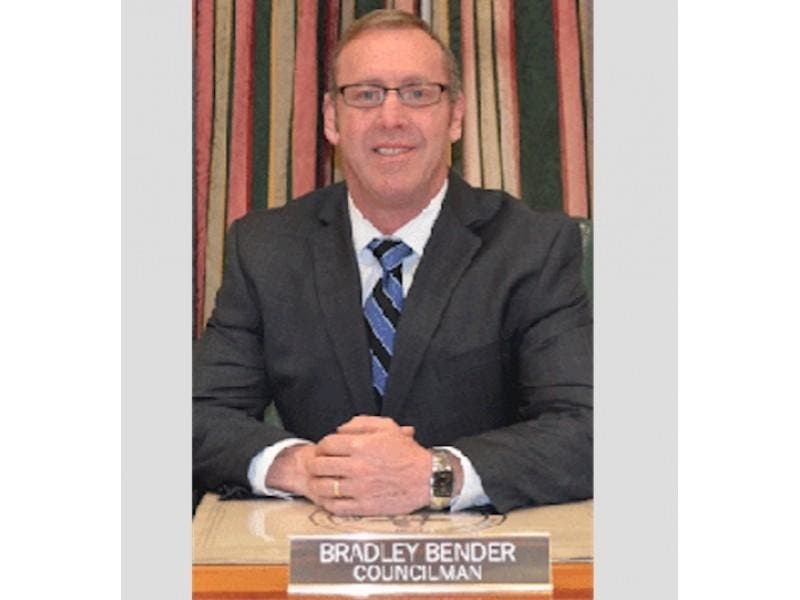
Bender introduced himself as a "grateful recovering addict" and former councilman.
He spoke from the heart of his journey: Bender was sentenced to two years in federal prison after pleading guilty to a charge of conspiracy to illegally distribute oxycodone.
He described showing up in a basement for an AA meeting, where he worked the 12 step program, did 90 meetings in 90 days, and found support. "Two and a half years later I'm still clean and still carrying the message," he said.
Bender said his was a "medically induced opioid addiction."
He also had a torn rotator cuff and back surgery; he needed 12 weeks of narcotics before his insurance company would approve an MRI, he said. Then, with pain management came even more narcotics, including injections in his back, he said.
He said he was "overmedicated" by an "unscrupulous doctor." Bender said he "shared" his medication "with a single third party who sold it — and I went to prison."
Bender said he can wear the truth on his sleeve now. "I don't have to run and hide from what I did."
His voice laced with bare honesty, Bender said, "The most disappointing thing is that after my indictment, I was alone. The only people that came to me were the people in the basement of that church."
Southampton Town Supervisor Jay Schneiderman, co chair of the task force, also called him, he said.
The epidemic encompasses all, he said.
"How many times, how often, are we going to turn our backs on our sick and our dying. Why close the door on the people you love, close people out of your lives, because they have an addiction or a problem?" Bender asked.
Discussing what led to his addiction, Bender said, "I didn't feel good about myself. I feel good about myself today."
His arrest was his very first run in with the law; before then he'd only had one violation for a seat belt, Bender said. Prison and halfway houses, he said, are not safe places, with heroin sold at a Chinese restaurant nearby.
Dearth of activities for young people
Another woman said prevention needs to be spotlighted earlier than high school. She asked why only one mandatory lesson on opioid addiction was offered in 180 days of school.
Others said there's not enough to do on the East End for kids, especially in the winter, and suggested dances, yoga, and other activities. She asked why only only one lesson is given in 180 days of school on the opioid crisis.
Southampton School Superintendent Nicholas Dyno said there have been two youth forums but agreed more assemblies could be held.
High school students spoke about the harsh realities on the East End, where drugs are sold behind supermarkets and at gas stations, where kids are doing cocaine behind closed doors in school bathrooms, with kids who are caught suspended only for a few days before they are back in school again as though nothing had happened.
One parent asked what take home message he could bring home to his kids.

Sally Gillies, Hallie's heartbroken mom, spoke. "If anybody had a chance, Hallie did. There's nothing you can do but show love."
Mark Epley, former Southampton Village Mayor and also CEO of the Seafield Center, offered advice: "Talk to your kids. Be involved. Be present. Evaluate what you are doing. If you are going out partying — that's what they will do."
Another man said his son was a half mile from their home, working at a fast food restaurant to save money for his first car when the manager, a married man with kids, turned him on to heroin.
"How well do you know the manager of the fast food restaurant. Have you vetted these people out?" he asked.
Other students pointed out that there are few programs such as Human Understanding and Growth Seminars, such as HUGS, or health classes; they also said programs should be made affordable or offered for free.
Voices filled with tears, girls from East Hampton said they see drugs all around them but no punishment for students.
Lars Clemensen, superintendent of the Hampton Bays School District, said it must be frustrating to be doing the right thing and and see someone who isn't, back in class five days later.
Other students said help for mental health issues is important but not readily available.
An eleventh grader from East Hampton High School sobbed as she described drugs sold behind stores and a dearth of programs. "I have a cousin that was found face down on the lawn after experimenting with alcohol and drugs. He's okay now, but they are selling drugs everywhere. So many of my friends are doing it and just won't stop."
Southampton Youth Bureau Director Nancy Lynott agreed programs are not accessible or affordable and said the lack of transportation is also a huge stumbling block.
Another man, 26, clean two years, said a sober house saved his life but pointed out none are available in East Hampton or Southampton. Insurance also needs to cover treatment beyond 28 days, he said.
A speaker also pointed out that the public needs to know that due to the 911 Good Samaritan law, even if there are drugs present, if someone is overdosing, those with them can call for help without fear of arrest.
The task force's efforts will continue: Next, on May 12 from 7 p.m. to 9 p.m., a candlelight vigil is planned for Good Ground Park in Hampton Bays.
"It is Mother's Day weekend. As such, we thought the Saturday night vigil would be poignant — to come together as a community to remember those who have been lost to the opioid epidemic," Scott said.
He added, "We still have a great deal of work ahead but we are making progress. Thanks to each of you for giving your time and effort to help save lives."
Patch file photos.
Get more local news delivered straight to your inbox. Sign up for free Patch newsletters and alerts.