Community Corner
Giant Hogweed Season: Plant Causes 3rd Degree Burns, Blindness
Dutchess and Putnam counties have the most giant hogweed sites in the Hudson Valley. If you find one, don't touch it. Here's what to do.


PUTNAM COUNTY, NY — New York State Department of Environmental Conservation is fighting the large, invasive and dangerous plant called giant hogweed in Dutchess and Putnam counties.
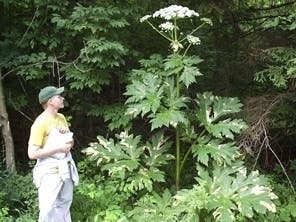
Giant hogweed can cause severe skin and eye irritation, including painful burns and scarring when skin exposed to its sap becomes more sensitive to UV radiation. The plants are currently blooming, so they're easy to spot. If you do see giant hogweed, please do not touch any part of it.
Instead, carefully take photos of the entire plant (stem, leaves, flower, seeds), note the location, and send a report to the DEC.
Find out what's happening in Southeast-Brewsterfor free with the latest updates from Patch.
Statewide efforts to control giant hogweed are making headway, said DEC Commissioner Basil Seggos. The Giant Hogweed Program, managed by DEC’s Division of Lands and Forests, is in its 12th year and has eradicated the plants from 623 sites, with another 448 plant-free sites being monitored.
“With the assistance of our local partners, DEC’s Giant Hogweed Program has made excellent progress in removing this dangerous invasive from New York communities,” said Seggos. “DEC not only works to eradicate this health hazard, but also to raise public awareness about how to recognize it, avoid it, and report it. We urge New Yorkers to stay vigilant and report potential giant hogweed to DEC, especially during the next few weeks as the plants begin to bloom and become more noticeable.”
Find out what's happening in Southeast-Brewsterfor free with the latest updates from Patch.
Over the years, DEC and its regional and municipal partners have confirmed 2,484 giant hogweed sites in 51 counties. Most active sites are concentrated in Central and Western New York. Dutchess and Putnam counties are the two most affected in the Hudson Valley.
.jpg)
With landowner permission, crews visit and remove these invasive plants using root-cutting, herbicide, and umbel (flower head) removal control methods.
DEC released a 2018 Annual Report, which details the progress being made to identify giant hogweed and eradicate this noxious weed. During the 2018 season:
- Crews visited 1,993 sites to survey for or control giant hogweed;
- No plants were found for the third consecutive year at 118 sites, bringing the total number of eradicated sites to 623 – an increase of 25 percent from 2017;
- Of all sites previously treated for infestation, 43 percent (1,071 sites) had no plants in 2018;
- Crews removed approximately 678,000 plants from 1,271 sites during the 2018 field season;
- Stream surveys were conducted for the first time last year. Crews searched upstream for additional infestations that may have contributed to known giant hogweed locations from seeds being carried downstream. A two-person crew visited 317 stream-side properties, surveyed 37.6 miles of stream frontage, and found 76 new infestations;
- Of the sites statewide that still had plants, 71 percent (1,005) had less than 100 plants and are considered small sites that can be eradicated relatively quickly. DEC expects many more of these sites to have no new plants in the next few years; and
- Larger sites are responding well to control. Many larger sites that required herbicide treatment are now small enough to be treated by root cutting. Fewer sites have large flowering plants and, in general, sites are patchier than in previous years.
In addition to working with regional and municipal partners, the public has been an invaluable partner in DEC’s Giant Hogweed Program, by submitting about 2,000 location reports via phone calls and e-mails each year.
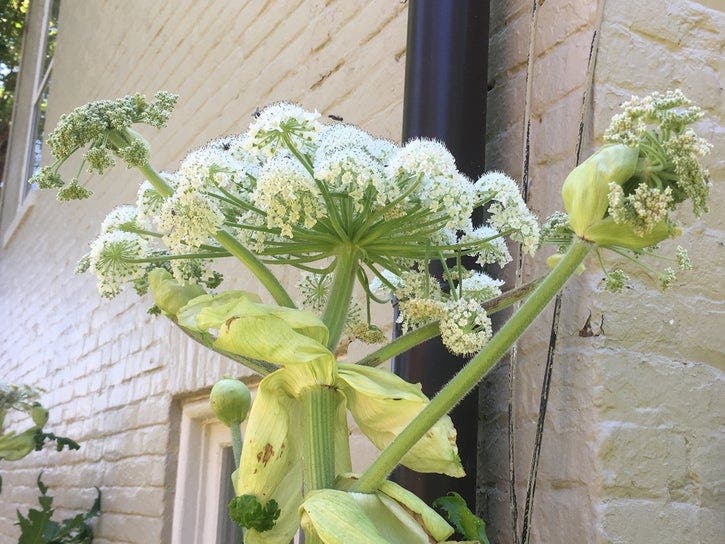
Giant hogweed is currently flowering, making this one of the easiest times of the year to locate the plant. Flowering giant hogweed are eight to 14 feet tall and have large, flat-topped clusters of small white flowers, a green stem with purple blotches and coarse white hairs, and large leaves up to five feet across.
If you find giant hogweed, please do not touch the plant, take photos of the entire plant (stem, leaves, flower, seeds), note the location, and send a report with the information via email to ghogweed@dec.ny.gov, text to 518-320-0309, or call the Information Line at 845-256-3111.
If confirmed, DEC will contact the landowner to discuss control options. To report and learn more about other invasive species, the public can use the iMapInvasives database and mapping tool that helps share and coordinate information about detections and response efforts.
In addition to health concerns, giant hogweed negatively affects the state’s ecosystem by crowding out native plants and contributing to soil erosion. As a noxious weed, giant hogweed is unlawful to propagate, sell, or transport.
It was brought to this country as an ornamental landscape plant. Virginia officials were upset when it was ID'd for the first time there last year.
For more information about giant hogweed, including eradication efforts, plant ID, or to view the 2018 Annual Report, visit DEC’s website.
Get more local news delivered straight to your inbox. Sign up for free Patch newsletters and alerts.