Community Corner
3 Worried Women Host Vigil for Ukraine At Putnam Courthouse
The quest for freedom brought war to Ukraine, said one of the emigres who can hear the shelling and see her mom cry during phone calls.


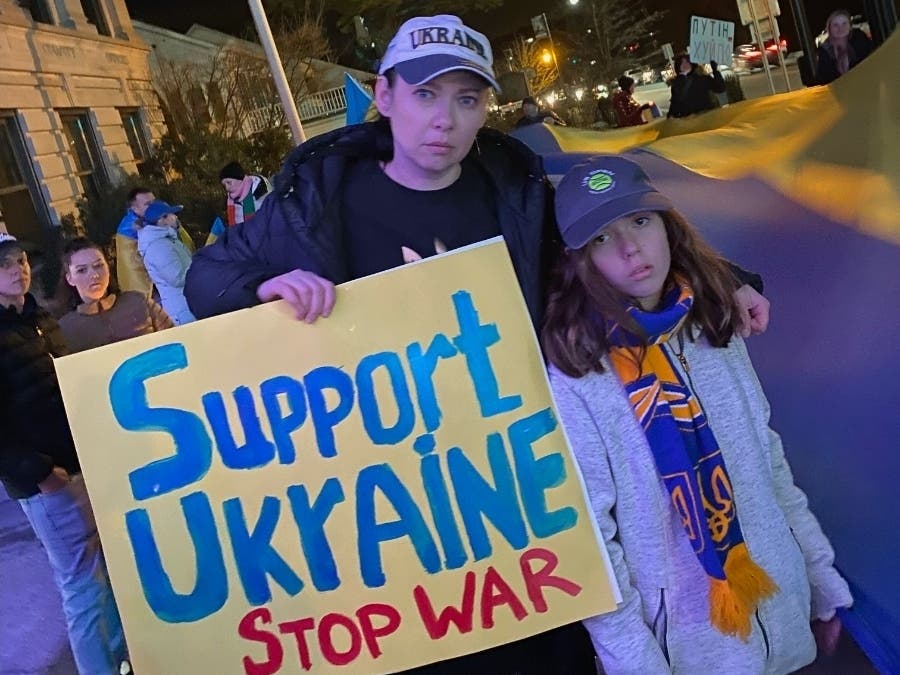


PUTNAM COUNTY, NY — For three Putnam residents, the Russian invasion of Ukraine is hitting all too close to home.
Iryna Galas, Svitlana Lazaresku and Yana Maksimova, who organized a vigil this week on the steps of the historic County Courthouse, are among many Hudson Valley residents with relatives and friends in Ukraine — and with hearts breaking because of it.
Lazaresku, who has lived in Carmel since 2004, said she grew up in a Ukrainian city of 200,000 people speaking three languages.
Find out what's happening in Southeast-Brewsterfor free with the latest updates from Patch.
"Never had any issues speaking Russian, in fact my father speaks Russian and so does my US-born son," she told Patch. "We did not need to be saved, we were doing fine. All the civilians and children that are being slaughtered back in Ukraine did not ask for this, they never asked for this 'help' and 'protection' from Putin. He thought he would destroy us but instead he united all the Ukrainians and the whole world around us.
"I am standing here with my fellow Ukrainians and everyone who came to support us. The victory is on our side, because we came with peace."
Find out what's happening in Southeast-Brewsterfor free with the latest updates from Patch.
Galas moved to the United States in 2009, after the "Orange Revolution" — which she took part in — led her to what she termed the "devastating realization that the 'iron fist' of Russia would never let go."
She shuddered at the events of 2014, when protests over the Ukrainian government's pivot away from Europe led to massive protests and the "Revolution of Dignity" which was followed all too quickly by Russian annexation of Crimea and its subsequent Donbas incursion.
"And here we are again," she said. "My parents are currently in Ukraine, refusing to leave. With both of them born and lived most of their lives in the Soviet Union, having 'relatives' and dozens of friends in Russia, this war is a complete end of their world, everything they knew."
Maksimova, who emigrated with her husband 14 years ago, also fears for relatives who share deep connections with the country now bombing them.
"My grandmother, 89, and my mom are from the heart of Russia. They moved to Ukraine back in the USSR, but Ukraine became their home! They know and respect the Ukrainian language, national traditions and just love the land where they lived most of their lives, the land where their children, grandchildren and great-grandchildren were born," she told Patch. "And where are they now? Deep down in the basement, hiding from the attacks of their own people!"
On Friday, Russian troops seized the biggest nuclear power plant in Europe after a middle-of-the-night attack that set it on fire and briefly raised worldwide fears of a catastrophe in the most chilling turn in Moscow's invasion of Ukraine yet.
The attack evoked memories of the world’s worst nuclear disaster, at Ukraine’s Chernobyl. In an emotional nighttime speech, Ukrainian President Volodymyr Zelenskyy said he feared an explosion that would be “the end for everyone. The end for Europe. The evacuation of Europe.”
Firefighters put out the blaze, and no radiation was released, U.N. and Ukrainian officials said, as Russian forces pressed on with their week-old offensive on multiple fronts and the number of refugees fleeing the country topped 1.2 million.
A round of talks between Russia and Ukraine yielded a tentative agreement Thursday to set up safe corridors to evacuate citizens and deliver food and medicine. But the necessary details still had to be worked out.
Ukrainian presidential adviser Oleksiy Arestovich said battles involving airstrikes and artillery continued northwest of Kyiv, and the northeastern cities of Kharkiv and Okhtyrka came under heavy strikes.
“The humanitarian situation is tense,” he said.
Frequent shelling could be heard in the center of the capital Kyiv on Friday, although more distant than in recent days, with loud thudding every 10 minutes resonating over the rooftops. Battles have knocked out the city’s electricity, heat and water systems, as well as most phone service, officials said.
"At some moments I feel sorry for Russians — they've never seen any better, they don’t know any better. Generations were depressed, and live in fear. But then I call my mom, see her tears, hear the terrifying sound of the sirens and these moments of weakness just disappear," Galas told Patch. "And here I am sitting at my some 500 sqft., warm, rented apartment with a full fridge and thinking how MUCH I have! And how little I can do to help ..."
The freedom to make basic choices, such as what country to live in or what language to speak, may seem obvious to Americans, Galas said, but it's a reason for war in Ukraine, and not only there.
"We can not stay silent," Maksimova said. "Stop Russian aggression! It hurts, it’s terrifying and it has to be stopped. You have to understand — Ukraine today, the world tomorrow!"
The Associated Press contributed to this report.
Send local news tips and correction requests to Lanning.Taliaferro@patch.com
Sign up for Patch email newsletters. Learn more about posting announcements or events to your local Patch site.
Get more local news delivered straight to your inbox. Sign up for free Patch newsletters and alerts.