Politics & Government
Feds' NYC Storm Barrier Plan: Meetings Wednesday In Westchester
After public outcry about potential damage to the Hudson River, the Army Corps of Engineers agreed to a public forum in Westchester.


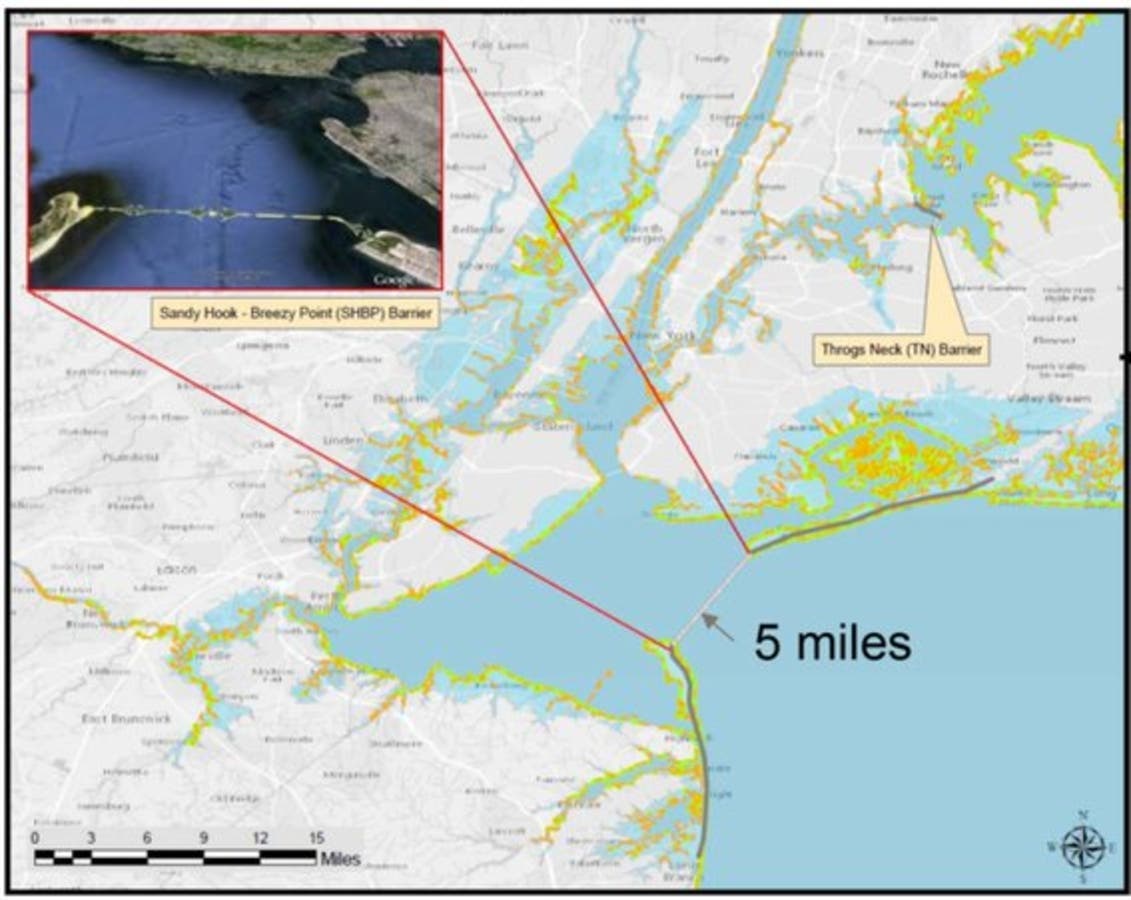
HUDSON VALLEY, NY — The U.S. Army Corps of Engineers will hold two forums in White Plains Wednesday to explore the effect on the Hudson River of building massive in-water barriers or land-based floodwalls, dunes and levees to protect New York City from storm surge flooding. The meetings were not on the Corps' original schedule, but activists and politicians forcefully pointed out that shutting off the Hudson River estuary would have an enormous impact far upstream and should be considered.
During its early July meetings, the Corps also failed to address sea level rise, advocates complained. They also questioned the sudden fast-tracking (for example, 12 days notice of the first meetings).
So, on Oct. 3, the Corps, the New York Department of Environmental Conservation, the New Jersey Department of Environmental Protection, and Westchester County Executive George Latimer will host two scoping meetings for the New York – New Jersey Harbor and Tributaries Coastal Storm Risk Management Feasibility Study.
Find out what's happening in Tarrytown-Sleepy Hollowfor free with the latest updates from Patch.
The $19.4 million study affecting more than 2,150 square miles – the shorelines of New York City, New York Harbor, northern New Jersey, western Connecticut and the Hudson up to Troy — is being done with the DEC and the New Jersey Department of Environmental Protection, in a partnership with several other agencies, including New York City.
Wednesday's meetings will be held at the Westchester County Center, 198 Central Ave., in White Plains, with the first meeting from 3 - 5 p.m. and the second from 6 - 8 p.m.
Find out what's happening in Tarrytown-Sleepy Hollowfor free with the latest updates from Patch.
But many say more needs to be done.
"We've finally been recognized but I would not say we're sitting at the table yet. We were able to get the USACE's attention through determination, diligence, and a concerted effort by the public, government officials, environmental groups, and community organizations," said State Senator Terrence Murphy (R,C-40th), who had argued for a meeting in the lower Hudson Valley in addition to the one held in Poughkeepsie. "But more needs to be done to improve the overall process. Tomorrow we have the opportunity to raise our voices and speak out against short-sighted decision making before the comment period closes on November 5th. I'm urging everyone to attend a meeting so we can listen, ask questions, and let our opinions and concerns be heard."
The USACE is considering six different plans for coastal storm protection, most of which call for construction of massive, in-water barriers in New York Harbor that would choke off the Hudson River Estuary where it meets the ocean. The barriers, resembling giant gates, would restrict tidal flow, blocking the migration of fish and trapping sediment, sewage, and other contaminants. The barriers would not protect against inevitable flooding from a rise in the sea level.
One plan under consideration calls for a surge barrier at the mouth of the harbor from Sandy Hook, New Jersey to Breezy Point in Queens.
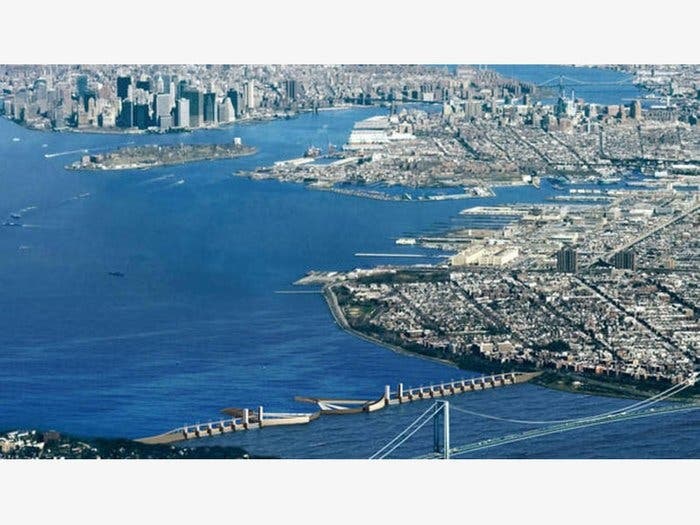
Alternative plans include multiple shorter barriers from Staten Island to Brooklyn and at various other locations blocking tributaries. The cost for the project has been estimated as high as $50-60 billion and could take decades to complete. Concerns have been raised that it could cause worse flooding in certain areas and harm nearby beaches. Environmentalists have raised concerns for many species that call the Atlantic Ocean home, including some that are on the endangered list.
"The federal government has done little to protect and restore the Hudson, compared to other major estuaries," said John Cronin, former Riverkeeper and senior fellow for Environmental Affairs at Pace University. "Instead, it has a long history of reckless proposals that would further damage the river. The latest Army Corps proposal is the worst I have seen in my 45 year career."
In early July, the Army Corps of Engineers held a series of meetings to explore the impact of offshore barriers and set the period for the public to comment at 40 days. Shockingly, hard-working families in the Hudson Valley, the ones most affected by the USACE's actions were left up the river without a paddle, Murphy said.
Because of the protests, the comment period was extended to Nov. 5.
"It's good that the Army Corps is listening to the massive public and elected outcry and first granted a comment period extension and now another public meeting," said Jessica Roff, Director of Advocacy and Engagement for Riverkeeper. "But these last minute extensions that come in fits and starts are not addressing the fundamental weakness in their process: a lack of transparency and information sharing and their severe lack of community engagement. The Army Corps needs to start this process over with truly meaningful engagement, and that engagement needs to extend from Long Island to Staten Island to New Jersey, Connecticut and throughout the Hudson Valley."
Get more local news delivered straight to your inbox. Sign up for free Patch newsletters and alerts.