Community Corner
Proposed NYC Storm Barriers Could Hurt The Hudson: Riverkeeper
The Corps of Engineers just announced five meetings next week to discuss the plans.


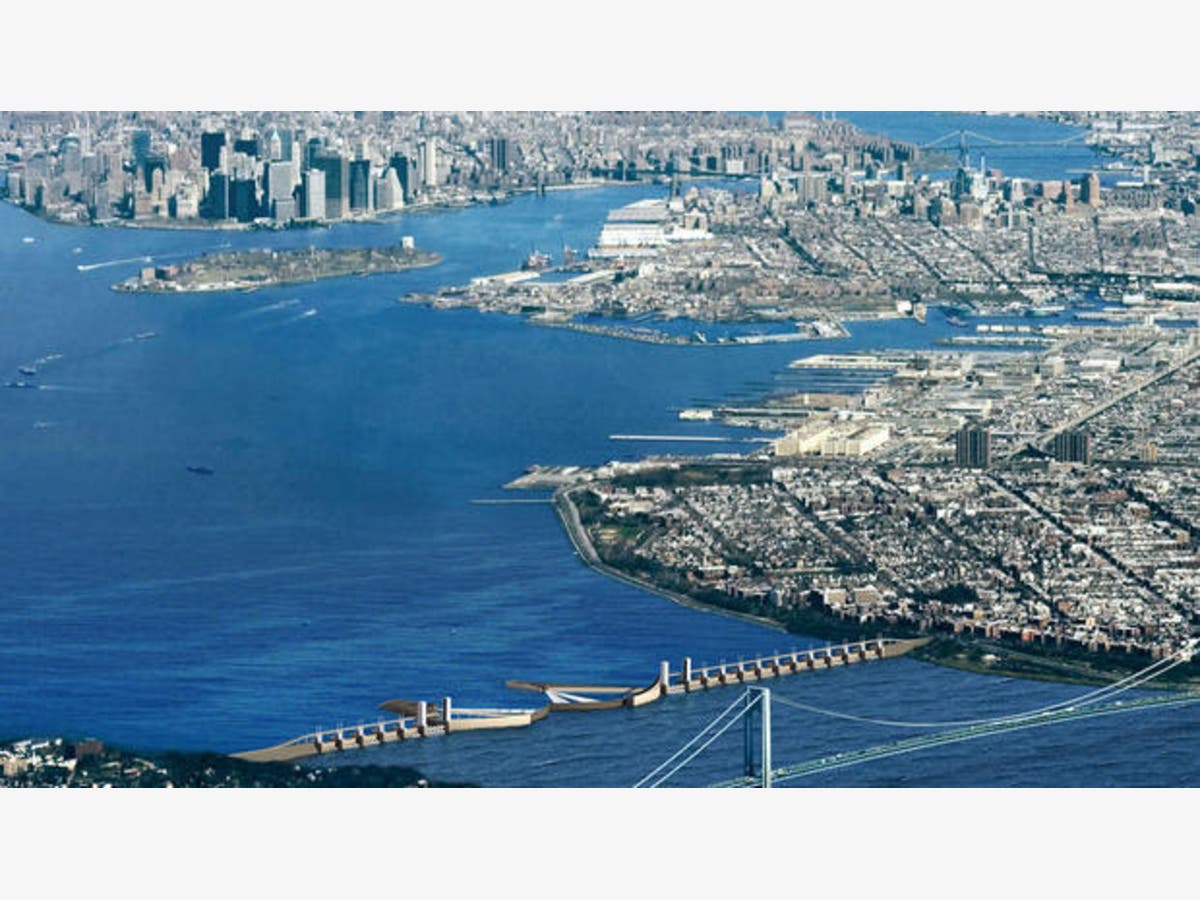
The U.S. Army Corps of Engineers just announced a series of meetings in New York and New Jersey July 9-11 on six plans for massive in-water barriers or land-based floodwalls, dunes and levees to “manage the risk of coastal storm damage” to New York Harbor and the Hudson Valley.
The Corps is suddenly fast-tracking the project, to the dismay of many concerned about the health of the Hudson.
Five public "scoping" meetings are scheduled for July 9 in New York City, July 10 in Newark, N.J., and July 11 in Poughkeepsie. While there are two meetings in NYC and in New Jersey, there is only one in the Hudson Valley.
Find out what's happening in Ossining-Croton-On-Hudsonfor free with the latest updates from Patch.
"We've had six years to do something about coastal flooding and storm surge, and now with just 12 days' notice, there will be public meetings on a plan that could forever change the ecology, view lines and navigability of our river, and not a single one in Westchester-Rockland, the ecological heart of the estuary," said New York State Sen. Terrence Murphy, calling it worse than the Coast Guard's idea to put long-term anchorages up and down the Hudson River for oil tankers.
The six alternatives are under consideration as part of the New York – New Jersey Harbor and Tributaries Coastal Storm Risk Management Feasibility Study, affecting more than 2,150 square miles – the shorelines of New York City, New York Harbor, northern New Jersey, western Connecticut and the Hudson up to Troy.
Find out what's happening in Ossining-Croton-On-Hudsonfor free with the latest updates from Patch.
The Army Corps has stated that it intends to “winnow down” the six alternatives to “one to two alternatives,” by mid-2018.
That's now.
However, environmentalists are concerned that the Corps has not done a thorough review of the environmental impacts of each alternative, nor has there been meaningful public input and participation.
Plus, said John Lipscomb, patrol boat captain and vice president of advocacy for Riverkeeper, "Massive in-water barriers with gates that regularly open and close for shipping will do nothing to protect New York City and Hudson River communities against sea level rise."
The $19.4 million study is being done with the New York State Department of Environmental Conservation and the New Jersey Department of Environmental Protection, in a partnership with several other agencies, including New York City.
The next phase of the study involves examining the six measures, including taking no action, which warrant further investigation to better manage coastal flood risks that remain in the region. The Corps says a full range of risk reduction measures are going to be offered to communities and include structural, nonstructural and natural and nature-based features designed to reduce the frequency and intensity of flooding, such as floodwalls, levees, beach fill, dunes and offshore bars.
Lipscomb blogged about the ecological dangers:
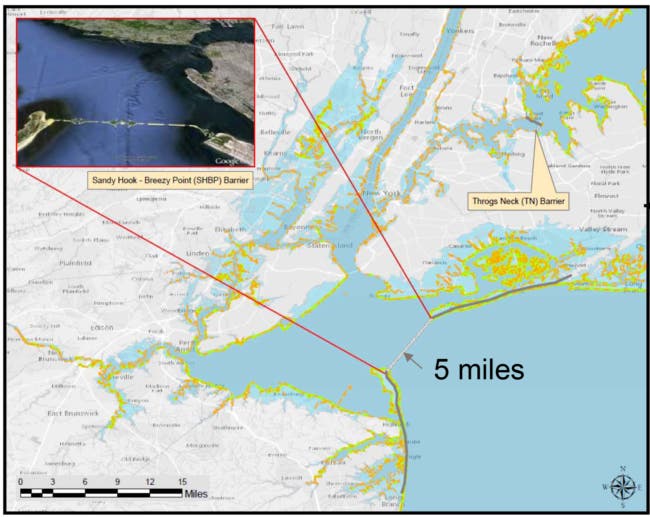
We all know that sea level rise and more frequent, intense storms require planning and action. But there is a difference between building more protective, resilient shorelines over time, and installing massive, in-water barriers that threaten to change the Hudson River and New York Harbor ecosystem forever. Two of the Army Corps’ six alternatives propose massive barriers designed to entirely close off the harbor and river from the Atlantic.
These in-water barriers are billed as protecting against “storm surge” – the above-normal, temporary rise of sea level produced by a coastal storm – and would have gates that allow for ship transit and for limited tidal movement in fair weather.
From Day One, these offshore barriers would start to restrict the tidal flow, contaminant and sediment transport, and migration of fish. They would impede the tidal “respiration” of the river. We fear that a slow death would be inflicted on the river, and that in time, the barriers would slowly, but surely, strangle the life out of the river as we know it.
They would significantly restrict migrations of striped bass, Atlantic sturgeon, herring, shad, eel and other species essential to the Hudson estuary. They would prevent the ocean tide from flushing New York Harbor, causing contamination to be more concentrated there. And they could restrict rainstorm flood waters, like those we experienced during the massive rainfall of Irene and Lee in 2011, from leaving the Hudson.
Unrestricted tidal exchange is essential to move sediment and flush contaminants. If tidal exchange is restricted, the harbor would require much more dredging to maintain shipping channels. Sewage and other contaminants would flush to the ocean more slowly, resulting in more pollution for our already contaminated harbor and river. Higher nutrient levels would lead to more frequent algae blooms and lower dissolved oxygen essential for aquatic life.
Want to attend one of the five meetings?
- Monday, July 9th, 3-5 p.m. and 6-9 p.m. at the Borough of Manhattan Community College in Tribeca, Richard Harris Terrace (main floor). 199 Chambers St, New York, NY 10007
- Tuesday, July 10th, 3-5 p.m. and 6-8 p.m. at Rutgers University-Newark Campus, PR Campus Center, 2nd Floor, Essex Room. 350 Martin Luther King Jr. Boulevard, Newark, NJ 07102
- Wednesday, July 11th, 6-8 PM at the Hudson Valley Community Center in Poughkeepsie, Auditorium Room. 110 South Grand Avenue, Poughkeepsie, NY 12603
For detailed information about the public information sessions click here.
To watch the meetings live click here.
For more information read the project Fact Sheet or email the Project Manager.
PHOTO: A moribund proposal for a New York harbor storm-surge barrier, originally proposed by the New York/New Jersey Metropolitan Storm Surge Working Group, is being resurrected by the U.S. Army Corps of Engineers as one of the alternatives in their ongoing New York and New Jersey Harbor and Tributaries Focus Area Feasibility Study./ Photo courtesy State Sen. Murphy's Office
>> Check Out The Hudson Valley Patches' Facebook Pages
Sign up for Patch newsletters to get updates about important stories in the Hudson Valley.
Get more local news delivered straight to your inbox. Sign up for free Patch newsletters and alerts.