Crime & Safety
Hampton Bays Fire Department Listed As Superfund Site
The site "poses a significant threat to public health and/or the environment;" an investigation is set to commence, the DEC says.


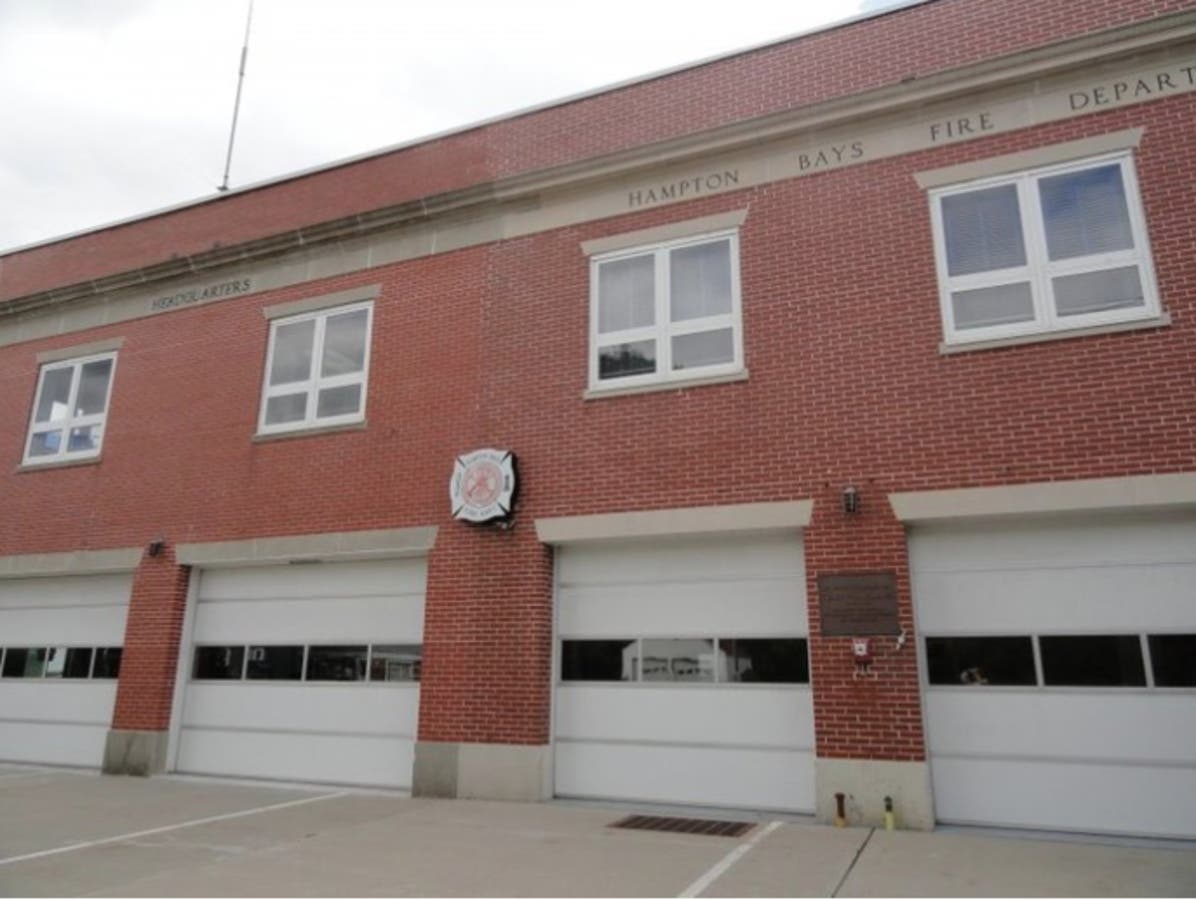
HAMPTON BAYS, NY — The Hampton Bays Fire Department was added to New York registry of state Superfund sites Wednesday, according to the New York State Department of Environmental Conservation.
A detailed investigation of contamination is set to begin, the DEC said.
The fire department, located on West Montauk Hwy., was added as a "Class 2 site that presents a significant threat to public health and/or the environment" due to Perfluorooctane sulfonic acid, or PFOS, and perfluorooctanoic acid, or PFOA, detected at elevated levels in groundwater at the Hampton Bays Ponquogue Avenue supply well field "above the United States Environmental Protection Agency’s lifetime health advisory level of 70 parts per trillion.
Find out what's happening in Westhampton-Hampton Baysfor free with the latest updates from Patch.
While some actions have been taken to reduce human exposures to PFOS and PFOA in these water supplies, remedial measures are needed to address the source of the contamination. Based on initial sampling at the Hampton Bays Fire Department, it appears that a source of this contamination is located at the fire department," a DEC notice said.
PFOS is a contaminant often associated with fire-fighting foam, the DEC said. In Jan., 2018, fire-fighting foam was identified within the maintenance building at the site. The remedial investigation will define the nature and extent of contamination in soil, groundwater and any other parts of the environment that may be affected, the DEC said.
Find out what's happening in Westhampton-Hampton Baysfor free with the latest updates from Patch.
Key components of the investigation work will include installing and sampling soil borings to identify possible on-site sources of contamination; and installing and sampling groundwater to monitor impacts from areas of concern.
Next, the information collected during the investigation will be summarized in a report; after the site investigation has concluded, the remedial party with oversight provided by NYSDEC will conduct a feasibility study, using information developed during the site investigation to develop and evaluate potential ways to clean up contamination related to the site. The information collected during the site investigation may also support the conclusion that no action, or no further action, is needed to address site-related contamination, the DEC said.
NYSDEC will then develop a draft cleanup plan, called a "Proposed Remedial Action Plan.” That plan will described the remedy preferred by NYSDEC, or, if warranted, a no action or no further action alternative, the DEC said.
"The New York State Department of Environmental Conservation is working aggressively across Long Island and the state to investigate and respond to areas potentially impacted by per- and polyfluoroalkyl substances, or PFAS," the NYSDEC said. "Using science as our guide, we have reviewed and mapped potentially impacted areas, and any facilities determined to be a potential threat to public health or the environment were prioritized for immediate actions. Every day, our experts are working directly with county and local governments to further our response, and community residents can always reach out to us for accurate and up-to-date information on our unwavering commitment to protect water resources across the state."
The Ponquogue Avenue Wellfield, which consists of three supply wells, is located about 600' to the south-southeast of the Hampton Bays Fire Department.
In 2014, the Hampton Bay Water District collected a sample from the wellfield which detected PFOS, at a concentration of 82 parts per trillion, above the current EPA health advisory level of 70 ppt. Subsequent samples were collected from the wellfield that confirmed the initial results, which led to the shutdown of one supply well in May, 2016. In 2017, the other two supply wells were shut down. The water district then constructed a carbon treatment system at the wellfield to treat the water prior to distribution.
On July 13, 2017, the DEC designated the Hampton Bays Fire Department, which they said was the apparent source of the PFOS, as a potential inactive hazardous waste disposal site, requiring investigation.
The fire department conducted a site characterization investigation in early 2018 to determine if PFOS was present at the facility; groundwater at the site contained PFOS up to 2,400 ppt, which led the department to reclassify the site, to a classification that means it poses a "significant threat with action required," according to the DEC.
The Hampton Bays Fire Department has entered into a consent order with DEC to fully investigate and clean up the site, and has submitted a work plan to perform a more comprehensive study, a remedial investigation, to determine the full nature and extent of the contamination at and emanating from the site, in order to evaluate alternatives for cleaning up the site.
The remedial investigation will likely begin in March.
The Hampton Bays Water District set to clarify for Patch, in 2017, what led to the closure of two of its wells.
At the time, according to Hampton Bays Water District Superintendent Robert King, in 2016, the district was testing, something it has been required by law to do since 2013, and found a "contamination level of 73 parts per trillion."
King explained that standards had been lowered, leading to the district's decision to embark upon the testing. Although they were not required to close the well, that well was subsequently closed due to the contamination.
"We did not have to do this; we did it on our own," he said.
The district continued to monitor the wells and in June, 2017, did another sample from a second well in the same well field that "showed a higher contamination," King said, adding that the water district voluntarily closed that well, also.
"This has been going on," King said. "This didn't just happen."
The Hampton Bays Water District met with the Southampton Town board, which approved expenditure of water district funds to put in a carbon filtration system.
In an effort to identify water supplies potentially impacted by perfluorinated chemicals, or PFCs, beginning in June, 2016, the DEC mailed surveys to more than 2,500 potential users of PFCs, which included select businesses, fire departments, airports, bulk storage facilities and Department of Defense/military bases in New York State, the DEC said.
The survey was intended to begin to identify facilities where PFOA, and PFOS might currently exist, or had formerly been, used, stored, manufactured, disposed of, or released, the DEC said.
"Based on the results, the DEC and Department of Health staff from the state's water quality rapid response team efforts have mapped all facilities where affirmative responses were received to assess public or private water supplies within one half mile of the facility and in need of further investigation," the DEC said. "The vast majority of those facilities responding in the affirmative were not located within one half mile of a water supply well. However, the state is focusing further investigations at certain sites including the Francis S. Gabreski Air National Guard Base, Suffolk County firematics, and the Hampton Bays fire district site."
The Hampton Bays Fire District commissioners could not immediately be reached for comment Friday.
Get more local news delivered straight to your inbox. Sign up for free Patch newsletters and alerts.