Politics & Government
Cuomo Tackles 'Dark Money' Political Campaigns Unleashed by Citizens United: VIDEO
The combination of economic anxiety, government failure and political disenfranchisement is a toxic brew, he said.


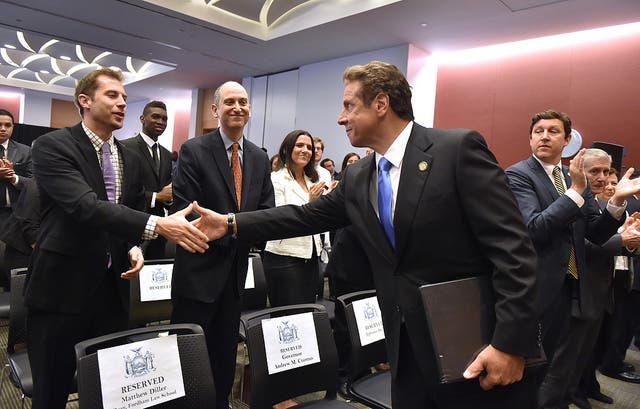
Gov. Andrew M. Cuomo announced Wednesday he is taking first-in-the-nation action to curb the power of independent expenditure campaigns unleashed by the 2010 Supreme Court case Citizens United vs. Federal Election Commission — a case connected to Chappaqua resident Hillary Clinton's 2008 run for the Democratic presidential nomination.
"This presidential political year is unlike any I have seen before and I am not alone," Cuomo said in a speech at Fordham University. "Most analysts have been focusing on how bizarre the campaigns have been. I don’t think the campaigns or even the candidates are the real story. They are not the stimulus of our political environment; they are the response. An angry, disenfranchised, frightened citizenry is driving the unprecedented extremes and intensity."
Over the past five years, the ability of average citizens to influence their government has been eroded, he argued. The power of the electorate has been eclipsed by wealthy donors, with elections being bought and sold. This is only exacerbated by economic stagnation for the middle class while income inequality continues to grow.
Find out what's happening in Yorktown-Somersfor free with the latest updates from Patch.
The governor made the announcement in a speech at Fordham University School of Law.
“The power to influence and the power to be heard in elections was tilted beyond all recognition when the Supreme Court upheld Citizens United. This decision ignited the equivalent of a campaign nuclear arms race and created a shadow industry in New York — maligning the integrity of the electoral process and drowning out the voice of the people. Citizens United must be reversed,” Cuomo said, according to a press release. “As Governor of New York, I am taking action to curb the powers of independent entities and ensure these committees cannot circumvent the law and cheat the system. We are also strengthening disclosure requirements so we know exactly where and from whom this dark money flows. Our message is clear: In New York, democracy is not for sale. I strongly urge the State Legislature to join me in restoring the people’s trust in government and pass this legislation this session.”
Find out what's happening in Yorktown-Somersfor free with the latest updates from Patch.
Governor’s Counsel, Alphonso David, issued an opinion to enforcement entities offering guidance on existing state law and whether coordination exists between independent expenditure campaigns and the candidates they support. The opinion clarifies permissible conduct under state law and works to preserve the integrity of the electoral process in New York.
Cuomo said he would also advance legislation which would limit the “quid pro quo” danger posed by colossal corporate donations and ensure that independent expenditure groups remain autonomous from the entities they support.
The legislation would also strengthen disclosure requirements and mandate that groups report the identity of anyone exerting control over them, as well as any former staffers or immediate family members of a candidate.
Cuomo said that, while there are many factors at play, he thinks Citizens United has done more damage to civic engagement than any other Supreme Court decision in modern political history.
The legislation he is proposing explicitly prohibits coordination in New York State election law for the first time.
Under his proposal, candidates would be prevented from forming committees, PACs would not be allowed to be run by former staffers or family members and candidates would not be allowed to discuss strategy with committees within six months of the election. The law would also require independent spenders to report the identity of anyone exerting control over the group, as well as any former staffers and immediate family members of candidates.
"A presidential election is a litmus test on how people view the state of the nation. Are you better off today than you were four years ago — is the country headed in the right direction? That is always the implicit question," he said. "This year the overwhelming response is no. The country is skeptical about their economic future, frightened by terrorism and frustrated by gridlocked government. Our government was promised to be the solution but has become part of the problem. As if all this was not enough, people also believe their political power – their ability to change and influence their government is being diminished. Today they fear electoral impotence: their vote and their voice is eclipsed by the rich and the powerful, who somehow, amidst governmental paralysis, still manage to have their interests served."
Citizens United vs. Federal Elections Commission
State officials offered this background information on Citizens United and campaign spending:
In 2008, the conservative non-profit Citizens United produced a film called Hillary: The Movie, which they wanted to run as a paid television advertisement. Under the Bipartisan Campaign Reform Act of 2002, showing the film during television broadcasts was a violation of federal law. In 2008, the United States District Court for the District of Columbia upheld BCRA and ruled that Citizens United was prohibited from running paid television ahead of the Democratic Primary. In 2010, the Supreme Court reversed course and issued a sweeping decision that prevented government from restricting the creation of unlimited independent expenditure committees. As a result, spending by outside groups — those who operate independently of political candidates — has more than doubled since 2010.
Five years ago, approximately 80 Super PACs were registered with the FEC, with independent expenditures totaling more than $90 million. In 2012, more than 800 Super PACs were registered with the FEC, with groups spending approximately $800 million that cycle.
In the three election cycles since 2010, Super PACs have spent more than a billion dollars. Nearly 60 percent of those donations — more than $600 million — were made by just 195 people and their spouses. In the 2016 presidential election, close to half the money raised by super PACs through the end of February came from only 50 mega-donors and their relatives.
In 2014, the first cycle since New York law increased reporting requirements for independent expenditure campaigns, $60 million was spent on state senate races. Spending in the most expensive race, for the 40th Senate District in Putnam and Westchester counties, totaled $7.5 million, more than what was spent in 91 percent of U.S. House races that same year.
PHOTO/Kevin P. Coughlin/Office of Governor Andrew M. Cuomo
Get more local news delivered straight to your inbox. Sign up for free Patch newsletters and alerts.