Schools
Intel Recognizes 3 Semi-Finalists at Yorktown HS
They're part of Yorktown's prestigious Science Research program.


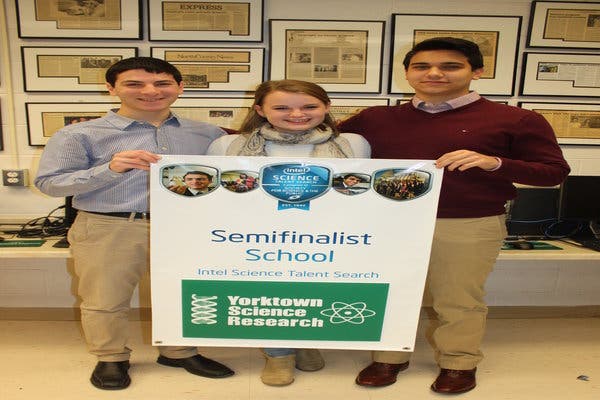
Three Yorktown High School Science Research students were proud to find out Wednesday that they were selected as national Intel Science Talent Search Semi-Finalists.
They are 17-year-olds Andrew Levin, Cayla Hamann and Andrew Amini.
The three entered research papers, a culmination of their science research projects they carried out during the last three years.
Find out what's happening in Yorktown-Somersfor free with the latest updates from Patch.
The semi-finalists were selected from more than 1,750 entrants from 512 high schools in 43 states, Puerto Rico, Washington, D.C. and six overseas high schools. Of the semi-finalists, 27 were from the lower Hudson Valley.
“We have 19 seniors that are immensely talented students all doing graduate level research in high school. We are thrilled that three have been recognized on a national level and we wish them well as they move into the next stage in the Intel award process,” said teacher Michael Blueglass, who oversees the Yorktown Science Research program with colleagues Dominic Guazzo and Rachel Koenigstein.
Find out what's happening in Yorktown-Somersfor free with the latest updates from Patch.
Yorktown officials offered this description of the projects by the student researchers:
Andrew Levin
“I designed a novel mechanism for solar tracking, which uses no electricity to operate. It was found that the tracker was successfully able to rotate towards a light source.” He adds: “Solar power is a rising source of clean and sustainable energy. However, innovations, such as the addition of a solar tracking system, are necessary. The goal of this research was to build a novel solar tracker with the rotation of bimetallic coils as its driving force.”
Cayla Hamann
“I have always been interested in renewable energies. I’m fascinated with the concept that energy exists all around us, and with the right technology, it could be harnessed and used towards a cleaner earth.” For her project, she “researched a type of thin-film solar cell called Cu2ZnSnS4 (CZTS), which currently exhibits low inefficiencies but is made out of abundant and inexpensive materials, making it a viable and competitive alternative source of energy.”
Andrew Amini
“My research involved developing machine learning algorithms to detect predict and monitor epilepsy seizures. I was able to develop an algorithm with high accuracy and a lead time of roughly two minutes before a seizure, which let epilepsy patients respond to their seizures before they even happen, dramatically reducing the risk of injury.”
Since its inception in 2001, Yorktown Science Research students have won numerous national and international competitions every year. More than 60 high school students are currently involved in the program.
“We have to credit the students for their talents and dedication, but also the parents, mentors, school and district administrators and the Board of Education for their support of our program,” Blueglass added.
On Jan. 20, 40 of the 300 national semi-finalists will be named finalists and receive a trip to Washington, DC, March 10-16, to compete for more than $1 million in awards.
Each semi-finalist receives a $1,000 award from the Intel Foundation with an additional $1,000 going to his or her high school.
Get more local news delivered straight to your inbox. Sign up for free Patch newsletters and alerts.