Politics & Government
Somers, Yorktown Residents Stay Eligible for Tax Rebates: Astorino
The property-tax rebates are coming out of $211 million in savings the county and 22 municipalities have identified.


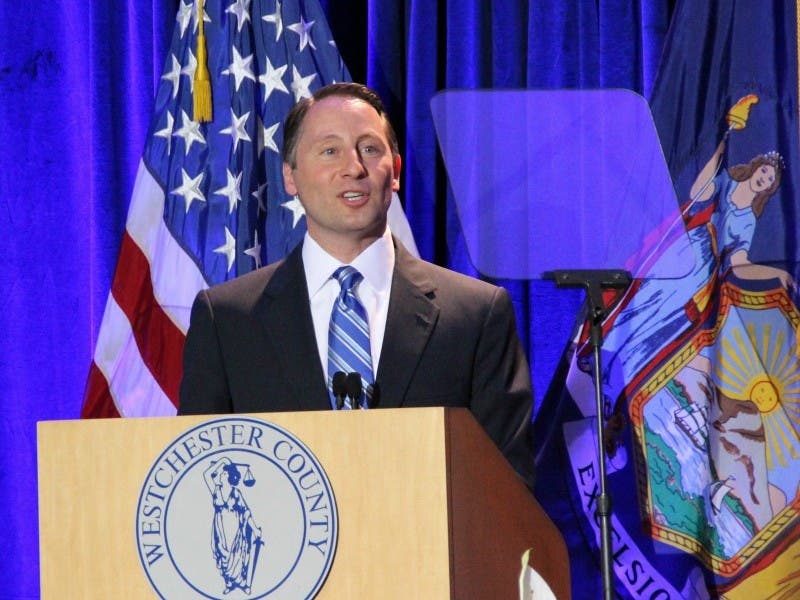
Residents in Mount Kisco and 21 other Westchester municipalities will continue to be eligible for property tax rebates from New York State, County Executive Rob Astorino announced Wednesday.
Under a joint efficiency effort between the county and the municipalities, which Astorino spearheaded, a total of $211 million in savings - $186 million from county government and $25 million from local municipalities and special districts – have been identified for implementation.
Find out what's happening in Yorktown-Somersfor free with the latest updates from Patch.
Because the savings exceed benchmarks set by the state, residents in the participating municipalities will remain eligible to qualify for property tax rebates through 2016. The rebates will be this year and next year, but the savings efforts will run through 2019.
“These savings are the product of smart government,” said Astorino in a statement. “Working as a team with 22 municipalities, we were able to come up with new approaches that allowed us to cut costs and still maintain and even improve services. The fundamental principle behind this effort is that sharing and consolidation can greatly improve efficiency.”
Find out what's happening in Yorktown-Somersfor free with the latest updates from Patch.
The county has been engaged in efficiency efforts with municipalities since Astorino came into office in 2010. One example is a mutual aid agreement with fire districts that saves more than $2 million annually. The fire districts were able to save money by moving to a centralized, shared model for dispatching and special equipment purchases, instead of doing those things independently.
Additional savings continue to come on line. This week, Mount Kisco entered into an agreement with the Westchester Department of Public Safety for supplemental police services that will save the village $2.4 million at no cost to county taxpayers.
“As the old saying goes: A million here and a million there, and pretty soon you’re talking about real money,” Astorino added. “The good news is that taxpayers will be able to share in the savings.”
The municipalities participating in the county-led plan are:
- The cities of Peekskill and Rye
- The towns of Bedford, Cortlandt, Eastchester, Harrison, Lewisboro, Mamaroneck, Mount Pleasant, North Castle, North Salem, Pound Ridge, Somers, Yorktown
- The villages of Bronxville, Mamaroneck, Mount Kisco, Pelham, Port Chester, Rye Brook, Scarsdale and Tuckahoe.
On Monday, the county submitted what is called a “joint government efficiency plan” to New York State. All municipalities in Westchester were invited to participate with the county on the plan. Some decided to submit their own plans to the state.
The projected savings are:
- $43 million in 2016
- $55 million in 2017
- $56 million in 2018
- $57 million in 2019
With the county and municipalities doing their part, Astorino repeated his call for Albany to provide meaningful tax relief to localities by reforming unfunded state mandates.
“The problem with the state’s tax cap is it only addresses half of the budget problem,” Astorino said. “It rightly creates incentives for curbing taxes, but it does nothing to limit spending by Albany, particularly with respect to unfunded mandates. The result is that local municipalities have less money to put toward local needs.”
Nine unfunded state mandates, totaling $454 million, will consume 83 percent of the county’s tax levy in 2015.
In Westchester, property taxes breakdown roughly as follows: 65 percent for school, 15 percent for county government, and 20 percent for local municipalities and special districts. Rebates are calculated on each portion of the bill. Broadly speaking under state law, residents are entitled to property tax rebates in 2015 equal to the amount the jurisdiction raised taxes, provided it was under the state cap.
In the case of the county, its portion of the rebate is based on the rate of inflation because Astorino proposed and won approval for a budget in 2015 with no tax increase, continuing a pattern of 0 percent tax increases since 2011 and a 2 percent tax decrease in 2010. The county’s rebate applies to residents in all 45 Westchester municipalities.
The joint efficiency plan comes into play for next year because the state has increased the requirements for qualifying for a rebate. In 2016, taxing jurisdictions will not only have to keep their tax increases under the tax cap to qualify for rebates, but will also have to have had produced efficiency savings equal to or greater than 1 percent of their 2014 tax levy. That figure translates into an $11.5 million threshold for the county and 22 municipalities, which was exceeded by the savings in their joint efficiency plan.
Get more local news delivered straight to your inbox. Sign up for free Patch newsletters and alerts.