Sports
Tweet This: Twitter's Presence In NFL/NBA Undeniable
Sports Figures Speak About Athlete "Tweets"

Since it was introduced to the world, Twitter has grown by leaps and bounds.
The online platform has evolved into one of the more controversial internet tools in professional sports, particularly the NBA and NFL, with athletes creating pages and actively contributing their comments.
In a technology-dominant world where news can be discovered at a moment's notice, it's evident that Twitter has created an outlet for professional and highly-touted amateur athletes that was once unheard of.
Find out what's happening in Yorktown-Somersfor free with the latest updates from Patch.
"We didn't have anything other than straight reporting, reporting the facts, and there were never any rumors or source-triggered rumors to comment on," said Terry Teachout, who recently directed a camp with the Yorktown Husker Club.
"I think Twitter is a lot for the kids to do recreationally," he added. "There's certainly a place for it. It's another creation to help the media get information from. Only a lot of the time some of the rumors are anonymous and need some credibility to them."
Find out what's happening in Yorktown-Somersfor free with the latest updates from Patch.
It gives athletes a chance to speak their minds on issues both in their everyday line of work and outside of sports.
The outcome has not always been positive.
Players have found themselves in hot water for submitting controversial "tweets" that violate the organization's strict policies about keeping what happens in the locker room behind those closed doors of the locker room.
Many athletes, the Atlanta Hawks' Joe Johnson, the New Jersey Nets' Terrence Williams (whose "tweet" made it obvious he was unhappy with his playing time situation), and the New York Jets' David Clowney, to name a few, have used Twitter to gripe about coaching or team situations and create a potentially team-hazardous media sideshow.
Duke-bound basketball standout Kyrie Irving announced his decision to play for the Blue Devils this past fall. His official announcement was first made via Twitter.
"Nowadays people can communicate on multiple levels," said Andy Dolich, the COO of the San Francisco 49ers.
Dolich, a Brooklyn native who earned his MA in sports management at Ohio University and has worked for the Memphis Grizzlies, the Oakland Athletics, and the Washington Capitals of the NHL, says that 49ers coach Mike Singletary has implemented a "one-voice" rule.
This rule prohibits players from commenting about team situations or voicing their opinions on a team decision through Twitter, Facebook, or any other online social network (in which their comments are visible to the public eye).
Dolich is certainly open to ideas catering to the demands of the technologically souped-up future.
He believes the fast-paced technology and the ability for athletes to divulge information creates an uptick in traffic and a greater communal following.
When weighing how today's communication tools could construct a wider fanbase and increasing the 49ers exposure, Dolich is open to what Twitter can bring to the table.
"Now it's social networking or the ability to TiVo-it's the ability to move into the future," he said. "What you're dealing with now is the essential nature of possibly a great change in the way people actually consume live sport God knows what they'll be six years from now. They'll be much more sophisticated I'm sure. I'm sure there will be intercranial tweeting. Your ESP will be able to tell your 4,200 Facebook friends what they think the next play will be."
Peppered with controversial questions about Twitter and its immense impact on the media and the world of professional sports and outspoken athletes, Dolich didn't flinch.
While most head honchos and front office operators sense that tweeting could
create potential friction between a disgruntled athlete and the organization,
Dolich is anxiety-free. The rule that coach Singletary has implemented helps tremendously.
Overall, however, Dolich is not crazy about limiting players' comments on Twitter. He instead chooses to promote the positive.
He believes that non-traditional media sources, including Facebook and Twitter, will ultimately produce an up tick in sports markets. This is because, according to Dolich, these networking and communication tools help propel a more communal following.
Still, he acknowledges that a firestorm and an excess of controversial stories could emerge through one individual tweet.
"There's no question that, if that wave of interest continues to grow, I think there's a challenge that we all have," said Dolich. "Does (a sports story) have two or three sources, or is somebody in any context, just saying 'Hey! I know this!' It goes as news, when in actuality, it's rumor or opinion."
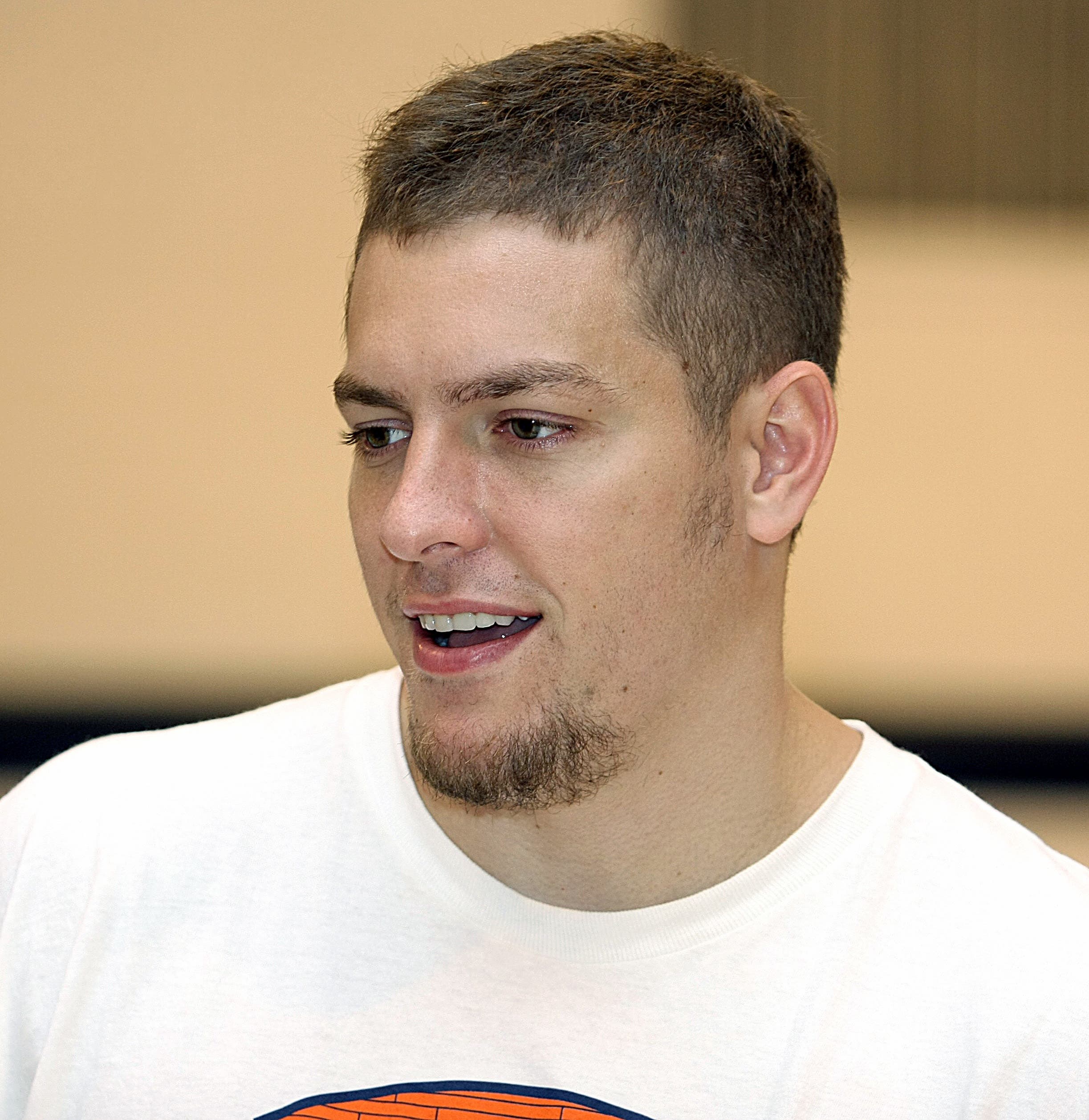
In Golden State Warriors forward David Lee, Dolich's words resonated.
"I'm definitely not opposed to it," said Lee, the 2010 NBA All-Star and Westchester resident, while working his third annual David Lee Basketball Camp with Teaches Hoops at Bell Middle School in Chappaqua, N.Y.
Lee maintains an account with Twitter but does not think athletes should use it to be outspoken about team situations.
"Part of being a player," he said "is knowing it's not really your job to question some things or questions things that are out of your control."
David Lee's camp director Terry Teachout, who authored a four-year stay at Division-I Duquesne University, said there was nothing of the sort when he was a player in the early 1980s.
Dolich said he believed the 49ers will reap the rewards of Twitter. He feels the instant updates are beneficial. He buys into the notion that material being sent from friend-to-friend via the internet, cell phones, blackberries, gadget-du-jour, or whatever it may be, ratchets up the interest level and communal following.
Twitter, which has grown by leaps and bounds and become the primary source for diehard fans wanting an inside-the-locker-room look at things, continues to keep a valued presence in the NBA, NFL and with the media.