

It is baseball season, and thousands of players at all levels will be playing the game every week all summer long. Whether the players are tots or pros getting good photographs of them requires some skill at shooting sports. Read on to discover what professional sports shooters know.
Photographing sports action is one of the more difficult photographic challenges. In most sports the action is fast so capturing peak action is difficult. Peak action is that instant of action that best depicts the athletic endeavor involved. It might be a jump, a throw, a catch, a kick, or any other action that characterizes the sport being photographed.
Regardless of the action involved, the ability to capture it depends upon several things.
Find out what's happening in Narberth-Bala Cynwydfor free with the latest updates from Patch.
On the equipment side the camera and lens must be capable of fast focusing, high shutter speeds, and high ISO sensitivity settings. ISO stands for International Standard Organization. Sensitivity refers to the the digital sensors ability to be adjusted to allow fast shutter speeds. Typical consumer point and shoot cameras and camera phones do not focus fast and do not give quality results at high ISO settings. Digital single lens reflex cameras and mirror-less interchangeable lens cameras do have those two important features. Equipment matters when it comes to sports photography. I am not implying that a lesser camera could never capture a good sports photograph. It happens but rarely.
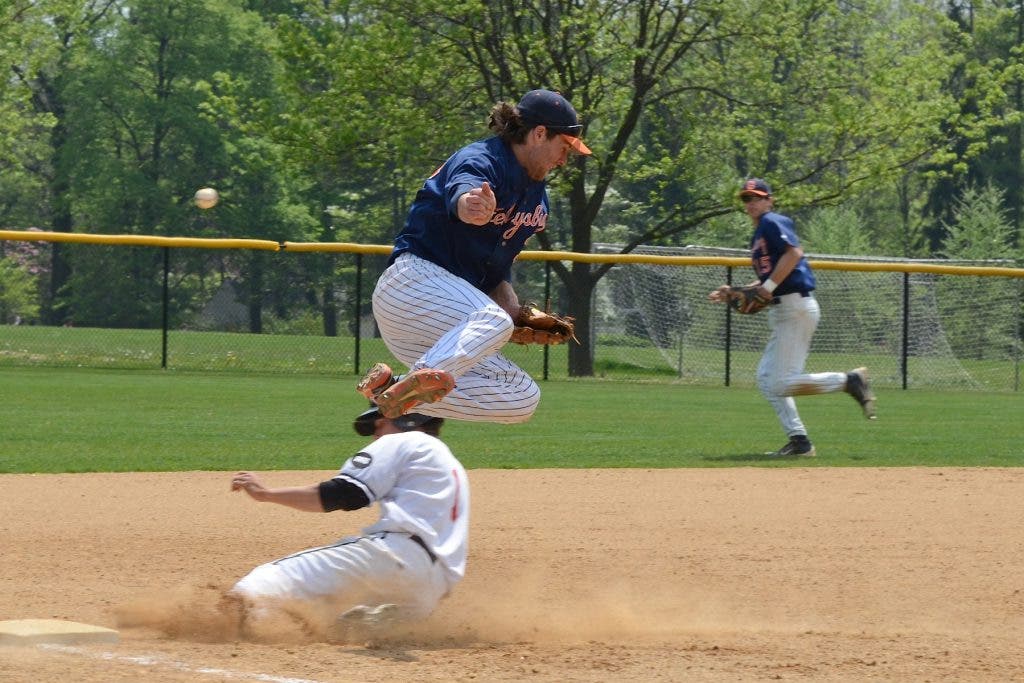
Another key ingredient for good sports photos is understanding the sport. If you know that a base runner on first base with no outs is likely to be headed to second base at some point, you know to have your camera ready to cover action at second base. You also know where you can best position yourself to get a good view of second base. When you photograph a batter you know that to be a good shot it has to involve swinging the bat. That is what batters do. That is what you have to capture. You also know that, if there is a ball involved in the sport, the best shots will always have the ball in them.
Find out what's happening in Narberth-Bala Cynwydfor free with the latest updates from Patch.
Making good exposures in sports photography requires two things: 1) a shutter speed high enough to stop action, and 2) an ISO high enough to allow a high shutter speed and aperture that will provide good sharpness throughout the depth of the field of view. If you don't understand those terms you should Google both "shutter speed" and "depth of field." You'll learn a lot through that search.
Most digital cameras offer a variety of exposure modes like program, aperture priority, shutter priority, and manual. When shooting sports I recommend shutter priority. In that mode, you select the shutter speed you want and the camera will adjust the lens aperture based upon the ISO you have selected. When possible, you want to select an ISO high enough to give you f/5.6 or more as an aperture when you set the shutter speed to the appropriate setting.
What is the appropriate setting? It depends on the speed of the sport. Auto racing can require shutter speeds in excess of 1/1000th second as can horse racing and other fast moving objects. Baseball does not move as fast as race cars or race horses, and 1/500th second is usually adequate. There is no hard and fast rule. Experience is the best teacher.
Finally, good sports photos require a sense of timing. If you shoot a photograph when you see the peak action, you will miss the best shot. In the 1/4 second from the time you depress the shutter button until the exposure is recorded in the camera, the peak will be missed. Good sports photography requires tripping the shutter about 1/4 second before the peak action. The only way to perfect that skill is by continually shooting sports.
It is time to look at the gallery. The captions tell the rest of the story. One thing you should notice. The ball is each of the three photos.