Crime & Safety
Narberth Ambulance’s Executive Director Speaks to the Senate
Policy Hearing: Narberth Ambulance's Executive Director Speaks on the Secondary Impacts of Gun Violence on EMS Workers

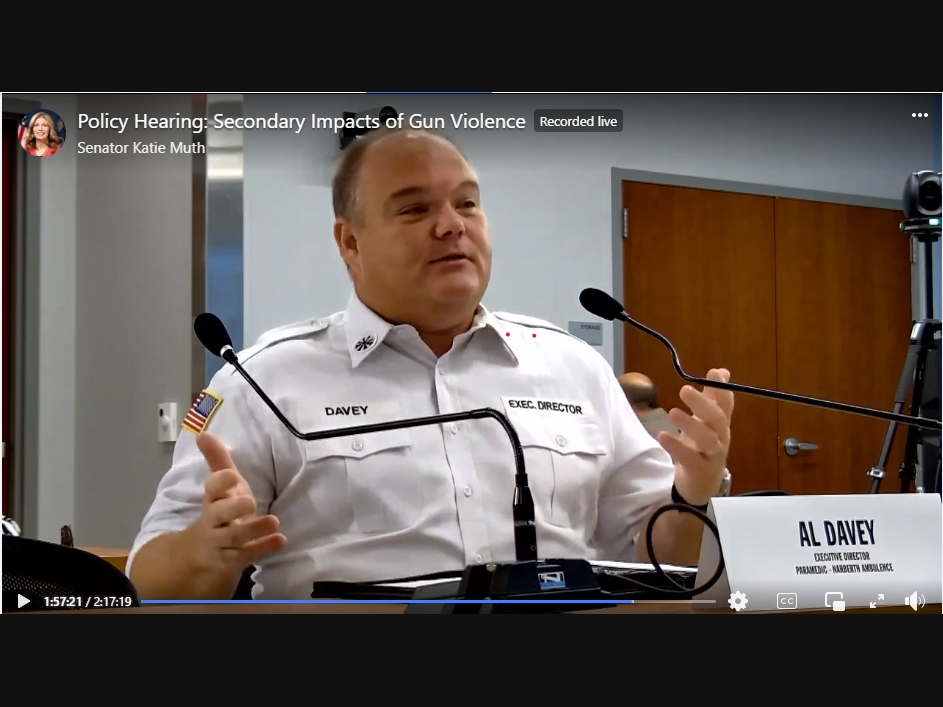
NARBERTH – Albert F. Davey, a paramedic for over 25 years and the executive director of Narberth Ambulance, recently spoke at the State Senate Democratic Policy Committee hearing about the secondary impacts of gun violence on EMS work. The hearing took place in person at Einstein Medical Center in East Norden Township and online over zoom. It was livestreamed and posted on Senator Katie Mullin’s Facebook account.
Davey started his speech by sharing a personal story. In the early 2000’s, a few years after the shooting at Columbine High School, Davey responded to a shooting at a local high school. Immediately when he arrived at the scene, he was tasked with watching over one of the victims. Within 20 seconds, he knew the child was not bleeding, the child was dead. This child was not a victim, but the actual shooter.
“I was ill-equipped for that moment and I was ill-equipped for the next thirty minutes where we sat together,” Davey admits.
Find out what's happening in Narberth-Bala Cynwydfor free with the latest updates from Patch.
Police and Emergency Medical Service provider’s mental health training is basic. Emergency Medical Technicians receive one day of mental health training and paramedics receive four days. Yet, emergency responders are answering more overdose, suicide and mental health crisis calls than ever before. The number of penetrative trauma calls in Montgomery County has doubled since 2019. Penetrative trauma includes any wound that penetrates the skin such as stabbings, explosives and shootings. Davey noted a large reason for this increase is suicide.
On top of the sparce training, finding skilled and trained mental health providers for EMS providers have become increasingly difficult. Police, firefighters and EMS typically use each other as a mental health resource and participate in peer-to-peer counseling because they respond to the same or similar calls. However, outside help is just as important. Davey mentioned that the effects of COVID-19 have been difficult because his staff is finally asking for help, and he has to tell them it could be a few months before they can get an appointment with a licensed psychologist.
Find out what's happening in Narberth-Bala Cynwydfor free with the latest updates from Patch.
“Five years ago, we would not wait for a counselor. We are now waiting upwards of two months to find someone just to talk to one of our staff members,” said Davey.
When Narberth Ambulance partnered with psychologists, they found most of the mental health stress reported by providers was not COVID-19 related, but stemmed from situations where they were called to an unsafe scene or they were a victim of a violent act. EMS responders ideally arrive next to a police officer when called to a potentially dangerous scene, however, sometimes they are the first to arrive and have to manage the situation on their own. Staff have reported assaults and Davey admitted he has been bitten.
Davey pleads for stronger toolkit and more training in respect to mental health, such as active shooter training. He wants to build a better set of mental management tools so responders can go into the scene prepared and come out of the scene supported.
“This rock we have to climb, with time and pressure will yield diamonds of mental health victories, and hopefully proper legislation for weapons to reside in properly trained and accountable hands,” said Davey.