Business & Tech
Record Gold Prices Felt at Street Level
At $1,500 an ounce, inventory control is key, Ardmore retailers say. Silver prices have also spiked, and while artists and buyers are seeking alternatives, the demand for gold is a constant at any price.



In terms of things ancient and constant, the buying and selling of gold may not be quite the oldest profession, but it’s up there.
Gold prices have affected everything from the price of grapes in the early Roman Empire to the sticker shock of an iPad. Gold is the financial world’s touchstone, its magnetic north. And these days, when its price per ounce spikes in any given market, or on even a single commodities exchange, the reverberations will be felt throughout almost every economy, micro and macro.
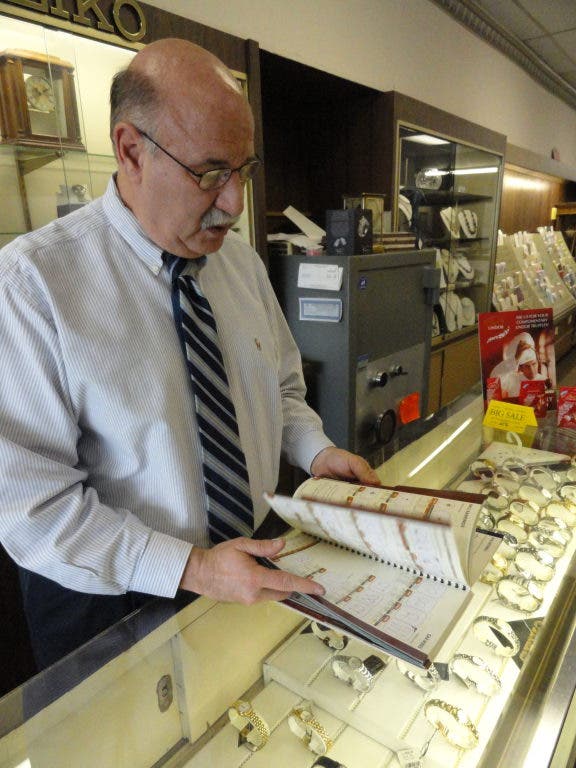
“Everything that you buy, everything that you do, is dependent on the price of precious metals,” said John Iannacone, co-owner of on Lancaster Avenue in downtown Ardmore. “You have a certain profit margin you have to stick to, and when you have to order and re-order things...”
Find out what's happening in Narberth-Bala Cynwydfor free with the latest updates from Patch.
Buoyed by a weakened dollar, gold last week hit $1,500 an ounce for the first time ever. Two months ago, it was around $1,400, and a year ago, it was hovering around $1,200—and that was a spike from 2008 prices, when dramatic economic events pushed prices to about $800. In the last five years, gold has doubled in value.
Silver, too, is at historic levels, doubling in value in just the past 12 months, and at its highest price since the early 1980s. “Silver is like gold on steroids,” Jon Nadler, a precious metals analyst for Kitco Inc., told Bloomberg News late last week.
Find out what's happening in Narberth-Bala Cynwydfor free with the latest updates from Patch.
Iannacone doesn’t change prices once his stock is in the store. But a recent customer, a man buying a size 10 gold engagement ring that did not fit, felt the sting of the price spike when he had to re-order the ring. The smaller 8½ size ended up costing more.
“It depends on when you order,” Iannacone said. “It’s not like the price of gasoline. We don’t really re-price. When we bought the thing, we know what our markup was, and we don’t pass that on.”
While prices are this high, casual buyers may stay away. But one aspect of the business in which customers at Giannini and elsewhere really get squeezed is in replacement parts, Iannacone said.
“If you break the clasp on your necklace, the gold parts are outrageous,” he said. “You have the clasps now costing as much as the chains in some cases.”
Around the corner in Suburban Square, the boutique , which sells clothing and accessories as well as jewelry at six stores along the Eastern seaboard, fluctuations in daily gold and silver prices normally have a less immediate impact.
“Buying it, I know we’re affected, but selling it—people are still coming in and buying,” said assistant manager Stephanie Spiller. “The people that are purchasing those pieces can afford to buy them.”
Where it is starting to take more recognizable effect is with the manufacturers—the artisans who supply part of the store’s inventory. “Some of our artists who worked entirely in silver before are now working with other kinds of materials,” Spiller said.
Jenni Tunbridge, Dandelion’s manager, said that despite those trends and skyrocketing prices, some things remain constant. “People are still more interested in silver and gold, overall," she said, adding that subtle adjustments up and down the wholesale and retail chain are expected.
Tunbridge produced an example of an artist communicating directly with Dandelion about silver prices, currently about $45 an ounce, up from under $20 a year ago.
“In the past I have been able to maintain prices for the entire year based on the price of silver at the beginning of the year,” wrote an artist from Lexington, Mass., in a letter to the store dated April 15. “That will not be possible this year. ... Let’s hope these high silver prices stabilize or, better yet, go down.”
While Giannini’s and Dandelion serve fairly distinct sets of clientele, Iannacone said all jewelers have to deal with herky-jerky prices in gold and silver, and be nimble enough to ride the wave into calmer waters.
“You don’t want to be stuck with high-priced inventory, so you try to spot-buy,” he explained. “If you go out and buy a bunch of stuff and then everything drops [in value], then you’re priced out of the market. And then you’re in big trouble.”
Gold and silver are not the only precious commodities shooting up these days, and Iannacone had more bad news for couples thinking about becoming engaged.
“There are a lot of foreigners who are now putting their money into diamonds—like crazy,” Iannacone said. “It has driven the price of good diamonds up, like 15 to 20 percent in the last two months.”
The spike in diamonds is also a result of a retreat from the U.S. dollar into harder assets.
“Traditionally, after Valentine’s Day, you figure it’s a slow time for diamonds,” Iannacone said. “But there has been a tremendous increase in the wholesale cost of diamonds out of Asia, the Middle East and Europe. Not only large diamonds, but across the board, and that has really squeezed consumers and manufacturers. We do a lot of custom work, and we have to buy to meet the customer’s specifications.”
An alternative that many couples are trending toward, he said, is to set engagement diamonds in sterling silver, which is softer and less expensive than gold, or non-traditional metals like tungsten or titanium.
Another trend is “costume jewelry,” said Tunbridge, with retro looks from the 1940s and ’50s finding their way into display cases. Gold and silver items filled with brass keep prices down, too.
“We talk about it all the time,” Spiller said, sharing that both she and Tunbridge are metal smiths themselves. Regarding the record prices, “Artists are still producing,” she said. “They have always found other ways around it.”
Get more local news delivered straight to your inbox. Sign up for free Patch newsletters and alerts.