Schools
Villanova Students Develop 'Green' Soap
Villanova's chemical engineering students have developed a way to make soap from used cooking oil.
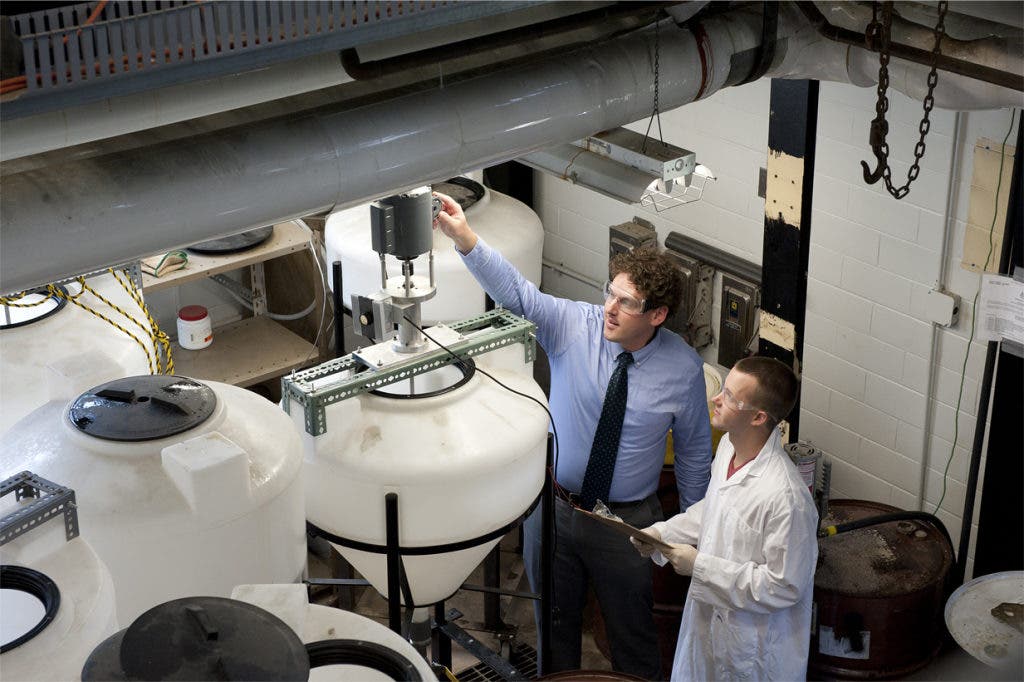

For about three years now, a group of Villanova chemical engineering students have been converting used campus cooking oil into biodiesel fuel, but it was only recently that they discovered a new use for the waste: hand soap.
“For a long time, we joked about soap as a side project, but it was nothing more than that,” graduate student Adam Hoffman said.
Three years ago, Villanova chemical engineering department chair Randy Weinstein approached Hoffman about starting a biodiesel project on campus. In spring 2009 after researching equipment and techniques, Hoffman and his colleagues began producing small batches of biodiesel fuel, and the project has grown from there.
In the past year, Hoffman and other students have been brainstorming ways to make the biofuel conversion process even greener by utilizing the glycerol produced by the oil-to-fuel reaction—eventually stumbling upon the idea of creating hand soap.
Since the fall, Hoffman and other students in Villanova’s chemical engineering department have been working to perfect the recipe for their hand soap, Hoffman said. The soap has been used to clean machinery, placed in campus bathrooms, and given away as a novelty gift for chemical engineering open houses.
Now, the students are looking into the possibility of selling the soap off-campus.
“It’s a little different from typical soap, but it’s a great moisturizer,” senior chemical engineering student Bridget Nyland said.
Nyland has been working with the biodiesel and sustainable soap projects as part of her senior thesis at Villanova.
“It came about as a joke originally,” Nyland said of the soap project. “My partner was working on it during the summer and playing around with it, and when we returned for the school year, we started talking to the chemical engineering department and realized it could actually be a real thing. It’s cool to see how interest in the project has grown.”
Find out what's happening in Bryn Mawr-Gladwynefor free with the latest updates from Patch.
The process for both products works like this: Students transport used cooking oil from campus dining facilities to the campus chemical engineering lab, where the oil is placed into reactors, mixed with sodium hydroxide and methanol, and agitated for about two hours, Nyland said.
What forms at that point is a layer of glycerol and a layer of biodiesel fuel—which is washed to remove excess oil and lye and then readied for use in campus machinery—a process that takes about four days.
“Our test vehicle for the biodiesel is a street sweeper,” Hoffman said. “We’re running it on 100 percent biodiesel fuel to see how the engine behaves.”
The biodiesel is also being used to offset petroleum use in campus lawnmowers, which use between 30 and 100 percent biodiesel.
Hoffman just accepted an offer to pursue his Ph.D. in chemical engineering at UC Davis, where he will continue his work on bio-based fuels in his doctoral work.
“You see everyone pointing at solar and wind power as the way to go, but it seems like we don’t have the infrastructure at the moment to implement those energy sources,” Hoffman said. “We have a strong dependence on petroleum products. Bio-based fuel is a system that can help wean us off of a dependence on oil.”