Health & Fitness
Those Angry Days--Lindbergh, Roosevelt and Willkie
In this prequel to World War II, the anti-war movement was on the right, the interventionists were on the left, and America slid into an undeclared war against Nazi Germany.


For boys of my generation, historical memory began with Pearl Harbor. Everybody's father had served in World War II. At summer camp, we imitated army life, sang army songs, and played battleships. Neither in camp nor in school did we talk about what happened in America before we entered the war.
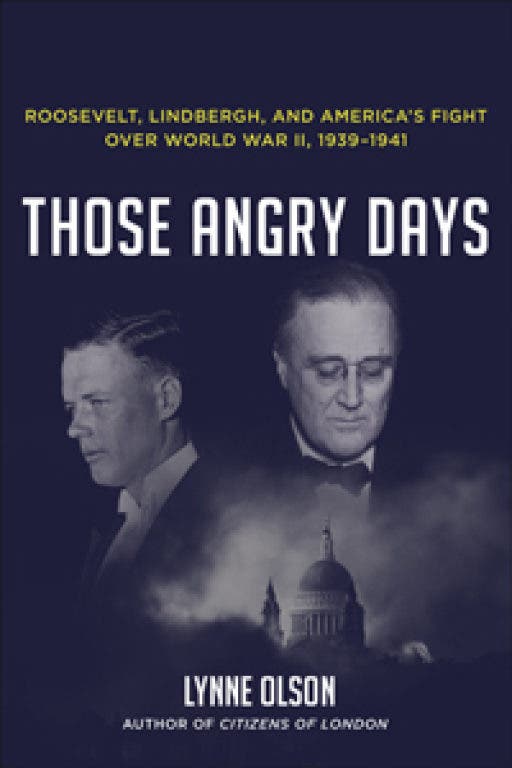
Journalist Lynne Olson brings us to those forgotten times in her new book Those Angry Days to be released by Random House on March 26. Olson tells the prequel to World War II, as she writes about politics in America between 1939 and 1941.
Find out what's happening in Chestnut Hill-Mt. Airyfor free with the latest updates from Patch.
Olson anchors her book on two polarizing characters: Hero-aviator Charles Lindbergh and former Presidential candidate Wendell Willkie. In the middle is President Franklin D. Roosevelt.
Find out what's happening in Chestnut Hill-Mt. Airyfor free with the latest updates from Patch.
Roosevelt wanted to do everything short of war to help Britain resist the Nazis.
However, he was restrained by neutrality laws and a powerful isolationist movement.
In the opening days of the war in Europe, two movements arose. To the President's right was America First, which called for a strong national defense but no involvement in a foreign war. America First drew its strongest support in the middle west and west.
To the President's left was a network of elitist lawyers, journalists, cultural figures and businessmen centered in New York. After World War II these people became known as Internationalists. Many of them entered the eastern liberal establishment of the Republican Party.
Afraid to run ahead of public opinion, Roosevelt used the New York group to push public opinion in favor of repealing the neutrality laws, giving military aid to Britain, and instituting the draft.
Enter the book's hero, Wendell Willkie. In 1940, Wall Street lawyer Wendell Willkie won the Republican nomination for President. Though he was an interventionist at heart, his party was largely isolationist.
By the summer of 1940, Britain was in dire straits. It was the only nation resisting Germany. Germany was supreme in the air and on the seas. German submarines---the wolf packs---were destroying shipping headed to Britain. Roosevelt and British prime minister Winston Churchill cracked a deal, whereby American would trade 50 obsolete destroyers to Britain in exchange for naval basis in British possessions in the Western hemisphere.
Roosevelt needed political cover so that Congress would approve the deal. According to Olson, Roosevelt sent his closest advisor, Harry Hopkins to see Willkie. Without an appointment, Hopkins appeared at the door of Willkie's apartment in New York. Willkie agreed not the raise the destroyers for basis deal during the campaign.
After Willkie was defeated for the presidency, he continued to lobby Republican members of Congress for aid to Britain. After Pearl Harbor he campaigned for national unity and the establishment of what was to become the United Nations. He died suddenly in 1944.
The anti-hero of Those Angry Days is Charles Lindbergh. After his solo-flight over the Atlantic in 1927, Lindbergh worked in the aviation industry. He avoided public life until the late 1930's when he became enamored with Nazi Germany. He emerged as the hottest speaker on the America First circuit. He was seen a political rival to Roosevelt. There was speculation that he would lead a fascist coupe d'etat.
On September 11, 1941, Lindbergh disgraced himself with a speech at an American First rally in Des Moines, Iowa. In the speech he blamed Britain and the Jews for dragging America into the war. As a public figure, Lindbergh was finished.
After Pearl Harbor, President Roosevelt refused to restore Lindbergh's commission in the Army Air Force. For a while he was blacklisted from the aviation industry. As a civilian test pilot, he flew combat missions in the Pacific supposedly without knowledge of the White House.
Olson tells a good story. Those Angry Days is easy, entertaining reading. Put it on your list for Father's Day.