Neighbor News
Stop Chasing Positions: The Hidden Biomechanics of a Powerful Golf Swing
Golf is 700 years old, and frankly, a massive portion of the industry is still teaching it wrong.


Walk down any driving range, and you will see amateur golfers freezing at the top of their backswing, checking their wrists, or trying to manipulate their arms into the "perfect" delivery slot. We have been brainwashed into treating the golf swing like a series of static poses.
Here is the undeniable truth: Everything you see in a golf swing has something before it and something after it that creates that exact "moment." The swing is not a collection of positions. It is an athletic chain reaction dictated by forces and pressures—and in biomechanics, almost all of those forces are opposites.
If you are frustrated with your ball striking, it is time to stop posing for the camera and start understanding the physics of human movement.
Find out what's happening in Doylestownfor free with the latest updates from Patch.
The Illusion of Chasing Positions and Creating Angles
When you look at a still image of Rory McIlroy or Nelly Korda at impact, it is tempting to try and consciously mimic that exact body shape. You try to physically drag the handle forward to create shaft lean. You try to force your hips open. You are actively trying to create angles.
This is a trap. Angles and positions are not things you do; they are the result of what you have already done.
Find out what's happening in Doylestownfor free with the latest updates from Patch.
When you consciously try to create lag or hold an angle, you slow the club down and introduce tension. Elite golfers do not hold angles; they create massive amounts of kinetic energy from the ground up, and those beautiful angles you see on high-speed video are simply the byproduct of a relaxed upper body responding to immense lower-body forces. The club is being whipped, not dragged.
The Rule of Opposites: Forces and Pressures
To understand the swing, you have to understand Newton's Third Law of Motion: For every action, there is an equal and opposite reaction. The golf swing is a masterclass in exploiting opposites.
- To swing the club down, you must first push up from the ground.
- To rotate your hips aggressively left, you must apply torque by pushing your feet in opposite directions.
- To throw the clubhead out toward the target, your body must pull in and away from the ball.
The "magic" happens in the interaction between your feet and the turf. Ground Reaction Forces (GRF) are the invisible engine of the golf swing. If your pressure shift is late, or if you are not using the ground to create vertical thrust, no amount of manipulating your hands will save your strike.
The Biggest Mystery: What It Actually Means to "Go Left"
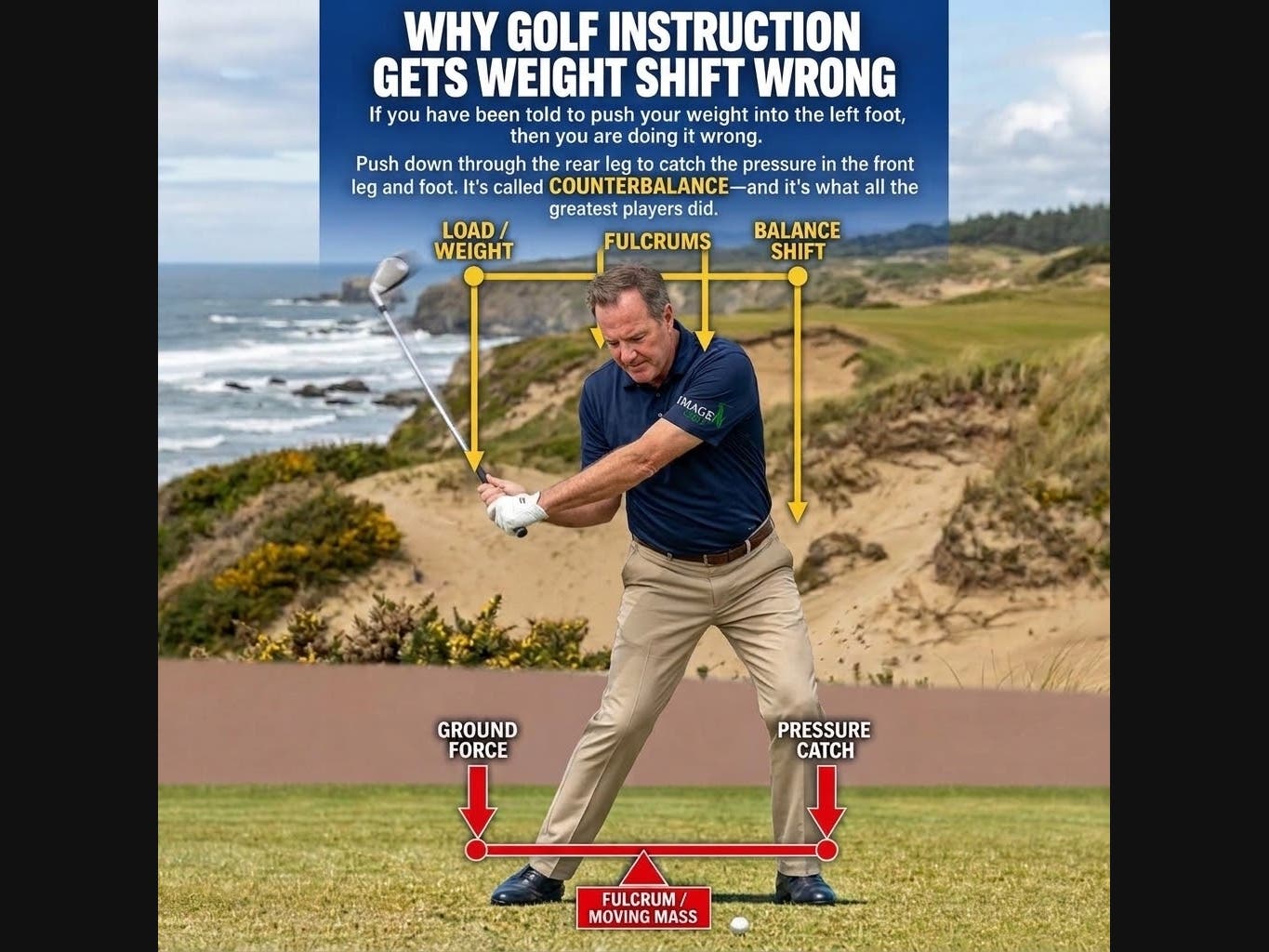
For decades, the standard advice to any golfer struggling with a slice or heavy contact has been: "Shift your weight to your left side."
This is arguably the most misunderstood concept in the 700-year history of the game. When average golfers hear "go left," they slide their hips laterally toward the target. This lateral slide destroys rotation, drops the trail shoulder too far down, and results in a weak, glancing blow.
Biomechanical studies have completely shattered the traditional "weight shift" myth.
According to extensive 3D motion capture and force-plate research by leading biomechanists like Dr. Young-Hoo Kwon and Dr. Sasho MacKenzie, peak linear force (the lateral shift to the lead side) actually happens incredibly early—often before the club even finishes its backswing.
By the time the club is traveling down toward the ball, the lead leg is no longer shifting left. Instead, the lead foot is pushing down and forward into the turf. Because the ground pushes back, this creates a massive braking force that pushes the lead hip up and back.
Imagine riding a bicycle at top speed and slamming on the front brake; the bike stops, and you fly over the handlebars. In the golf swing, your lead leg is the brake. By posting up and pushing back against the ground, you create a rapid deceleration of the lower body, which acts as a catapult, violently firing the upper body, arms, and clubhead through the ball.
You don't "go left" through impact. You brake hard on the left side to send the clubhead forward.
Stop Posing, Start Moving
If you are an average golfer feeling stuck on a plateau, you need a paradigm shift. Stop agonizing over where your club is pointing at halfway back. Stop trying to muscle the clubface square at impact.
Your brain is incredibly adept at athletic motion when you get out of your own way. You don't think about your elbow angles when you throw a baseball; you shift your pressure, plant your foot, and let it fly. The golf swing is no different.
Focus on the pressure in your feet. Feel the sequence of pushing the ground away. Let the club react to your body, rather than trying to force your body to react to the club. When you finally embrace the physics of forces, pressures, and opposites, you stop playing "golf swing" and start playing golf.
Keywords: Golf biomechanics, stop chasing golf positions, ground reaction forces in golf, golf swing sequence, Dr. Young-Hoo Kwon, golf kinematic sequence, creating lag in golf, golf weight shift myth, ImaGEN Golf, Daniel Guest golf instructor.
Hashtags: #GolfBiomechanics #StopChasingPositions #GroundReactionForces #GolfSwingTips #ImaGENGolf #DanielGuest #GolfInstruction #PlayBetterGolf #KinematicSequence #GolfPhysics