Schools
Teachers Get Green Education
Area teachers learned how the rain garden and porous pavement constructed during Mercer Museum's recent expansion help the environment.


Mary Ellen Noonan knows firsthand the fury of stormwater runoff.
When a deluge of rain hit Doylestown a few years ago, she found out living downhill from the center of town wasn’t exactly the best place to be.
The rain fell harder and faster than it could be absorbed in the ground, so water started flowing down the street toward Noonan's property.
Find out what's happening in Doylestownfor free with the latest updates from Patch.
Gravity, being what it is, moves water to the lowest point. That included the water coming off the paved surfaces at . The river of water traveled south on Green Street and then continued downhill past her house on Hillside Avenue.
The force of the water caused the railroad tie wall at the end of her driveway to collapse.
Find out what's happening in Doylestownfor free with the latest updates from Patch.
That's one reason Noonan was concerned when Mercer Museum officials for the museum on Doylestown's Pine Street.
It was Karl Janetka’s job to figure out how to turn that situation around.
Janetka, the engineering department manager of Van Cleef Engineering Associates in Doylestown, along with colleague and landscape architect L. Scott Mill, discussed some of the steps they implemented to curb stormwater runoff at the museum.
Noonan and Janetka were at Mercer Museum recently, speaking at part of a three-day watershed education workshop for teachers, sponsored by the Bucks County Conservation District.
“One of the biggest challenges we had was how do we manage stormwater on the site?” Janetka recalled.
Two approaches were establishing a rain garden, and re-grading and installing porous pavement in the parking lot closest to Green Street, which runs in front of the museum.
Both were ideas in keeping with Bucks County Historical Society’s desire to use sustainable building practices, Janetka said.
Before the renovation, when it rained, water would run down Mercer’s “sledding hill” along East Ashland Street, into a small inlet and then a storm sewer along Green Street – often flooding the area, if the volume of water couldn’t be absorbed quickly enough.
Both the permeable material of the parking area and the rain garden help to better retain and control stormwater runoff, Janetka said.
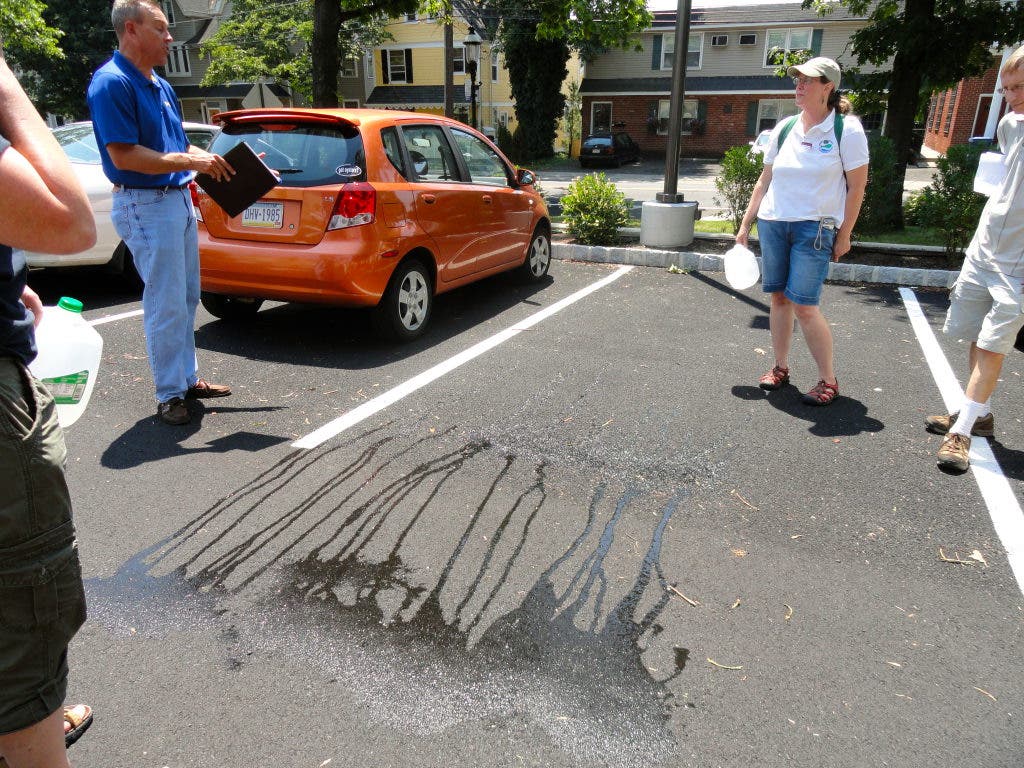
The group had a chance to see the system in action by conducting a small experiment of their own.
Noonan, who’s also an educator for the conservation district, and teacher Carol Golding each emptied a gallon jug of water – one on the asphalt-paved driveway and the other on the porous pavement.
The water poured on the driveway immediately ran downhill and ended up on the side of the porous pavement. The water that was poured directly on the porous surface almost immediately started to be absorbed into the ground.
One of the teachers questioned why the permeable paving system wasn’t used on the entire paved surface.
Janetka said since construction is more labor-intensive and a bit more expensive – up to 20 percent more than regular asphalt paving – it is usually relegated to areas that would benefit most.
“The idea is to try to limit the areas where it’s used and take advantage of the natural lay of the land, where you’re doing as little as you have to. The key to this being a viable, long-term system is good operation and maintenance.”
Street sweepers should clean the porous areas of debris at least twice a year and the inlets should be vacuumed out as well, he said.
The museum’s rain garden, a quarter of an acre of perennials, shrubs and native trees, replaced a grassy area, said Mill. It’s an alternative to a traditional retention basin.
The graded depression and the plants in it help absorb rainwater, thereby also reducing flooding.
As it requires less mowing, it is also easier to maintain, he said, but it still requires educating people who might view it as an “ unkempt, untidy garden.”
The group also stood at the top of W. Ashland Street and viewed the “green” roof that covers the museum's new 13,000 square foot addition.
Already quite common in Europe, “You’re going to be seeing more and more of these” in the States, said Janetka.
Mercer’s is planted with sedum, a hardy succulent. It provides insulation during winter weather and can reduce air conditioning costs during the heat of summer.
Water discharge from the green roof goes into Mercer’s rain garden.
At this point, Noonan feels the museum did a good job implementing stormwater management practices.
“They have three good management plans in place there,” she said.
The next “hellacious rain,” which dislodged Noonan's railroad ties, might be the deciding factor.
More than a dozen teachers, mostly from Central Bucks, , for which they earned continuing education credits.
Aside from classroom time, they also visited Ralph Stover State Park and the Giving Pond in Upper Bucks as well as the Quakertown Swamp.