Community Corner
Who Designed the World War I Memorial Fountain?
The History Guy tells how the monument to "the war to end all wars" was created and what makes it unique.
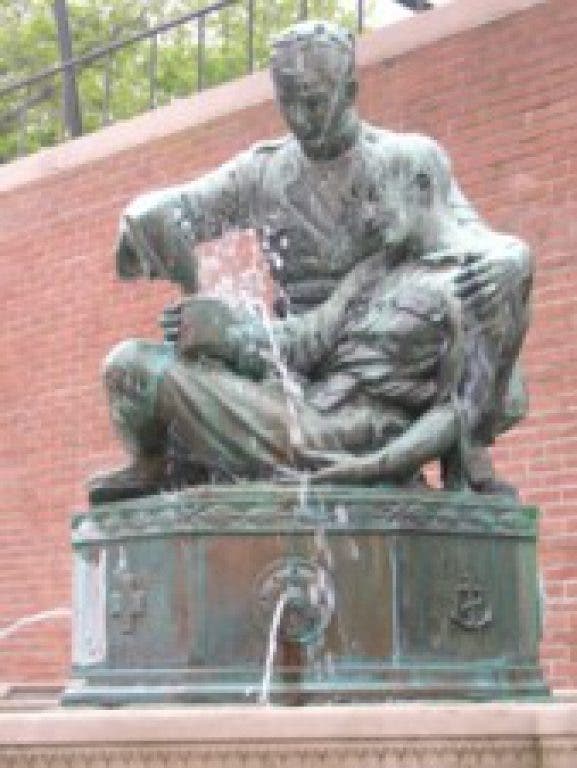
The World War I Memorial Fountain, at Broad and Main streets next to the Bucks County Courthouse, is one of the most unusual war monuments I've ever seen. Since Veterans Day originally commemorated the Nov. 11, 1918 armistice that ended World War I, this is an appropriate time to ask about the memorial. Who designed it and what is the significance of the statue of the two wounded doughboys that is the centerpiece of the fountain? - H.F., Doylestown
The fountain was dedicated at 2 p.m. on Memorial Day, 1922, following a parade through Doylestown that included 200 veterans of what was then called the "World War," as well as members of the Grand Army of the Republic (Union veterans of the Civil War).
Find out what's happening in Doylestownfor free with the latest updates from Patch.
"Thousands looked on Memorial Day as three Doylestown young women, sisters of soldiers who gave their lives during the World War, unveiled the impressive and beautiful memorial fountain dedicated by the people of the community," the Doylestown Daily Intelligencer reported the next day.
"And as the flag was lifted, revealing the bronze group of statuary depicting one wounded soldier ministering to the relief of a comrade more sorely injured, the audience as one person broke into applause," the article continued.
Find out what's happening in Doylestownfor free with the latest updates from Patch.
The newspaper described the memorial as follows: "The life-size bronze statuary group, which surmounts a monolithic bowl of blue Indiana limestone, leaves out all of the bitterness of war and accentuates service and humanitarianism. It avoids the idea of carnage, slaughter and devastation, and impressively pictures the 'buddy' spirit of the American soldier and the beauty of human sympathy.
"The group is the principal feature of the memorial. It depicts one injured soldier, kneeling, ministering to a more sorely injured 'buddy,' who reclines on his arm, pouring water from his canteen into a cup clutched by the fevered fingers of his companion. The water running into the cup escapes through the interior of the monument, and comes out through decorative apertures on four sides of the bronze base into the monolithic bowl."
A committee formed to produce a World War memorial for Doylestown considered many designs for tablets, monuments, fountains and flagstaffs before selecting the creation of William R. Mercer (1858-1939), a Doylestown sculptor and craftsman who was the brother of Henry C. Mercer. John Bateman, a sculptor from Haddonfield, N.J., made the fountain, which cost $8,500.
William Mercer used two World War I veterans from Doylestown, Raymond Rutherford and Russell Gulick, as his principal models, although a half dozen or so local soldiers posed at some point, according to the Intelligencer. Mercer worked in his studio at Aldie, his home that was the predecessor of .
In a 1960 Intelligencer article, Rutherford recalled how he and Gulick were asked to come to Aldie in full uniform on a "very hot Saturday morning."
"I believe at the time we did not know why we were going, only that Mr. Mercer wanted to see us. When we arrived, Mr. Mercer told us we were to be the models for the World War I memorial," said Rutherford, then 60.
"We posed on a wooden, revolving platform outside of Mr. Mercer's studio...four pictures were taken. Mr. Mercer directed the operation," Rutherford related.
"As I understand, a plaster of Paris model was made from the pictures and from this model the bronze creation. A fill-in or substitute was used for the exact details of the uniform and equipment," he said. "After the picture-taking, Russ and I were treated to a glass of ginger ale (plain, ha)."
Mercer's final sculpture differed somewhat from the photographs, which were handed down in the Rutherford family (Raymond Rutherford died in 1987 at age 87). For example, Rutherford wore a helmet while pouring a canteen for Gulick, who was almost prone. The finished statue has the canteen-pourer wearing a head kerchief and the other soldier in a sitting position. The men's actual faces were not reproduced.
The octagonal base of the fountain, into which the water flows, also is of interest. One panel has this inscription: "In commemoration of the valor and sacrifices of the men and women of Doylestown and the surrounding country who served in the World War this memorial is placed here by their fellow citizens."
The other seven panels depict the names of four World War I battles--Chateau Thierry, Montfaucon, Fismes and Meuse-Argonne; a bas relief of a soldier, an ambulance and a town in France; a bas relief of rows of marching soldiers; and the Bucks County seal.
When he delivered the dedication address in 1922, Judge William C. Ryan said the memorial would serve as a permanent reminder of the sacrifices of those who served in the World War.
"But time will dim its details and efface the memory of the names and deeds of those who, on bloody fields, and on the sea, in the military service, and in the innumerable other activities in foreign lands and in the homeland, wrought out the glorious result. It is altogether meet [proper], therefore, that we of this generation should erect these memorials that shall remain to tell the story to future generations after we shall have passed away. It is the story of the American spirit that we would perpetuate," he said.
"For the design of this beautiful memorial we are indebted to the genius of a patriotic fellow citizen. He has embodied in it a phase of war that is born of human sympathy. It depicts that comradeship that remains a precious memory to all returned soldiers. It symbolizes that service of mercy so conspicuous in those troubled days. Does it not suggest also the duty of our country, only slightly wounded, toward those lands of the Old World upon which the blows of war fell so heavily?"
"As this beautiful fountain shall stand here, by this busy highway in the years to come, may it speak to those who come and go the lesson of the cup of cold water in the name of Him whose mission on earth was peace," the speaker concluded.
The History Guy has seen dozens of World War I memorials in towns in Pennsylvania, New Jersey and other states. Most, like the ones in Fallsington and Quakertown, depict a doughboy either standing at attention or charging into battle.
William Mercer's World War I Memorial Fountain is as unique as his brother Henry's and .