Health & Fitness
Another Tick-Borne Disease In PA — With Potentially Strange Side Effects
Another tick-borne disease has spread to PA, and it may produce some strange side-effects that could impact the way people eat.


A tick that produces a rash similar to that of Lyme disease has spread to Pennsylvania, and it may produce some strange side effects that could impact your diet.
The lone star tick produces southern tick-associated rash illness, or STARI, that can lead to fatigue, fever, headache, muscle and joint pains, according to the Centers for Disease Control and Prevention.
But there's another potential symptom that you may not have expected: an allergic reaction to red meat.
Find out what's happening in Newtownfor free with the latest updates from Patch.
Thomas Platts-Mills, the director of the University of Virginia School of Medicine’s allergy division, told nj.com that research shows that people who have been bitten by the tick have suffered a meat allergy called alpha-gal.
"If you're allergic to shrimp, well, most people don't eat shrimp every day. So if you have a reaction to shrimp, you know it. People come in and tell us they're allergic to shrimp, and they're usually right," Platts-Mills told nj.com.
Find out what's happening in Newtownfor free with the latest updates from Patch.
The publication cited one victim, Jerry Dotoli of Ocean County, New Jersey, who had gone to Florida for the winter and was beset by frequent hives accompanied by a ferocious itching "four times worse than poison ivy." Dotoli got a blood test and was told he had become allergic to meat, pork and dairy, with the possible culprit being a lone star tick.
Pennsylvania health officials says they do not keep statistics on how many people have been bitten by the lone star tick because the rash too closely resembles Lyme disease. But the Pennsylvania State University Department of Agricultural Sciences said the tick is among the four most common in the state, and the four account for 90 percent of patient submissions for identification.
Read more: Dangerous Tick-Borne Disease Spreads To PA, CDC Warns
Here is where the tick has been found:
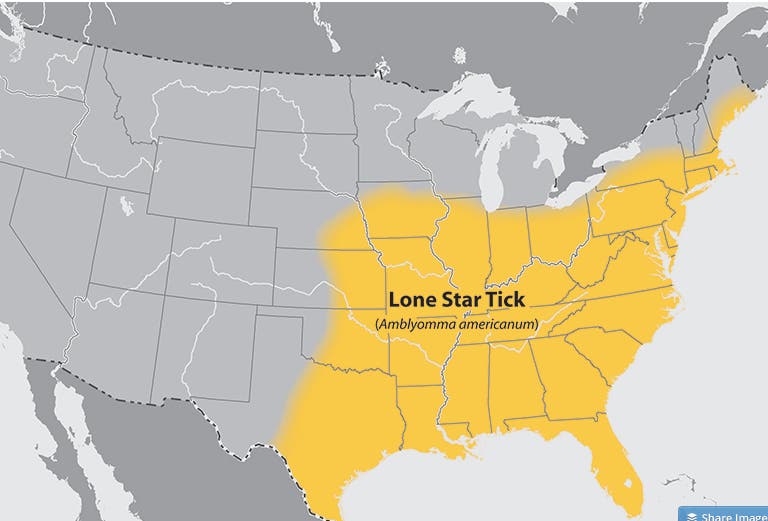
In a New Yorker interview, Platts-Mills also cited a recent study published in the New England Journal of Medicine that identified the cause of the tick-bite symptoms: The allergic patients had pre-existing antibodies to alpha-gal.
A 43-year-old hunter came into his Virginia clinic claiming that he had suffered from three separate severe allergic reactions to eating beef, which contains alpha-gal. When Platts-Mills asked about ticks, the hunter revealed that his feet were covered with bites, according to the article.
Here are some other potential symptoms:
The rash of STARI is a red, expanding “bull’s-eye” lesion that develops around the site of a lone star tick bite. The rash usually appears within seven days of the tick bite and expands to a diameter of 8 centimeters (3 inches) or more. The rash should not be confused with much smaller areas of redness and discomfort that can occur commonly at the site of any tick bite. Patients may also experience fatigue, headache, fever and muscle pains. The saliva from lone star ticks can be irritating; redness and discomfort at a bite site does not necessarily indicate an infection.
STARI is diagnosed on the basis of symptoms, geographic location and possibility of tick bite. Because the cause of STARI is unknown, no diagnostic blood tests have been developed. Researchers once hypothesized that STARI was caused by the spirochete, Borrelia lonestari; however, further research did not support this idea.
It is not known whether antibiotic treatment is necessary or beneficial for patients with STARI. Nevertheless, because STARI resembles early Lyme disease, physicians will often treat patients with oral antibiotics.
CDC photo
Get more local news delivered straight to your inbox. Sign up for free Patch newsletters and alerts.