Health & Fitness
Cases Of Mysterious Polio-Like Illness Double In PA: CDC
The eight cases represents a more than doubling in Pennsylvania since October, when state health officials put out a warning to residents.


PENNSYLVANIA — Public health officials remain perplexed about a mysterious paralyzing illness — acute flaccid myelitis, or AFM — that is occurring in record numbers this year. The federal Centers for Disease Control and Prevention said Monday that more than 150 children in 36 states have come down with the polio-like illness, including now eight in Pennsylvania.
The eight cases represents a doubling in Pennsylvania since this fall, when state health officials put out a warning to residents. In October, officials in Pennsylvania had confirmed a third case of the rare but dangerous polio-like condition. In addition to the three confirmed cases of acute flaccid myelitis in the state at that time, there was also a suspected case.
The CDC said in a conference call with reporters Monday that it remains unclear what is behind the illness that causes some children to lose the ability to move their face, neck, back, arms or legs. The symptoms tend to appear about a week after they have had a fever or respiratory disease, CDC officials reported. No one has died this year, but AFM was linked to one death in 2017 and it may have caused other deaths in the past, the CDC said.
Find out what's happening in Newtownfor free with the latest updates from Patch.
Health officials have ruled out polio virus as a cause of AFM, but it can be just as devastating as the illness that once struck tens of thousands of U.S. children a year, resulting in lasting paralysis in some children. However, most kids who contract it do recover, the CDC said.
Polio was virtually eliminated after the introduction of a polio vaccine that became available in the 1950s.
Find out what's happening in Newtownfor free with the latest updates from Patch.
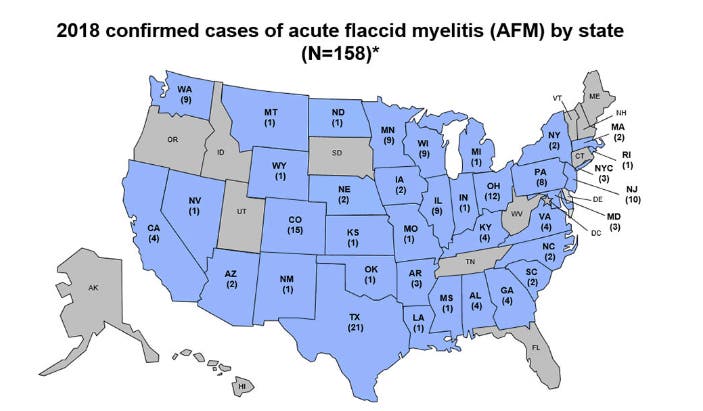
The agency said there have been 158 confirmed cases this year, but public health officials are investigating almost double that number — 311 — of suspected AFM cases. For an illness to be counted as AFM, the diagnoses must include an MRI scan that show lesions in the part of the spinal cord that controls muscles, the CDC said.
Here's a look at the number of cases by state:
About half the kids who have come down with the mysterious illness this year were admitted to hospital intensive care units and hooked up to machines to help them breathe, the CDC said.
In 2012, three cases of limb weakness were reported in California, but the first real wave of the illness occurred in 2014, when 120 cases were reported. In 2016, there 149 cases. The number of cases was significantly lower in 2015 and 2017 — another head-scratcher for public health officials.
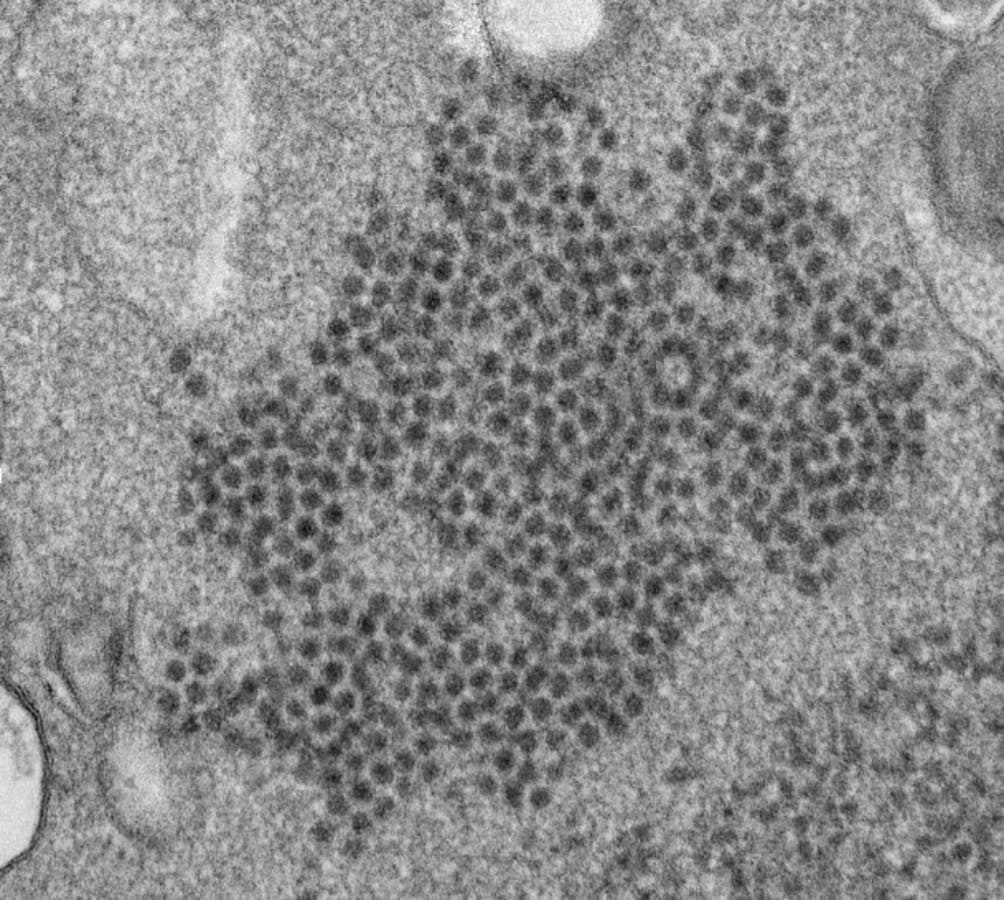
The wave of AFM illnesses in 2014 corresponded with a virus called EV-D68. That “remains the leading hypothesis,” Dr. Ruth Lynfield, a member of a 16-member task force the CDC appointed to investigate AFM.
But there’s some disagreement among the medical detectives. There have been waves of AFM in years when the EV-D68 virus wasn’t active, and testing doesn’t confirm the presence of the virus in every case. Also, EV-D68 infections aren’t new in kids and many Americans carry antibodies against it — so why would the virus suddenly cause a paralyzing illness?
“This is a key question that has confounded us,” said the CDC’s Dr. Nancy Messonnier, who is overseeing the agency’s investigation into the outbreak.
Equally mysterious is why AFM cases surge in two-year cycles. And here’s another wrinkle: More than 17 countries have reported scattered AFM cases, but haven’t seen the same cyclical surges reported in the United States.
When there is a wave of cases in the United States, they typically spike in September and taper off significantly by November. The problem has peaked this year, but the CDC said last week but the number of cases could go up as investigators continue to look at not-yet confirmed cases.
The states with the greatest number of AFM cases this year are Texas (21) and Colorado (15), but the state tallies may not truly represent where the illnesses are happening. Colorado was hit hard in the 2014 outbreak, and doctors there may simply do a better job of diagnosing the illness, the CDC said.
"AFM is a rare condition. It's also a serious condition. So we want to encourage parents to seek medical care right away if you or you child develop symptoms of AFM such as sudden weakness or paralysis of the arms and legs," Messonnier said during a fall conference call.
Some with the illness may notice facial droop or weakness, difficulty moving eyes, drooping eyelids, or difficulty swallowing or slurred speech, according to the CDC. In some rare cases, AFM may cause numbness or tingling in the limbs, the inability to pass urine and breathing difficulties due to muscle weakness that require urgent ventilator support, the CDC said.
With reporting by Beth Dalbey, Patch
The Associated Press contributed to this report.
Image: This 2014 file electron microscope image made available by the Centers for Disease Control and Prevention shows numerous, spheroid-shaped Enterovirus-D68 (EV-D68) virions. Doctors have suspected a mysterious paralyzing illness, acute flaccid myelitis, might be tied to the virus. This year has seen a record number of cases of the mysterious paralyzing illness in children, U.S. health officials said Monday, Dec. 10, 2018. (Cynthia S. Goldsmith, Yiting Zhang/CDC via AP, File)
Get more local news delivered straight to your inbox. Sign up for free Patch newsletters and alerts.