Schools
Ghana Educator Inspires own Heritage Academy Students and Those at Ursinus
Kwesi Koomson's gentle guidance and passion for education produces excellence.
In Ghana, West Africa, students must pass two national tests. In ninth grade, if a student fails this exam, he or she does not continue with his or her education. The same is the case in their 13th grade national exams.
In 2003, only 42 percent of students in the area in which Heritage Academy now stands were passing the national academic proficiency tests in Ghana.
In 2004, its first year of functionality, Kwesi Koomson’s Heritage Academy produced a 100 percent proficiency rate on the national tests, and has continued to do so every year since. How is such a tremendous change even fathomable?
Find out what's happening in Perkiomen Valleyfor free with the latest updates from Patch.
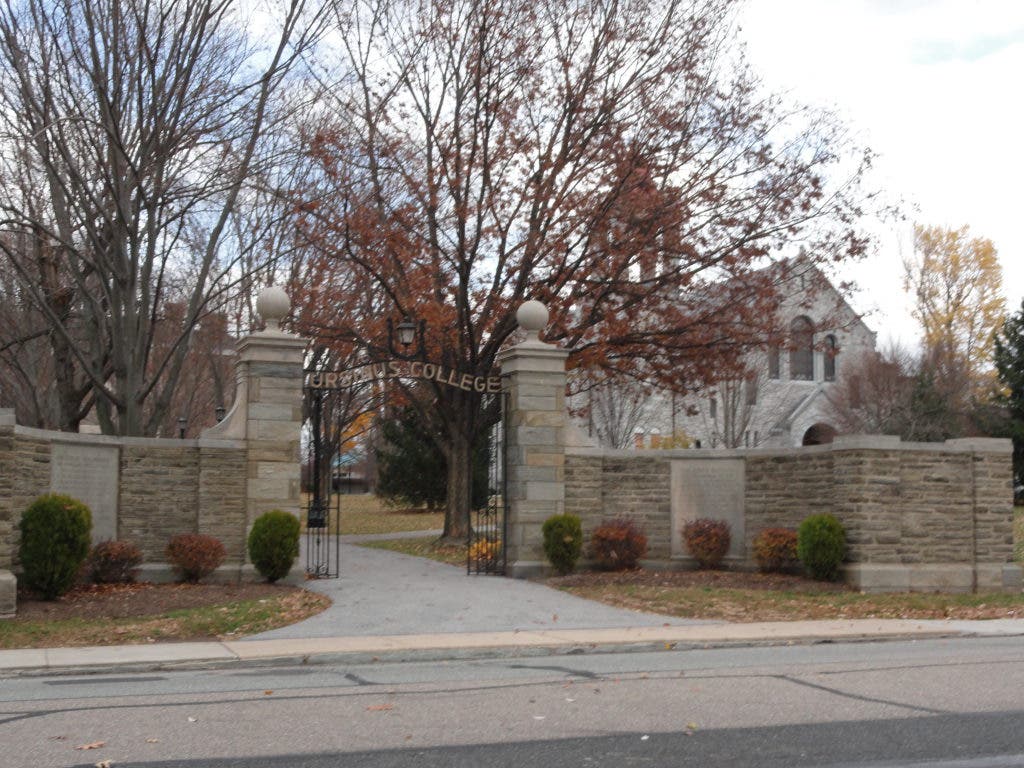
Ursinus students and faculty were given the remarkable opportunity to share in Koomson’s fascinating journey during his talk, “A Simple Beginning,” earlier this month in Ursinus’ Pfahler Auditorium.
Koomson was born and raised in a small village in Ghana. In his adolescence, he received a unique scholarship to complete his high school studies in England, and from there another scholarship to Franklin and Marshall College in the United States.
Find out what's happening in Perkiomen Valleyfor free with the latest updates from Patch.
His interests during his own education were initally centered on medical studies.
“I was going to be a doctor since I was this high,” Koomson laughed, bending to the floor.
An experience at the Lancaster Hospital during his senior year, however, quickly changed his mind. While shadowing a doctor there, Koomson came across the case of a small boy who had been hit by a stray bullet while riding his bike.
“I’m embarrassed to admit it,” he said, “but I ran away.”
This experience led Koomson to truly consider why he had spent a lifetime wanting something of which he knew very little, and these considerations led him, after earning his M.A. in mathematics from Villanova University, to the Heritage Academy.
Koomson founded Heritage in 2004 in Ghana, establishing the school with 32 students in the local United Calvary Church. The community where the school was founded was more than eager to facilitate its success.
Within a short time of his announcing plans for the school, Koomson had volunteers willing to make the school’s furniture, teach the school’s students and cook their food.
“But we had no students,” Koomson joked.
As soon as the time came for the school to open its doors and hopefully recruit its first 24 students, more than 100 children flooded the church, wanting to become a part of Heritage.
Koomson and his staff selected 32 of the children in 2004, only because space in the church was limited, but the team has been expanding the visions of the school and accepting more students each year since.
In 2005, Heritage moved its campus to the buildings and warehouse of a company which had gone out of business many years before. Within two weeks of the academy’s acquisition of the property, all the classrooms had been filled.
Since then, the school has acquired a separate campus to educate more students and is currently converting the warehouse into a two-story building.
So why Heritage? Its popularity and success are unprecedented, especially in the village of Ghana. What is its secret? Koomson was happy to highlight a couple quick tips with querying students.
First off, he shared, the teachers at Heritage do not cane their students. In most other schools in the area, bad behavior results in being “caned,” or hit with a cane, but instructors at Heritage do not even have canes in their possession.
Koomson laughed, recalling the PTA meeting at which this policy was announced. Parents were confused, he remembered. They couldn’t understand how the teachers would keep behavior in check or how discipline would be implemented.
Koomson’s argument was this: Misbehaving students who have been threatened with being caned will learn to behave, but only in the view of those who threatened to discipline him or her. However, addressing each behavior specifically and rationally results in the overall reconstruction of behavior.
Koomson told parents to give him three months. If, at the end of those three months, behavior was any worse than it had been at the start, he promised to take a field trip to buy every parent of every student of the school a cane with which to punish their children themselves.
Needless to say, the gifted teacher never had to make that trip.
There are many other special aspects of the school. The extended school day (8:30 a.m. to 3:30 p.m.) is particular to Heritage because other schools in the area do not feed their students lunch and, instead, send them home for the sake of financial savings.
The pen-pal program the school endorses also plays a role in the education of a Heritage student. Koomson noted a direct, positive correlation between each student’s pen pal contact and his or her test scores.
A focus on well-roundedness also plays an integral part in the definition of Heritage. A general knowledge class provides a way for students to engage intellectually in a classroom without lesson plans.
“Try explaining what skiing is to students four degrees from the equator,” Koomson laughed. “There are kids who live 11 miles from the beach and have never seen the sea before.”
Heritage makes it a point to immerse students in the unknown and to educate them not only in their academics, but in life and possibility.
Heritage demonstrates this enthusiasm for life and learning in its continual expansion of the school and of its horizons, with Koomson enthusiastically behind them every step of the way.
“I feel like I owe it to the next generation to do something for them,” he told the group of Ursinus students.