Politics & Government
Developer Changes Hotel Proposal, Offers to Settle Suit with Township
Threatens further legal action as backup plan.

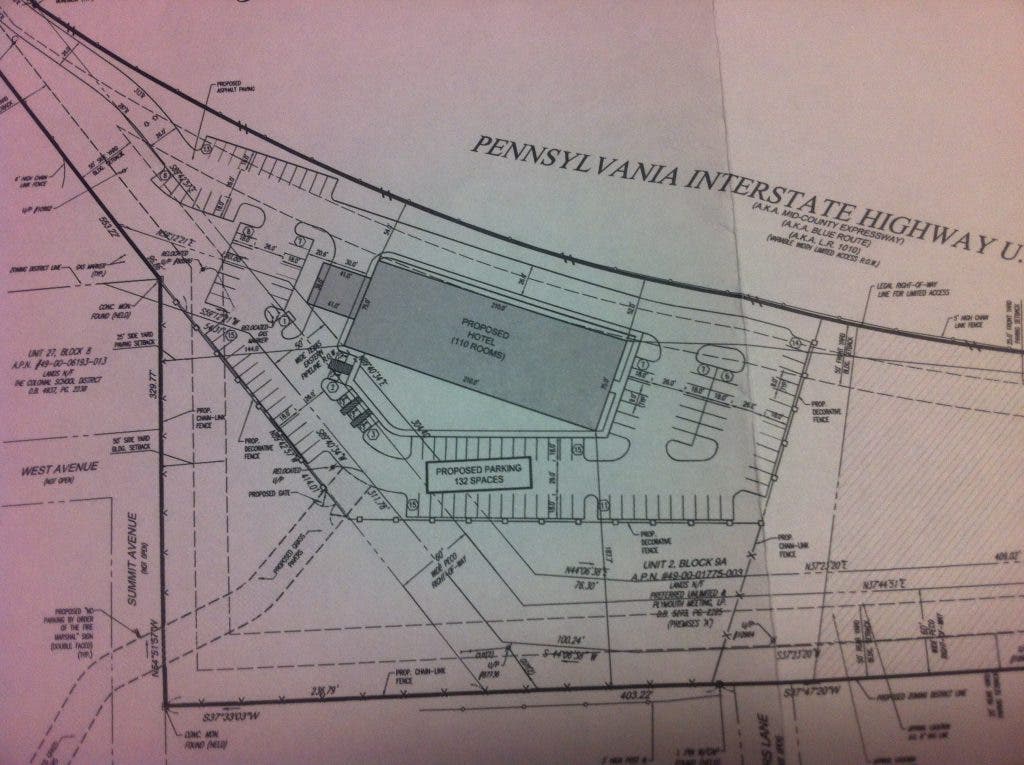
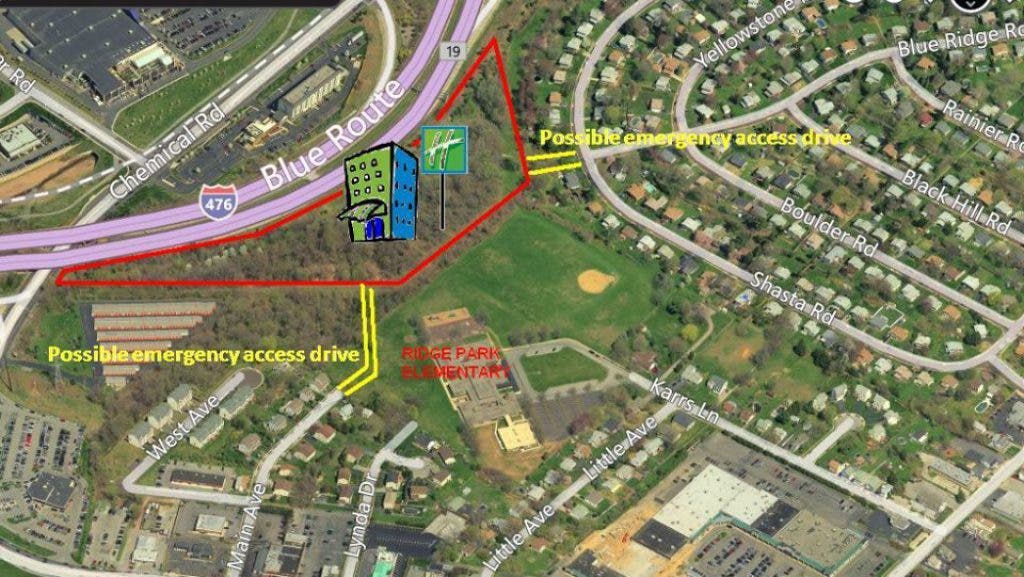

Prime Hotels, Inc. has provided Plymouth Township with an updated proposal to build a hotel on a lot next to Ridge Park Elementary in Plymouth Meeting, along with a settlement offer for a currently existing lawsuit filed by the developer. The specifics of the proposal, which includes increasing the hotel's size but moving it away from surrounding neighborhoods and adding safety precautions, was presented before Plymouth Council Monday night.
The offer follows an original to build an 82-room hotel on the oddly shaped eight-acre property, which is framed by the school, the Blue Route, and the neighborhood of Plymouth Park. A skinny northwestern arm of the property stretches to 2005 Chemical Road, where cars would enter and exit via a long driveway.
Find out what's happening in Plymouth-Whitemarshfor free with the latest updates from Patch.
The township's Zoning Hearing Board and Planning Agency voted against the proposal in December, by respective 4-1 and 3-3 votes, after expressing concerns over the hotel's impact on local neighborhoods and traffic, proximity to the school, and adherence to zoning code.
Attorney Craig Robert Lewis then filed an appeal with the Montgomery County Court of Common Pleas on behalf of his client in February, in an attempt to overturn the ZHB decision. The case has not yet been heard.
Find out what's happening in Plymouth-Whitemarshfor free with the latest updates from Patch.
Craig Robert Lewis claims that his client has been attempting to build on the property for several years, but that the township has denied each proposal.
"For at least five years, the owner has been seeking the right to develop this property," Lewis said. "We have submitted several different proposals, ranging from a series of restaurants and office developments…in each and every instance we have been met with opposition."
Lewis also said that the property holds "numerous challenges" to development, including its odd shape, topography, and split zoning of light industrial and residential. Lewis said he thinks his client has a strong chance to win in court and be granted the necessary variances.
"I believe we have a strong case before the Court of Common Pleas… it is a fundamental tenant of Pennsylvania law that every single property owner has the right to use and enjoy property," Lewis said. "Thus far, the application of Plymouth Township Zoning code… has done nothing but sterilize this property."
Lewis also looked to exert additional pressure on the township by stating that should his client lose the appeal in the Court of Common Pleas, they will file a second lawsuit alleging "inverse condemnation." Inverse condemnation is a legal process by which the client claims that government has over-regulated a property to the point that it is no longer usable. Under the 5th Amendment, government can not "take" land without condemning and paying for it, which becomes the ultimate goal in inverse condemnation proceedings.
"That may be where this is headed," Lewis said. "If we lose [the current case], the next step for us is that we're left with no option but to file an inverse condemnation claim."
However, several Plymouth Township officials have said that the property does present opportunities to develop. Minutes from the December Zoning Hearing Board meeting show that solicitor Joseph McGrory asked representatives of Prime Hotels why a catering business, printing business, or warehouse would not work on the property. Minutes show that the representatives responded that no studies had been done for those businesses, but that a warehouse would likely encroach on the residential district.
Further, section 1400 of the Plymouth Zoning Code outlines a number of uses for limited industrial zones, including material or food manufacturing, wholesale trade, food service, printing, public utility, laboratories and warehouses. While a subsection does allow for the use of hotels, it is under the condition of 500 feet of continuous frontage along a highway and location in the township core, neither of which the property meets.
In an attempt to address previous concerns expressed by the township and residents, Lewis also presented the following changes to the proposal:
- Moving the building as close to I-476 as possible, away from the school and residential areas.
- Increase in size from 82 rooms to 110 rooms, to attract "higher quality" franchises.
- Decrease required number of parking spaces to 1.2 per room.
- Reduce impervious surface.
- Create 2.5-acres of open space as buffer to residential district, for possible dedication to township or school district.
- Disallow the development of the rest of the property except for hotel or office use.
- Construction of decorative fence to surround hotel's footprint and "contain" users to property.
- Construction of chain-link fence to surround the entirety of the property with the exception of the open space area to keep out individuals.
- Construction of emergency access road to Main Avenue, with locked gates, only accessible by fire personnel.
- Widen driveway to 26 feet to address fire concerns.
Plymouth Council said very little in response to the presentation. Township solicitor Thomas Speers inquired about construction vehicles accessing the site through residential neighborhoods. Lewis replied that only one trip would be necessary to clear an access road down to Chemical Road, through which the rest of the vehicles would enter.
Public comment was not accepted at the meeting, as it was Council's monthly workshop session. Council will likely discuss the proposal at Monday's legislative session, where public comment is on the agenda.
Get more local news delivered straight to your inbox. Sign up for free Patch newsletters and alerts.