Health & Fitness
An Invasive Insect Threatens your Gardens: Viburnum Leaf Beetle
The viburnum leaf beetle, an invasive species from Europe, is advancing and it may destroy all the local viburnums.


Viburnums are handsome shrubs or small trees that grace our forests and gardens. Most have white flowers in the spring grouped in umbrella shaped corymbs. Their berries provide food for many birds during the fall and winter. They grow well in shade, as well as in some sunshine. One of them, arrowwood, gets its name for its long, strong, straight shoots. Native Americans used them to make arrows.
If you have viburnums in your garden it may be a good idea to check them for a new pest which has been spreading across North America.
Last spring, Mark Fallon, senior naturalist at Briar Bush Nature Center (Abington) noticed some grubs devouring the leaves of arrowwood bushes.
Find out what's happening in Upper Moreland-Willow Grovefor free with the latest updates from Patch.
The insects were new to him. No wonder! They had never been seen in Southeastern Pennsylvania before. We identified them as the viburnum leaf beetle (VLB, for short) with the help of an excellent website, Bugguide.net, and proceeded to report them to the National Agricultural Pest Information System.
Mark felt excited at first when he saw this new bug. His feelings changed when he realized that we were dealing with an invasive non-native species. Many native beetles eat leaves; in fact, they are called leaf beetles for this reason.
Find out what's happening in Upper Moreland-Willow Grovefor free with the latest updates from Patch.
Usually, they don't cause serious harm, just some tolerable damage year after year. They rarely get out of control, because the natural enemies or the natural defenses of the plants themselves are enough to keep them in check. To people like Mark, such creatures are welcome because he knows that these insects are food for the wild birds and their babies.
Non-native species can be another story altogether.
They leave most of their natural enemies behind when they arrive in a new land, and they encounter plants unprepared to counterattack a new pest. Thus their numbers grow unchecked, free from such restraints, causing more and more damage each year, and ultimately destroying entire populations of plants.
This is becoming the case with the viburnum leaf beetle.
It arrived in eastern Canada, probably with some nursery stock. It came from either Europe or Asia almost a hundred years ago. In the last thirty of forty years, it began spreading into several states and Canadian provinces, attacking several species of viburnums, arrowwood in particular, which seems to be the most vulnerable. It can turn a healthy shrub into a grey skeleton in just two or three years.
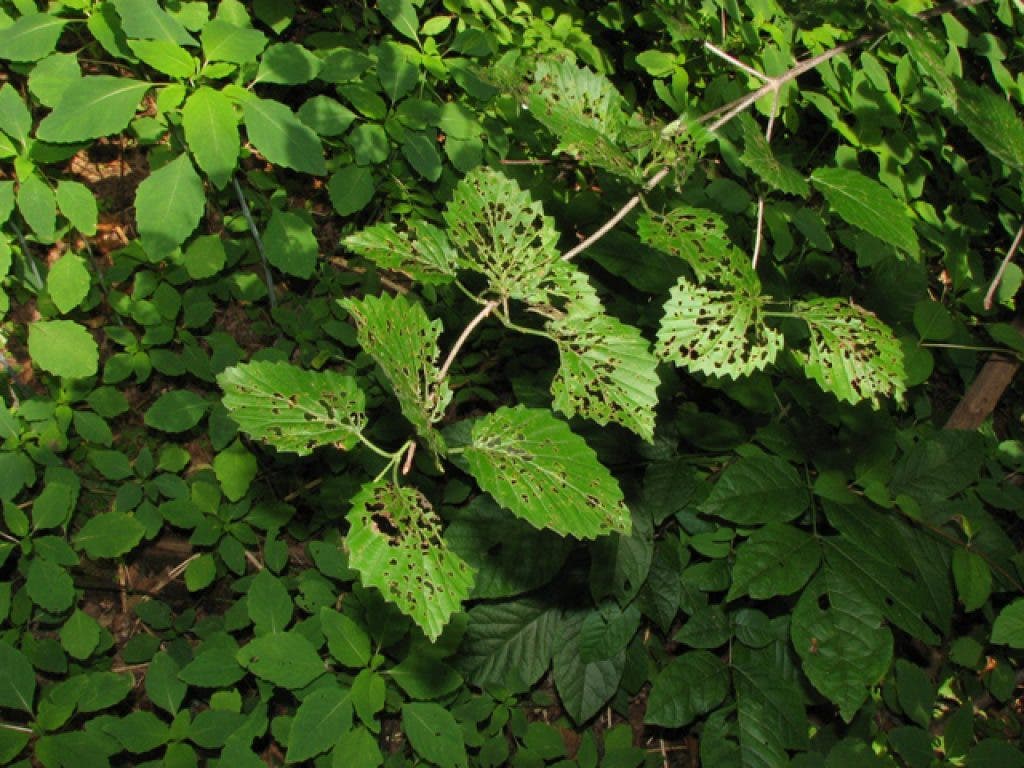
The larvae or grubs are active in the spring. They are about the size of a grain of rice or smaller, yellow-greenish with black dots. They make characteristic holes on the leaves of arrowwoods.
By mid-June, they crawl underground, and for about a month there is no visible activity. Around mid-July, the adult beetles emerge and start adding more holes to the leaves. They continue to be active until the fall. The beetle is no bigger than the larvae, brownish with a coppery shine. It is hard to catch because it drops promptly from the leaf it is feeding on if disturbed.
The females chew little holes arranged in rows on the underside of twigs near the ends of branches; they lay about eight eggs in each hole and plug them with sawdust and feces.
During the fall and winter, it is relatively easy to spot these egg masses and to remove them, although this can be time-consuming and impractical if you have more than one or a few shrubs, or if they are too tall.
There are a few equally laborious methods to combat the grubs or the adult beetles. In the spring, you can prevent the larvae from crawling down the stems of the shrub by using sticky tape.
There are also some detergent mixtures to sprinkle on the leaves where the larvae are feeding. Adult beetles can be caught by spreading a white sheet under a bush and shaking the branches.
For more information, you can consult the following pages, where you will find a number of resources and additional information as well as illustrations: "Viburnum Under Siege, part I" and "Viburnum Under Siege, part II".
At Briar Bush Nature Center, we are doing our best to control this pest. If you have viburnums, it would be wise for you to do the same.