Neighbor News
A Hearing Set for July 15th to Discuss the Future of Quaker Block
The hearing is the first step in a process that will allow the Hickman Friends Senior Community of West Chester to build a new facility





Early last winter, in my Daily Local News editorial, “Will the Hickman Raze It’s Buildings?”, I tried to call attention to a development proposal at West Chester’s Quaker Block at North Walnut and Marshall Street. This area is on the same street and a short distance from the Barclay Grounds, the property currently being acquired by the borough as a passive park .
Only a handful of stories have appeared in the Local – the latest in February which reported on two neighborhood meetings, each attended by fewer than 30 people – and notices about a hearing slated at Borough Hall July 15th, were posted at the Hickman property only last week.
So I write this editorial with haste, with the hope that my fellow neighbors will attend the hearing. More on that later, but I will say that there will be time for public discussion when the meeting begins at 5:30 p.m. I know – the time is not much of an incentive to attend for those who like their early summer evenings, but according to the hearing notice, the discussion is likely to continue at the regular meeting at 7:30 pm).
Find out what's happening in West Chesterfor free with the latest updates from Patch.
The block includes the Friends Meeting house and the West Chester Friends School, but many residents associate this centuries-old neighborhood with a longtime community nonprofit, The Hickman Friends Senior Community of West Chester.
My own association with the Hickman community has included years of attending summer ice cream socials, outdoor concerts, and the annual “Art of Caring,” a major fundraiser that involves local artists who paint items that are then auctioned, often for thousands of dollars.
Find out what's happening in West Chesterfor free with the latest updates from Patch.
I think it was my longtime support of the Hickman and their contribution to the neighborhood’s sense of place, as sociologists might call it , that led to my shock in hearing the news that the Hickman plans to demolish their original 19th-century buildings, which currently stand at Marshall and N. Walnut Streets.
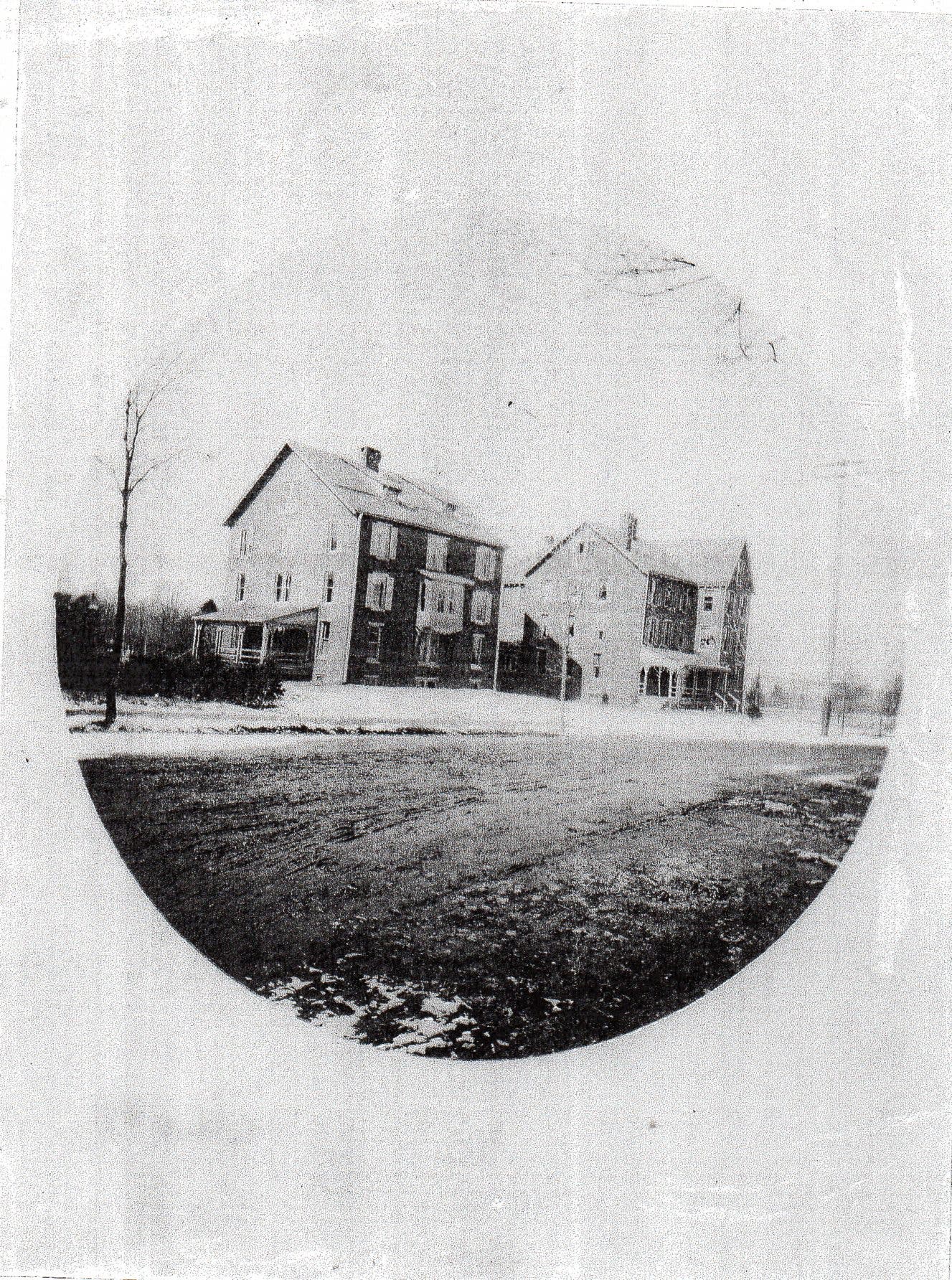
Recently, the Hickman changed their design plans for the “Sharpless-Hall “replacement” building, as it’s being termed - no doubt accommodating public reaction. But regardless, the Hickman’s needs – to build a new facility to house residents with Alzheimer’s and dementia – will forever eradicate a prominent corner of the neighborhood. (The Sharpless-Hall buildings are shown here in the last images. The early photograph was taken when the structures were not joined together.)
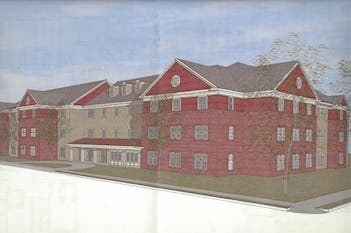
If the project goes through, drivers on the busy Marshall Street will no longer see the Hickman’s tree-shrouded brick structure known as Sharpless-Hall (pictured here in a c. 1890s picture), but instead see a three-story structure that will look like any other medical institution that unfortunately, are typically the style-du-jour in many suburban neighborhoods. (See the architect’s rendering here.)
Only this part of West Chester is not your ordinary piece of suburbia. It’s a stately neighborhood of tall trees and mansard-roofed homes. I live down the street and drive through the area at least once a day. It only just struck me recently that the Hickman’s facility at the other end of the street, the Mary Taylor House (pictured here with trucks out front) , may have been designed to resemble those neighborhood houses.
In fact, I can’t drive by the Mary Taylor House without thinking how no new construction comes close to the charm and appeal of 19th-century homes. In recent weeks, I often residents crowded on a small porch area that is really part of an entrance and I am reminded what can go wrong with getting approval for projects. It’s often difficult to visualize a project based merely on the floor plans. In the case of the Mary Taylor House, it’s a shame that the structure lacks even a real porch or an outdoor seating area where residents could interact with passersby. The main entrance, in fact, towers above the sidewalk.
Perhaps worse, to build the Mary Taylor House, the Hickman demolished the former homeopathic, Memorial hospital, another landmark that had been architecturally comprised in recent decades but was nonetheless part of neighborhood.
Given residents’ reaction to the proposed Sharpless-Hall Replacement building - it was quickly dubbed “Mary Tutor 11” - it was perhaps understandable that the Hickman heeded input from neighborhood meetings (none of which I heard about until after the fact) and changed the design.
The new plan calls for a three-story building that to me, resembles a tourist center in Williamsburg. The radical change may have been an attempt to mimic the design styling of the 1936 Colonial Revival building next door, a structure long rented by the Hickman for resident housing.
Two major changes: there is no outdoor garden area and no underground parking. Apparently, the borough promises that no street parking will be allowed, but the proposed building will take up much of the corner lot, and parking for the Friends School will be lost to the new building.
Judging from the floor plans I was given by the Hickman, the Sharpless-Hall Replacement Building will be a state-of-the-art senior care facility, complete with identical second and third floors, each with 25 units (19 so-called studios and 6 one bedroom apartments). The Hickman’s director kindly gave me the floor plans so I could understand the project).
There is no central dining room so I don’t know if that means that the Hickman’s Colonial Revival building will undergo a restoration since residents currently dine at the c. 1890s Sharpless-Hall.
My questions, I suspect, will be quickly answered by Hickman director, who has gone out of her way to quell mixed feelings such neighborhood projects tend to inspire. I was even given a personal tour of Sharpless-Hall to see its condition.
I was also reassured that the design for the proposed building is still a “work in progress” and perhaps more critical that the hearing planned for July 15th will serve as a public discussion the “proposed Overlay Amendment to the Zoning Ordinance.” The director described the overlay in an email to me, noting that the proposed amendment will actually correct an “error” with the ordinance (when created in the 1930s). As a result, the “three purposes of the Quaker Block - religious, education, and senior living - have thus been non-conforming,” she wrote.
The hearing’s purpose is explained, of course, in the posted signs that finally went up July 4th on the Hickman property (and posted here). I’m sure the hearing will be discussed at the neighborhood block party slated for tomorrow as well.
Still, all this doesn’t change my mind about the Hickman’s intention to demolish its original buildings and to build a structure, as we have seen with the Mary Taylor House, that not only dominate the school grounds (and effect the central, historical importance of the Friends Meeting ) , it will call for the razing of trees including a towering oak tree that now shades an outdoor seating area.
If that happens, the Quaker Block will be book-ended by the Mary Taylor House and new construction that will meet a need, but sadly, to me, will be another example of the chipping away of West Chester’s historic character and the suburbanization of an unique neighborhood that has reflected the borough Quaker heritage for 125 years.