The Golden Triangle of Sherry
Peter Andrews CSS, CSW, MBA
General Manager, Grapes & Grains
Find out what's happening in Barringtonfor free with the latest updates from Patch.
Sherry is a wildly misunderstood wine. A fortified beauty from the southwest of Spain, Sherry offers aromas and flavors that no other wine can offer. From the soil type, climate and grape varietal, to origins in “The Golden Triangle,” Sherry is a wine that is well-worth a try.
Nestled far southwest of Spain lies the Golden Triangle region- Jerez, El Puerto de Santa Maria (El Puerto) & Sanlucar de Barrameda (Sanlucar). Because of varying soil types and climates, each of these small regions offer unique styles of Sherry.
Find out what's happening in Barringtonfor free with the latest updates from Patch.
Jerez lies furthest inland and is known for its Albariza soil type. Albariza is a spectacularly white chalky soil that can absorb up to 33% of its own weight in water. During the extremely hot & dry summer months, the soil forms a thick crust that prevents rapid evaporation and keeps the vines hydrated. The coastal regions of El Puerto & Sanlucar offer a completely different soil type. They are loam & sand-based, which offers faster evaporation and riper grapes. Jerez gives more elegance while El Puerto & Sanlucar gives more power.
As the grapes are harvested and fermented, there are several grades the dry finished Sherry receives. These grades determine the final style of the Sherry. (These styles range from the non-oxidatively aged Fino, Manzanilla & Amontillado, to the oxidatively aged Oloroso, Cream Sherry & Palo Cortado).
At this point, the wine is fortified. The best & most elegant wine will turn into Fino, Manzanilla & Amontillado Sherry- which is fortified to no more than 15% ABV. Wine destined for nutty & rich Oloroso, Cream & Palo Cortado Sherry will be fortified to 17%.
The alcohol percentage plays a significant role in Sherry’s aging. At 15% ABV, a film of frothy white yeast known as the flor develops. The flor cannot survive at any more than 15% ABV. The Flor yeast is an integral part in making non-oxidative styles of Sherry. This yeast prevents the wine from oxygen (and oxidation) as it feeds on the acidity in the wine. The Flor can only develop in southwestern Spain due its special climate characterized by humidity from the sea air.
These climatic conditions are so important that each Bodega (winery) has been designed to catch air flow in the most efficient ways to create the Flor!
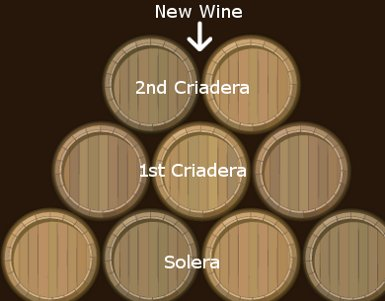
Once the wine is fortified & is destined for its style, it is time to age it. The aging process happens in what is known as the Solera System. Confusingly, solera has two meanings; the aging system is called the solera as well as the final casks in which the wine is bottled from are known as the solera.
*See attached picture
Sherry aging with the flor requires constant nourishment. This comes in the form of fresh wine entering the solera system. So how is it done? As seen in the picture below, there are many levels of aging. The lead blender known as the Capataz, takes no more than 1/3 of the wine from the solera. In this case, the bottom row of casks are to be bottled. As the Capataz takes out his desired amount of Sherry to be bottled, he will then refill it from each previous Criadera. A criadera is simply each level of aged casks. Once the Capataz reaches the top level, he will refill that same quantity taken with the newly fortified wine.
These solera casks can either be aged with flor yeast or not--it all depends on the style desired.
So, after all of that, you deserve a glass of sherry! Now that you see the intense amount of work that goes into making sherry, don’t you think it’s worth a second chance? The complexity and longevity of these wines is remarkable. Do not be scared by the stuff your Grandmother used to drink; the Sherry of new is fun and exciting. It is both food-friendly and surprisingly inexpensive!
We even offer a sheet similar to the chart displayed to take with your bottle purchase. It will help determine what you’re drinking, how long you have to drink it and the type of aging