Politics & Government
Statewide Changes in Career Preparation Programs Raise More Questions Than Answers
Proposed modifications have administrators worried about an uncertain future for Career and Tech programs.


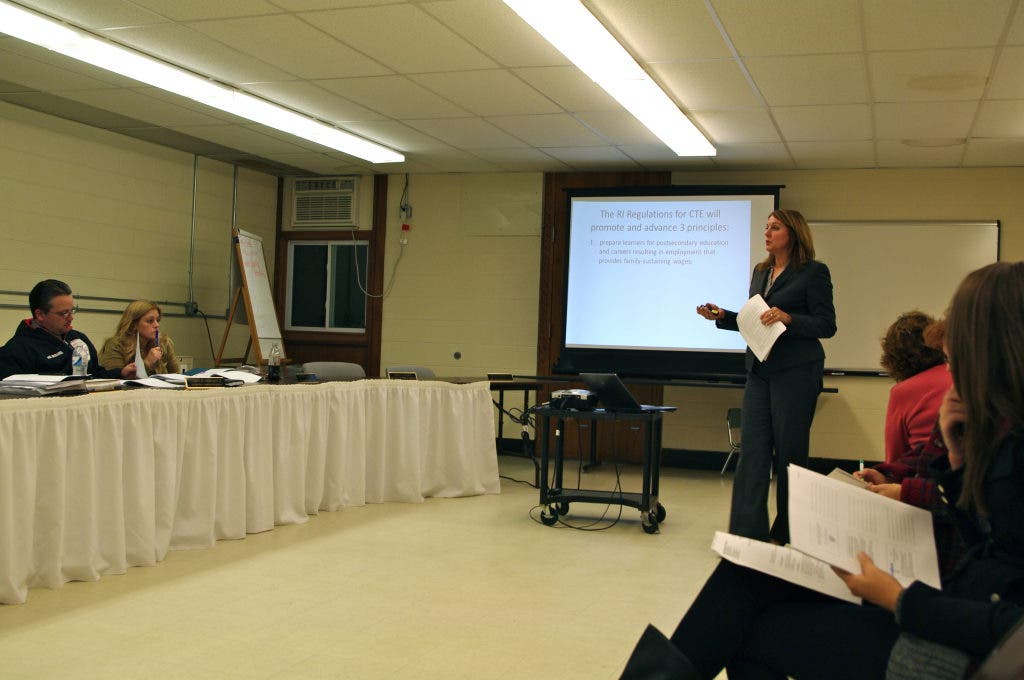
At Tuesday night's School Committee meeting, Lori Ferguson, Director at 's Regional Career and Technical Center (RCTC), presented an explanation of changes in high school Career Preparation programs across that state that the Rhode Island Department of Education (RIDE) is looking to implement as early as next fall.
One of the changes will be to introduce more Innovation Programs that would allow students to learn in an interactive online setting. Ferguson explained that this would be beneficial in terms of not needing minimum class sizes in order to offer a course, but she is still concerned as to how certain types of courses could be taught thoroughly without a traditional classroom setting.
RIDE officials, including Education Commissioner Deborah Gist have yet to provide a detailed plan for the establishment of this type of program.
"This could be a good thing or it could not. There's a little bit of ambiguity because no one really knows what it looks like yet," said Ferguson. "There's no rubric or criteria yet, so I think there's a fear of the unknown."
Another change being introduced by RIDE is the restructuring of the state's current regional divisions for career and technical centers. Currently, students from Coventry, Exeter, West Greenwich and North Kingstown have first access to enroll in the region's programs. If a program is not offered at a certain center, a student can access the program at another center in their region and are currently guaranteed transportation.
Ferguson explained in her presentation how RIDE is planning on significantly broadening Coventry's region, eliminating West Greenwich (WG students would travel to Chariho for courses,) and adding areas such as Foster, Scituate and Glocester. There would be two centers in the new region, Coventry's RCTC and Warwick Area Career and Tech.
According to the presentation, the potential impact of this change is unknown, as there are both negative and positive aspects to the decision.
Positive points would be that students would have more choices statewide and the larger recruitment area could possibly draw in more students, therefore bringing in more tuition, however with current Coventry students being able to access other centers, it could end up resulting in an "even trade" situation.
One of the biggest impacts of the regional changes may be the distribution of Perkins Funding as the current regions were developed based on Perkins distribution throughout the state. The modifications could mean the same or less money made available to districts. This is a significant concern as Perkins funding was cut approximately 10 percent this year and according to Ferguson, cuts are expected to double next year.
Another looming topic is transportation, as the changes would cause some students to travel farther. Transportation costs and arrangements have not been fully organized yet, leaving educators, parents and students unsure of whether or not students in certain areas could easliy to get to school.
Find out what's happening in Coventryfor free with the latest updates from Patch.
Concerns brought up by Committee members and administrators included situations where students might base their location decision on social, athletic or graduation requirement factors instead of where they are best suited. Superintendent Michael Convery suggested that a timeline requirement be designed so that students would not be able to alternate back and forth between centers freely, as this would cause profound problems regarding tuition and enrollment.
A significant concern of Ferguson's was that Center directors are now recruiting in their current regions, however RIDE has expressed interest in applying the changes as early as next September, making portions of recruitment attempts futile. She also pointed out that many of the questions asked by Committee members have been submitted to RIDE but not yet answered.
"The logistics of going from one map to the other brings up as many questions as it does answers," said Convery. "I would hope that these concerns would be addressed before this plan is implemented."
Ferguson agreed with Convery, saying that she and fellow directors would encourage RIDE to implement the plan in 2013 because they are simply not prepared for the changes next year.
The Committee agreed to submit to RIDE a letter of concern regarding the changes.
"I think you're certainly justified," said Ferguson. "The final vote is in January, so I think the message needs to go out now."
Get more local news delivered straight to your inbox. Sign up for free Patch newsletters and alerts.