Community Corner
Court Sides with ACLU in Cranston Prison Gerrymandering Case
A lawsuit that accuses the city of practicing gerrymandering by counting all ACI inmates as Cranstonians can go forward, a judge has ruled.


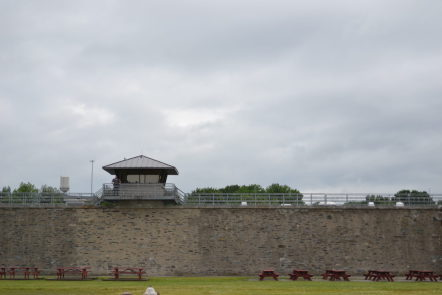
On the eve of the the Sept. 9 primary, a U.S. District Court judge has denied the city of Cranston’s request to dismiss a lawsuit filed by the Rhode Island chapter of the American Civil Liberties Union alleging the city engages in “prison gerrymandering” by counting all inmates at the state prison as residents of Ward 6.
Judge Ronald Lagueux — the same judge who ruled the city was violating the Constitution by displaying the fabled prayer banner on the wall of the Cranston High School West Auditorium — ruled Monday that the lawsuit filed on behalf of a group of Cranston residents can go forward.
The lawsuit alleges that the city’s 2012 redistricting plan violated the one person, one person principle by counting every inmate as a Cranstonian living in Ward 6 and not as residents of their home towns. The allegation is that by counting all the inmates at the Adult Correctional Institutions in Cranston as Cranston residents, they inflate the population count in Ward 6.
Find out what's happening in Cranstonfor free with the latest updates from Patch.
Without the incarcerated population, Ward 6 has only 10,209 true constituents. Yet those constituents now wield the same political power as the roughly 13,300 constituents in each of the other ward, the lawsuit alleges.
“I’m thrilled this case is going forward,” said Karen Davidson, lead plaintiff. “As a Cranston resident and taxpayer I’m entitled to equal representation and I will keep fighting for it.”
Find out what's happening in Cranstonfor free with the latest updates from Patch.
Judge Lagueux agreed with the ACLU’s assertion that the claim is legally viable, stating that “...the inclusion of the ACI prison population is not advancing the principle of electoral equality because the majority of prisoners...cannot vote, and those who can vote are required by State law to vote by absentee ballot from their pre-incarceration address” and that the incarcerated population’s “inclusion in Ward Six does nothing to advance the principle of representational equality.”
“We’re excited our case is going forward, and we urge the City to correct its prison gerrymandering problem without delay,” said Steven Brown, executive director of the ACLU of Rhode Island. “By not correcting this, the City of Cranston is allowing the 2014 elections to be held under a one-person, three-quarters of a vote regime.”
Cranston residents Karen Davidson, Debbie Flitman, Eugene Perry, and Sylvia Weber have joined the ACLU of Rhode Island as plaintiffs in the case. They are represented in federal court by Demos, the Prison Policy Initiative, and the American Civil Liberties Union.
“This is a big win, because it shows that our legal arguments are valid,” said Adam Lioz of Demos, counsel for the plaintiffs. “We hope the City will fix the problem—but if not, we look forward to proving our case at trial: that persons incarcerated at the ACI aren’t really constituents of local politicians and so shouldn’t be counted at the prison for purposes of representation.”
“Counting people at the ACI as constituents of Ward 6 officials makes no sense,” said Aleks Kajstura of the Prison Policy Initiative. “They can’t use the park or library, attend a City Council meeting, or send their kids to public schools. And, even those who can vote must do so from their actual legal residence, not the prison location.”
Get more local news delivered straight to your inbox. Sign up for free Patch newsletters and alerts.