Schools
Johnson & Wales Culinary Arts Museum Celebrates African-American Food
A sold-out opening of a six-month exhibit brings Rhode Islanders together for a tasting of food and black history and tells a story visitors were encouraged to share.
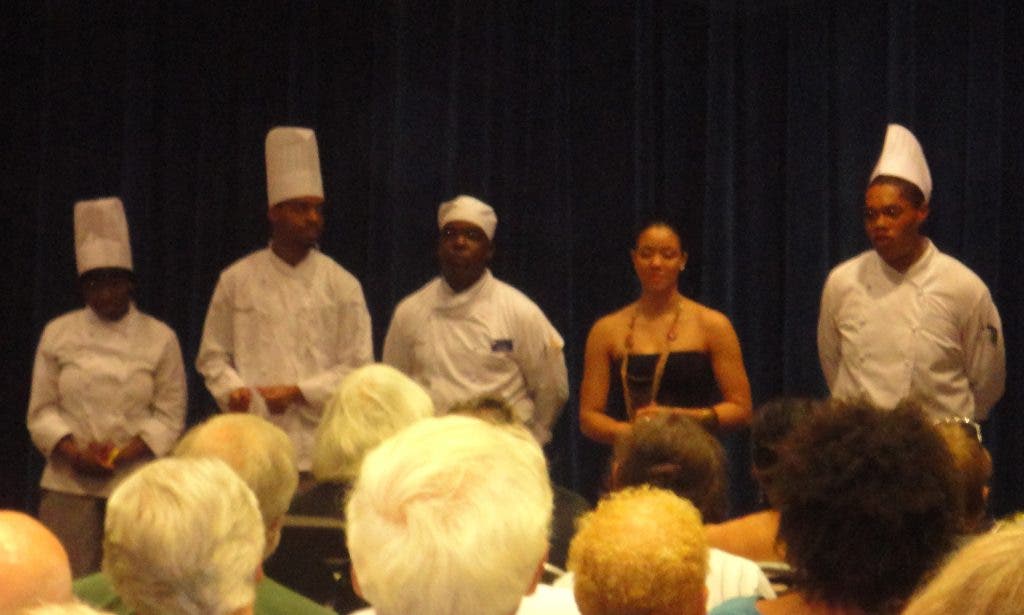


Life-size photos of African American chefs and other historical snapshots welcomed guests at the opening of the new Johnson & Wales University Culinary Art Museum exhibit last week.
Called “Creative Survival: African American Foodways in Rhode Island,” the exhibit also showcased culinary artifacts from African American history. Along with items unearthed by project director Ray Rickman, and guest curator Robb Dimmick, the exhibit includes artifacts from the Rhode Island Historical Preservation and Heritage Commission.
The evening began with an introduction by Dimmick—also an educator and professional actor—and thank you to the exhibit’s funders, the Rhode Island Council for the Humanities (RICH). The organization awarded a grant to Ocean State Learning in support of the exhibition, which was completed in partnership with Johnson & Wales and will now occupy the museum until March 4, 2012. It is free and open to the public from Tuesday through Sunday, 10 a.m. to 5 p.m. Museum officials are encouraging black Rhode Islanders to bring in items for inclusion in a scrapbook.
Find out what's happening in Cranstonfor free with the latest updates from Patch.
Guests, including Senator Harold Metts, Representative Raymond Hull, and Central Falls City Council President William Benson Jr., enjoyed a food-tasting menu inspired by the cookbook Spoonbread and Strawberry Wine by Norma Jean Darden, the keynote speaker. Foods were chosen and prepared by students and members of the Bridging Culinary Arts Club of Johnson & Wales. Darden says they did an excellent job and she especially enjoyed the potluck gumbo.
The exhibit explores the story of African American cooking in Rhode Island, from South County plantations to East Side of Providence farms, from church suppers to soul food restaurants and showcases the ingenuity of black food in slavery, survival and celebration. Visitors are taken on a journey that starts in the early 18th entury and delves into the complicated relationship between food and slavery. Highlights include 19th century archeological artifacts from black neighborhoods and historical accounts of 20th century black restaurants in Providence and Newport.
Find out what's happening in Cranstonfor free with the latest updates from Patch.
Visitors learned that the first oyster and alehouse opened in Providence in 1736 and was owned by freed slave, Emmanuel Manna Bernoon. Newport’s Charity “Duchess” Quamino, a slave, was the state’s most esteemed pastry chef who served delicacies to George Washington.
“These untold stories of ambition fraught with economic challenges and culinary triumphs will enrich viewers and reveal how extraordinary creativity became the substance, survival and success of the Rhode Island Black community and influenced the nation,” Dimmick said.
Rhode Island has a long, little known history in both African American life and food development. Though not often discussed, the pairing between the two is interwoven—it is this essence that is captured in the new exhibit.
In his opening remarks, Dimmick said “African American food provides a marvelous classroom in which to examine the confluences of the humanities: race, culture, religion, politics, biography, social sciences and the arts all intermingle on a plate piled high with history and identity. Black cooking is black life. It is struggle, survival, celebration and pride in a spoonful. Black food is uniquely American. Food in early Rhode Island is a powerful symbol of the racial symbiosis between blacks and whites that is rarely if ever discussed or acknowledged but exists as the very foundation of racial discord and collaboration in America."
"Colonial Rhode Island African Americans ingenuity and entrepreneurial spirit led the nation in innovation, excellence and artistry. By examining Rhode Island black foodways multiple doors open to the humanities. As participants you find new windows to understanding the foundations of black culture and the intersections of that culture with your own.”
Darden expanded on these thoughts when in her keynote speech, she spoke of the importance of knowing our history, and how in African American culture, food is an integral part of the experience.
“You, the wonderful people at Johnson and Wales I’ve met, touched on something that really resonated in me because we have secrets—we have secrets and none of us seem to realize that all of us, as Zora Neale Hurston said, are part of history and revealing that history for me is very illuminating,” expressed Darden.
Darden discovered she was one generation removed from slavery when rummaging around in her family’s attic. This marvelous exhibit reminds her of the things she found and she encouraged the audience to do the same thing—to go back and discover what went on in their own personal histories.
A former Wilhelmina fashion model turned restaurateur and author, Darden first became interested in cooking when a food editor at Vogue said that she, given her roots, must have a good cookbook in her. That began her seven-year pilgrimage in which she traced those roots and fell in love with food. She did eventually write that cookbook and has since opened two New York restaurants (Miss Mamie’s and Miss Maud’s); a catering business called Spoonbread; and has served the likes of then-President Bill Clinton and would-be President Barak Obama.
“It’s a profession that you just never know what’s going to happen. Every day is opening night—and it’s a wonderful feeling. You get to share with people in their greatest moments. Food is wonderful. I am so glad to be at Johnson and Wales where they are celebrating that and have a museum dedicated to it. It’s just so glorious. If you have good food who cares if you’re brown, green or red. It’s a leveler,” she said.
And Dimmick agrees.
“When we arrived 30 years ago we were hard pressed to find the African American food presence—and it’s part of the fabric of Rhode Island. As Norma Jean alluded to, food is a leveler—when it’s presented, it removes boundaries. This was an extraordinary event in Rhode Island embraced by everyone here. We need to use food in a way that allows us to teach.”
Rickman, who is also president of his consulting group, echoed the sentiment by saying that students “can’t look forward to the future unless they know about their past. Their culture will take them there.”
“Food makes this history more accessible,” Dimmick added. “It makes it possible to explore black culture in ways that other approaches do not.”
Richard J.S. Gutman, director and curator of the museum, said it was a wonderful event and he was very happy with the turnout.
“It shows there’s a lot of interest in this subject and we were able to reach out to new people as well," he said.
Gutman also said Darden delivered a provocative speech and inspired guests as well as the young chefs in attendance who want to make their mark in the world. Five students prepared food for more than 225 people in a volunteer effort that took several weeks to design.
Of Rickman he said: “He is the leading force, a thinker, a doer, protagonist and activist. His main mission is to get people thinking about those who maybe fell through the cracks.” He approached him with the idea and presented items that had never before been on display. Gutman was intrigued. “It’s a great way to engage students and think about this topic on many different levels.”
Earlier in their careers, Rickman and Dimmick ran a Cornerstone Books. They saw it as an opportunity to present African American history through literature. That is how they met and promoted the work of Darden, as well as Maya Angelou, James Baldwin and Henry Louis Gates, among many others.
“We’re making progress. Not enough, but we are. All of this, the slave trade here, wasn’t discussed 25 years ago,” Rickman concluded. “We’ll be back next year. We’ll be at this the next 20 years.”
Of all their work, Dimmick says this is certainly the crown jewel.
"We hope others will take the inspiration of what we’ve done and continue.”
And in her final words to the wide-eyed audience anticipating the inspired culinary treats, Darden did her part to convey the same message.
“I hope that other people will take the germ of this idea and pull yourself into the process of history. Take a moment to think about the next generation. Others are coming after us and we need to share.”
For more information on Norma Jean Darden’s businesses visit www.spoonbreadinc.com.
The Culinary Arts Museum is an educational resource for Johnson & Wales University, the community at-large, food scholars, and the food service industry. The Culinary Arts Museum seeks to both preserve and interpret the broad culinary and hospitality heritage addressed by the university. It is a showcase for the work of students, faculty, alumni, and distinguished visiting chefs. Through exhibitions and special events, the museum strives to interpret the evolution of food preparation and presentation, the development of culinary equipment and technology, the diverse menus offered, and the places where people partake of food.
The museum will next host a chocolate and ice cream exhibition slated to open on Valentine’s Day 2012. Called Season of Sweets, it will illustrate the confectionary business and how products are marketed. For more information about the museum, please visit www.culinary.org or call (401) 598-2805.