Schools
School Start Times will be Explored by Ad Hoc Committee
The East Greenwich School Committee voted to create a special committee to study the feasibility of later school start times — and its cost.


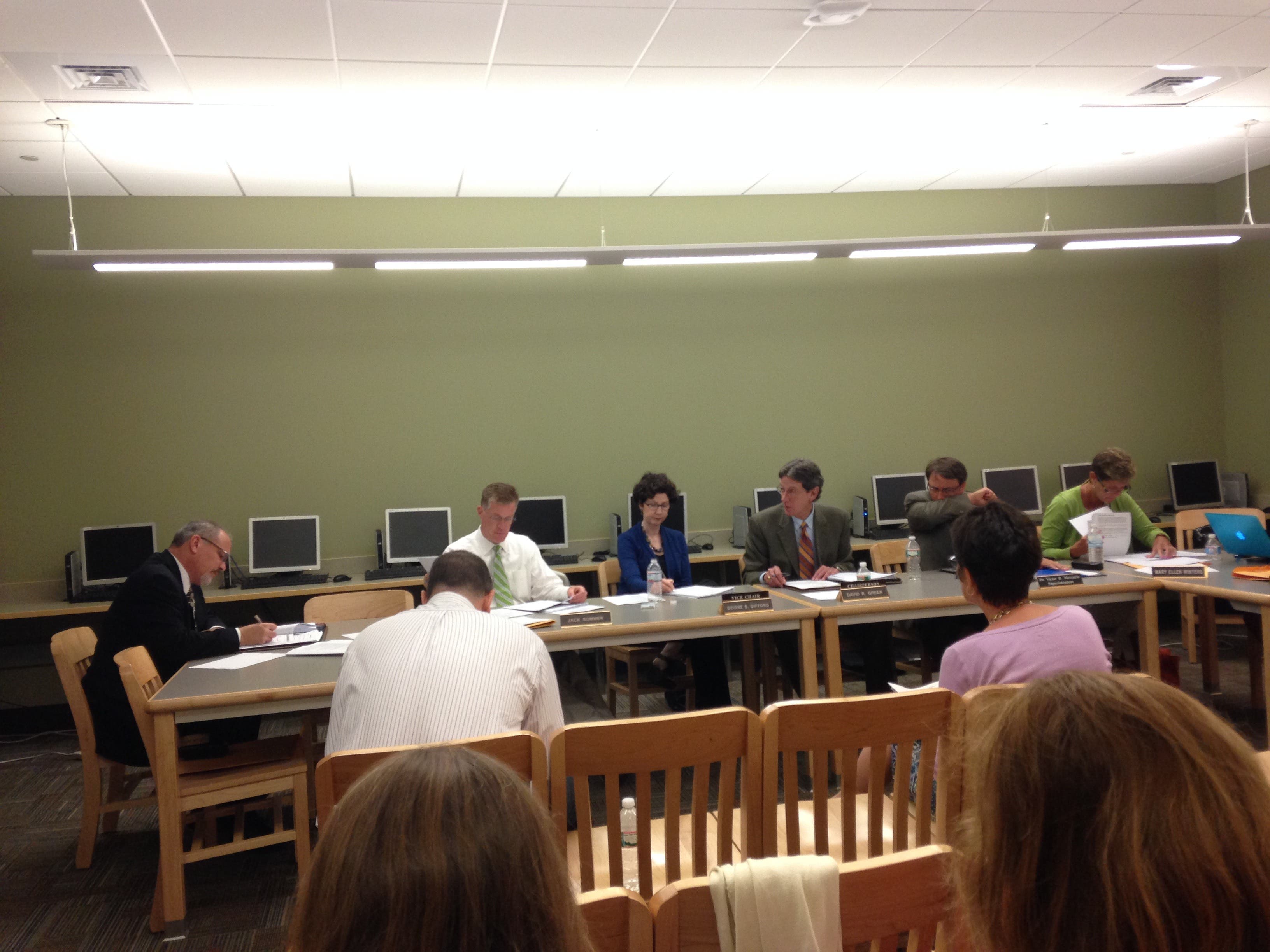
In a unanimous vote, the East Greenwich School Committee on Tuesday approved the formation of an ad-hoc committee to explore the feasibility and cost of later start times for some or all students in the district.
The formation of the committee was the goal of a group of parents who have for months been pushing for the district to explore later start times, citing a growing pool of evidence that equates academic success and overall well-being with a later start to the day.
On Tuesday, Superintendent Victor Mercurio presented a draft proposal outlining the charge of the new committee, which calls for the committee to “determine the feasibility of implementing and sustaining changes to the current start times of the district’s schools to the extent that said feasibility is cost effective and sensitive to the comprehensive fiscal needs of the entire district.”
Find out what's happening in East Greenwichfor free with the latest updates from Patch.
School Committee members suggested inserting text in the formal charge to also state that the reason for the committee’s existence is similarly about improving student learning.
“While the feasibility financially is certainly a part of this, isn’t the whole idea of the start time for students sleeping and making sure they get the optimal start time. . .in being best prepared for the school day?” asked School Committee Member Deidre Gifford.
Find out what's happening in East Greenwichfor free with the latest updates from Patch.
Mercurio responded by saying he was agreeable to revisions, noting that he had presented a draft document that also neglected to include school committee members on the list of possible members, which would be adjusted as well.
The committee would be comprised of 8 to 10 members with representation from parents, teachers, at least one central office member and several building level administrators, including the athletic director or coaches. There would also be at least one student on the committee along with one or two school committee members.
According to the draft, the committee is tasked with conducting an exhaustive study, which will include a review of literature to “ascertain the best practices in school start times to support teaching and learning,” conducting a district-wide survey, a comparison with other communities with different start times, a pair of public forums for community input and two faculty and staff forums.
At a minimum, the committee must look at the possibility of flattening the bus transportation schedule into a two-tier system, synching the start and end times of both the secondary and elementary schools and the relative and absolute start times for both the secondary and elementary schools.
The committee will set its own timetable and ultimately will prepare a report outlining its conclusions and possible recommendations.
Gifford noted that it’s important that the athletic community gets fair representation, noting “one of the major obstacles is always around sports.”
Mercurio said he imagined the AD would fall under the building level administrator category on membership list. He also agreed that the membership should include individuals “who have worked with students outside of the school day in any capacity, whether it’s music or chess or one of those clubs as well.”
It was agreed that there would be an added cost to any change, with School Committee Chairman David Green saying it would be a mistake to go forward with the notion that it could be done in a cost-neutral manner unless someone has some unlikely “epiphany.”
Rather than undermine the process from the start, Green suggested the committee would attempt to find the most cost effective way.
“it would be foolish to go into it saying ‘I’m going to do it a cost-neutral fashion’ and then find out you can’t do it,” Green said.
It was also agreed that the whole point of later start times would be pointless if there wasn’t total community “buy-in.”
Dr. Richard MIllman, a widely-regard sleep medicine specialist who attended previous meetings to testify on behalf of later start times, told the committee on Tuesday that without everyone using the extra time to actually sleep, it would be wasted effort.
“The hardest thing is teacher’s can’t take advantage of time that wasn’t there before school to catch up with kids,” he said. “You have to understand that the whole point is to get thirty extra minutes of sleep.”
In some communities that switch to later start times, students still come early to school to make up for the later afternoons in school, which defeats the purpose.
In recent weeks, he said his wife has been approached by “angry mothers who think the whole idea is stupid” and he cautioned that the selection of committee members could make or break the result.
“How you choose your parents can either blow it up or make it work,” he said. “You need a parent who is gung ho, a parent who is neutral and a parent who is totally against it.”
Otherwise, the committee risks lacking the credibility across town needed to actually get a change off the ground.
Millman also noted that the district has actually made the problem worse with the rollout of Chromebooks to students as part of the 1:1 program at the high school this fall. (An update on the rollout will be posted later).
As teachers pile on the homework, kids will be staring at screens later and later into the night. Those screens emit blue light, Millman said, which tells the brain it is in daylight, disrupts sleep patterns and “is going to keep them more awake.”
Millman suggested the district consider orange filters for the Chromebook screens or even the use of orange sunglasses to block some of that blue light to make sure students get the proper rest they need at night.
The push for creating the committee came largely from a group of parents who started a local Start School Later chapter.
The group, which has been using a Facebook group in addition to the petition and SSL chapter membership to raise awareness of their plans, is aware of the uphill battle in changing school start and end times.
The reality is that a school community gets used to routine. Athletic teams have practice and games after school. The bus schedules would have to change, and that means other school districts and out of district placements would have to be changed. Day care and babysitters would be looking at a new reality. Morning and afternoon routines would be upended.
Studies and experience shows that adolescents and teenagers are biologically wired to stay up later and get up later in the morning. It also is evident that students who get to school with an extra hour of sleep or more do better in class, pay attention more and otherwise learn more while in school.
There are safety reasons, too.
“Kids are catching buses at 7 a.m. in the winter in the dark, standing on dark street corners,” said Catherine Rodgers, who helped lead the charge for later start times in East Greenwich. She noted that many students participate in music activities, such as at Archie R. Cole Middle School, where they arrive as early as 6:35 a.m. to participate.
And children today are encouraged to participate in after school activities and sports, so they’re coming home later in the afternoon with homework still to do. So the suggestion that they get to bed earlier leaves the question: when would they get to do their homework?
“There’s just so many safety issues involved, as well as reduced tardiness and delinquency and academic success,” Rodgers said. “In all the studies that that have to do with sleep levels in teenagers — biologically, they’re more inclined to fall asleep later and wake up later. There’s something about the circadian rhythm with this particular age group.”
Get more local news delivered straight to your inbox. Sign up for free Patch newsletters and alerts.